TL;DR (Too Long; Didn’t Read)
- Limited Color Spectrum: Cats are not color blind but see the world similarly to humans with red-green color blindness, primarily perceiving shades of blue, yellow, and gray.
- Superior Night Vision: Thanks to a high density of rod cells and a reflective layer called the tapetum lucidum, cats can see in light levels six times lower than humans require.
- Specialized for Hunting: Feline eyes prioritize motion detection and peripheral vision (200-degree field) over sharpness, making them naturally near-sighted but elite at tracking movement.
- Anatomical Advantages: Their elliptical pupils allow for rapid light control, while their forward-facing eyes provide the precise depth perception necessary for pouncing on prey.
Table of Contents
Can Cats See Color in Low Light Conditions?
You might have noticed your feline friend staring at a blank wall at midnight. It makes you wonder if they are seeing a ghost or just a very colorful moth. While we stumble over shoes in the dark, our cats navigate the living room like seasoned ninjas.
But do they see that world in technicolor or classic black and white? The answer is a bit more complex than a simple yes or no. Let’s dive into the fascinating world of feline vision to see how your kitty views the world when the sun goes down. Their superior night vision allows them to perceive much more than we can in the dark.
The Mystery of Feline Vision and Color Perception
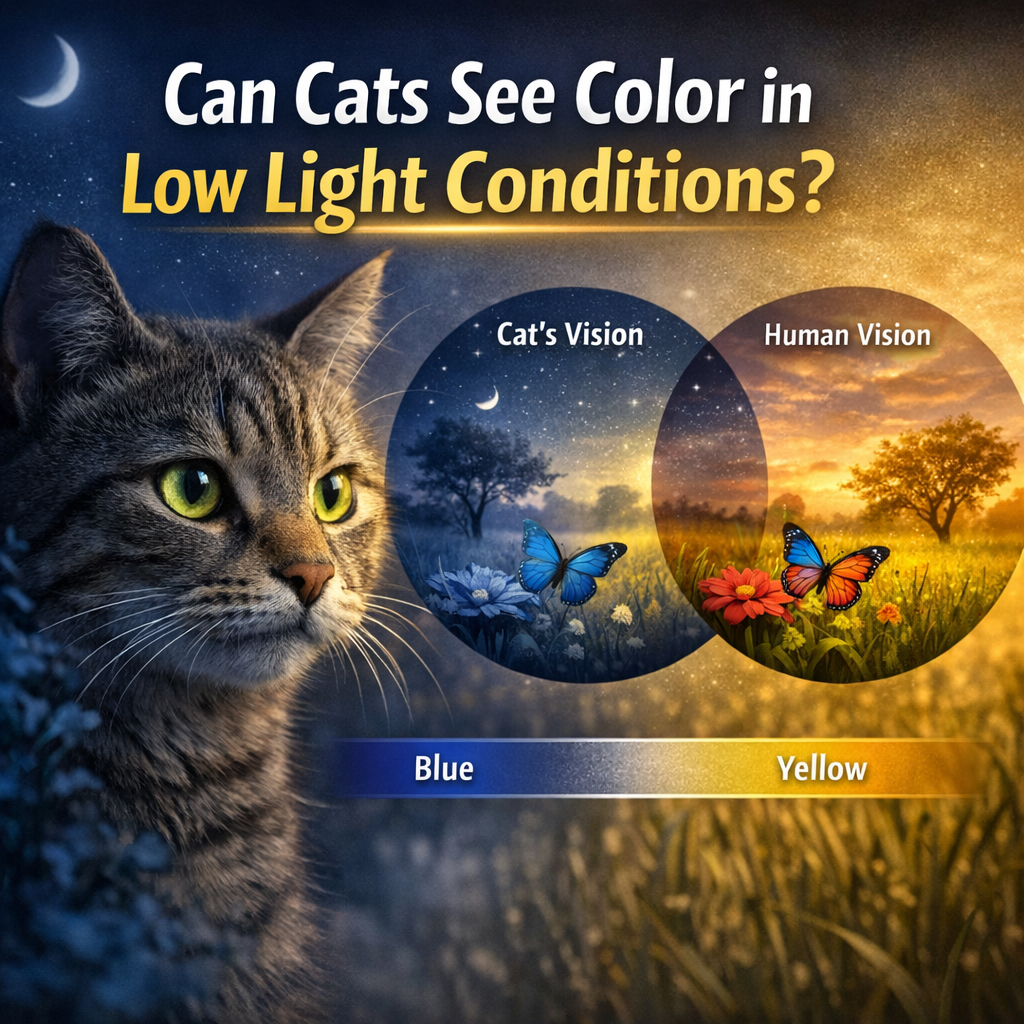
When it comes to color perception, cats do not see the world quite like we do. While humans enjoy a vibrant rainbow, feline eyes are tuned to a different frequency. Cats are not completely color blind, but their visible spectrum is much more limited than ours.
Scientific observations from experts suggest that animal color perception varies wildly across species. For our feline companions, the world looks a lot like a faded photograph. They primarily see shades of blue and yellow, along with plenty of gray.
This means your cat is essentially living with a form of red-green color blindness. That bright red laser pointer dot? To them, it likely looks like a white or yellowish light. They simply lack the cone cells required to process the red end of the spectrum.
The Role of Rods and Cones in the Cat Retina
To understand why feline vision differs from Humans, we have to look at cat eye anatomy. The retina acts as the camera film of the eye, containing two main types of nerve cells: rod cells and cone cells.
Cone cells are responsible for color perception and visual acuity in bright light. Humans have three types of cones, but cats only have two. This reduction in cones is why they cannot see the full range of colors that we find on a Unisex Soft Cotton Tee.
However, what they lack in cones, they more than make up for in rods. The cat retina is packed with these cells, which are designed to detect light levels and motion detection. This high concentration of rods is the secret behind their superior low light vision.
Night Vision and the Magic of the Tapetum Lucidum
If you have ever seen your cat’s eyes glow in a dark hallway or in a camera flash, you have seen the tapetum lucidum in action. This is a thin, reflective layer located behind the retina that acts like a mirror.
The tapetum lucidum reflects light back through the rod cells a second time. This visual adaptation gives the feline eyes another chance to absorb every stray photon. This is why night vision in cats is so much more effective than in Dogs or humans.
Because of this biological mirror, cats only need about one sixth of the light that humans require to see clearly. They are perfectly evolved for low light vision during dusk and dawn, which are the prime times for cat hunting ability in the wild.
Visual Acuity: Why Cats are Near-Sighted
While they are masters of the dark, cats struggle with visual acuity at a distance. In the world of cat vs human vision, we win the long distance trophy. Most cats are actually near-sighted compared to their owners.
An object that looks sharp to you at 100 feet will appear blurry to a cat until they get within 20 feet of it. This near-sightedness happens because their eyes are optimized for motion detection and close up hunting rather than admiring distant landscapes.
Their elliptical pupils also play a role here. These vertical slits can change size rapidly, allowing for incredible control over light levels entering the eye. This helps them maintain depth perception even when pouncing on a toy in a dim room.
Motion Detection and Peripheral Vision
A cat might not appreciate the subtle hues of a sunset, but they will notice a tiny spider crawling across the floor from the corner of their eye. Their peripheral vision is outstanding, covering about 200 degrees compared to the human 180 degrees.
This wide field of view, combined with a high density of rod cells, makes them elite at motion detection. Even in low light conditions, a slight twitch of a mouse’s whisker is enough to trigger their predatory instincts.
Understanding cat behavior means recognizing that they prioritize movement over color. Whether they are patrolling the backyard or chasing a string in the kitchen, their feline vision is a finely tuned tool for survival and play.
Expert Insight
“A cat’s eyes are not just cute marbles, but precision instruments designed to stalk, detect movement, and see in the dark with light sensitivity six to eight times better than humans.” (PangoVet Animal Behavior Expert)
The Science of Feline Eyesight and Anatomy
To understand what your cat sees, we have to look at cat eye anatomy. Like us, Cats have a Retina at the back of the eye packed with two types of nerve cells: rods and cones.
Rod cells are the heavy lifters for low light vision and motion detection. These cells allow your cat to spot the slightest twitch of a mouse tail in the shadows.
Cone cells are the specialists that handle color perception and visual acuity. Here is the kicker: cats have a massive amount of rods but very few cones compared to Humans.
Your cat is built for the night shift. While Humans have ten times more cones to see vibrant sunsets, Cats have the hardware to track movement in a dimly lit basement.
The Role of Cones and Rods in Feline Vision
The balance of rods and cones determines how an animal experiences the world. Feline eyes are optimized for survival and hunting rather than admiring a rainbow.
Cats possess a high concentration of rod cells, which makes them incredibly sensitive to light levels. This gives them a massive advantage in motion detection during twilight hours.
However, because they have fewer cone cells, their color perception is limited. They do not see the world with the same saturation and variety that we do.
Colors Detectable by Cats
When it comes to the visible spectrum, feline vision is quite different from ours. Scientific observations suggest cats see primarily blue and yellow.
They are essentially similar to a human with red-green color blindness. While you see a bright red apple, your cat likely sees a brownish or gray orb.
Because they cannot perceive the full red spectrum, their world is a palette of blues, yellows, and many shades of gray. This is why that bright red laser pointer is more about the movement than the color.
Enhanced Low Light Vision and the Tapetum Lucidum
Have you ever seen your cat’s eyes glow in a photo? That is the tapetum lucidum at work. This reflective layer sits behind the Retina and acts like a mirror.
The tapetum lucidum reflects light back through the rod cells a second time. This visual adaptation significantly enhances their low light vision and hunting ability.
This allows Cats to see clearly using only about one sixth of the light levels that Humans require. It turns a dark hallway into a well lit playground for your feline friend.
Visual Acuity and Near Sightedness in Cats
While they excel in the dark, Cats struggle with visual acuity. Compared to Humans, Cats are actually quite near-sighted and see the world in softer focus.
An object that looks sharp to you at 100 feet might only look clear to a cat from 20 feet away. Their eyes are designed for close up pouncing rather than long distance spotting.
Despite this near-sightedness, their peripheral vision is superior. Cats have a 200 degree visual field, giving them a wide angle view of their surroundings to spot any incoming threats or toys.
Can Cats See the Full Color Spectrum?
There is a common myth that cats see the world like an old fashioned television show in black and white. This is simply not true. While your kitty might not appreciate the vibrant neon pink of your favorite Unisex Soft Cotton Tee, they definitely do not live in a grayscale world.
Scientific observations suggest that cats have dichromatic vision. This means their color perception is limited compared to humans. While we have three types of cone cells to process the visible spectrum, cats only have two. This makes their world look a bit more muted and pastel than ours.
Essentially, feline vision is remarkably similar to a human with red-green color blindness. They primarily see the world in shades of blue and yellow. If you toss a bright red toy across the floor, it likely looks like a dull brownish-gray or dark charcoal to them. They are not ignoring the color; they just cannot see it!
The Role of Cones and Rods in Feline Vision
To understand animal color perception, we have to look at the cat retina. This layer at the back of the feline eyes is packed with nerve cells called rods and cones. While humans have a high concentration of cones for detail and color, cats have a massive abundance of rod cells.
These rod cells are the secret behind their elite motion detection and ability to function in various light levels. Because cats have fewer cones than humans, they sacrifice the ability to see a full rainbow of colors in exchange for superior hunting skills in the shadows. It is a trade off that makes them the perfect little predators.
Cat vs Human: Visual Acuity and Near-Sightedness
When comparing cat vs human vision, it is not just about color. Cats are actually quite near-sighted. While a human with 20/20 vision can see an object clearly from 100 feet away, a cat needs to be about 20 feet away to see that same object with any sharpness.
This lower visual acuity means they do not see fine details as well as we do. However, their peripheral vision is much wider than ours. A cat has a visual field of about 200 degrees compared to our 180 degrees, giving them a distinct advantage when spotting a fluttering moth out of the corner of their eye.
Enhanced Low Light Vision and the Tapetum Lucidum
The real superpower of feline eyes is their low light vision. Cats only need about one sixth of the light levels that humans require to navigate. This is largely thanks to the tapetum lucidum, a reflective layer located directly behind the retina.
The tapetum lucidum acts like a mirror, reflecting light back through the rod cells a second time to maximize every photon. This is also why your cat’s eyes seem to glow with a spooky green or gold hue when caught by a camera flash or a flashlight. This adaptation is vital for their natural cat behavior as crepuscular hunters.
Visual Adaptations for Hunting and Motion
Everything about the cat eye anatomy is designed for the hunt. Their elliptical pupils can dilate significantly more than our round ones, allowing them to control the amount of light entering the eye with extreme precision. This helps them maintain focus whether they are in bright sun or dim hallways.
Their depth perception is also finely tuned for pouncing. By using their forward facing eyes, they can accurately judge distances to catch prey. Combined with their incredible motion detection, these visual adaptations ensure that even if they cannot see the red laser dot as red, they can certainly see it moving with lightning speed.
The Magic of the Tapetum Lucidum
Have you ever taken a photo of your cat and seen their eyes glow like twin lanterns? That is the tapetum lucidum in action. This specialized reflective layer is located behind the retina and acts as a biological mirror.
When light enters the eye, it passes through the retina and hits this layer. The tapetum lucidum reflects the light back through the retina a second time. This gives the rod cells another chance to capture every single photon available.
This visual adaptation is the secret behind their elite night vision. While you might be fumbling for a light switch, your cat only needs about one-sixth of the light levels that humans require to navigate perfectly.
Because of this, feline eyes are perfectly tuned for low light vision. They excel at motion detection and hunting during the transition hours of dusk and dawn. It is what makes them such effective predators, even when the sun goes down.
However, there is a small trade-off for this superpower. This extra reflection can cause light to scatter, which impacts their visual acuity. This is one reason why cats are often near-sighted compared to humans.
While you can appreciate the crisp details on your favorite Unisex Soft Cotton Tee from across the room, your cat sees the world with a bit more blur. Their depth perception and cat hunting ability rely more on movement than fine detail.
This unique cat eye anatomy also includes elliptical pupils. These slits can expand massively in the dark to let in more light or contract tightly to protect their sensitive nerve cells during a bright afternoon nap.
Visual Acuity and Near-Sightedness in Cats
While cats have us beat in the dark, we definitely win the prize for clarity. Visual acuity refers to how sharp an image appears, and this is where humans take the lead.
Because cats lack the high density of cone cells found in humans, they are quite near-sighted. Their feline eyes are built for the hunt, not for reading fine print at a distance.
An object that you can see clearly at 100 feet away would look like a blurry mess to your cat. They generally need to be within 20 feet to see the same level of detail that we do.
The Role of Cones and Rods in Feline Vision
To understand why your cat sees the world differently, we have to look at the cat retina. It contains two main types of nerve cells: rods and cones.
Rod cells are responsible for detecting light levels and motion. Cats have an abundance of these, which is why their motion detection is so superior to ours.
Cone cells are what allow for color perception. While humans have three types of cones to see a full rainbow, cats only have two, limiting their ability to see the full visible spectrum.
Comparing Feline Vision vs. Human Vision
It is a classic case of cat vs human when it comes to optical strengths. While we enjoy vibrant sunsets, cats are busy tracking the slightest wiggle of a mouse in the grass.
Their elliptical pupils help them focus quickly on moving targets, even if the background remains a bit fuzzy. This is a key part of their specialized visual adaptations for survival.
The following table breaks down the major differences in how you and your feline friend perceive the world around you.
| Feature |
Cats |
Humans |
| Low Light Vision |
Excellent (6x better) |
Poor |
| Color Palette |
Blues, Yellows, Grays |
Full Rainbow Spectrum |
| Visual Acuity |
20/100 (Near-sighted) |
20/20 (Sharp) |
| Peripheral Vision |
200 Degrees |
180 Degrees |
| Motion Detection |
Superior |
Average |
Depth Perception and Hunting Ability
Even with their near-sightedness, cats have incredible depth perception. This is vital for their cat hunting ability, allowing them to judge the exact distance for a pounce.
Their eyes are placed forward on their face, much like ours. This placement provides a wide range of peripheral vision, giving them a 200 degree view of their surroundings.
Whether they are chasing a laser pointer or a real bird, their eyes are perfectly tuned for high speed action. They might not see your Unisex Soft Cotton Tee in high definition, but they certainly see you moving toward the treats!
Hunting and Motion Detection
Cats are crepuscular hunters, meaning they are most active during the twilight hours of dawn and dusk. Their feline eyes are perfectly tuned for cat hunting ability during these specific light levels.
While humans rely on bright light to see clearly, feline vision is built for the chase. Their peripheral vision is much wider than ours, covering about 200 degrees to help them spot a scurrying mouse from the corner of their eye.
They might not see the tiny details on a feather, but they will catch the slightest twitch of its movement. This focus on motion detection over color is why your cat might ignore a stationary red toy but go wild for a moving blue string.
The Role of Rods and Cones in Feline Vision
Inside the cat retina, there are two main types of nerve cells: rods and cones. Rods are responsible for detecting light levels and motion, while cones help differentiate colors.
Cats have a much higher concentration of rod cells compared to humans. This visual adaptation allows them to detect subtle movements in the shadows, making them elite hunters even when the sun goes down.
However, because they have fewer cone cells, their color perception is limited. Humans have three types of cones to see a full rainbow, but cats only have two, which changes how they view your favorite colorful graphic tee.
Low Light Vision and the Tapetum Lucidum
Have you ever seen your cat’s eyes glow in a dark hallway? That spooky shimmer is caused by the tapetum lucidum, a reflective layer located behind the retina.
The tapetum lucidum acts like a mirror, reflecting light back through the rod cells a second time. This effectively doubles their ability to see in low light conditions compared to humans.
This specialized cat eye anatomy is why feline vision is six to eight times better than ours in the dark. While you are reaching for a flashlight, your cat is already halfway across the room.
Depth Perception and Elliptical Pupils
In the feline world, movement matters more than fashion. To help with that final pounce, cats have incredible depth perception aided by their unique elliptical pupils.
These vertical slits can change size rapidly, allowing for precise control over the amount of light entering the eye. This helps them judge distances accurately when stalking prey in the backyard.
These visual adaptations ensure that cats remain top tier predators. Their eyes prioritize the speed and distance of a target over its specific hue or brightness.
How Color and Vision Affect Your Cat’s Behavior
Understanding animal color perception can completely change how you shop for your furry roommate. While you might be browsing for a Unisex Soft Cotton Tee from our shop featuring a vibrant neon cat, your pet is processing that graphic very differently.
Feline vision is not built for the full rainbow. Cats have fewer cone cells in their retina compared to humans, which limits their color variations. This lack of a third cone type results in a visual experience similar to red-green color blindness in humans.
In the eyes of a cat, the world looks like a faded painting where blue and yellow are the stars of the show. Scientific observations suggest cats see primarily blue and gray, with some yellow tones popping through the visible spectrum.
The Role of Rods and Cones in Low Light Vision
While humans have three types of cones to see a wide range of colors, cats prioritize rod cells. These specialized nerve cells are experts at motion detection and functioning in varying light levels. This is why your cat is a master of the midnight zoomies.
Cats also possess a tapetum lucidum, a reflective layer located under the retina. This anatomical marvel acts like a mirror, reflecting light back through the photoreceptors to enhance low light vision. It is also the reason feline eyes glow in the dark or when caught by a camera flash.
Because their eyes are packed with rods rather than cones, cats trade color intensity for superior night vision. They can see clearly in levels of light that are six times lower than what a human needs to navigate a room.
Visual Acuity and the Hunt for Toys
When choosing toys to stimulate cat behavior, stick to the shades they know best. Blue and yellow toys will stand out against a dull background. Avoid red or orange toys for evening play sessions, as these colors simply fade into dark gray shadows in the feline visible spectrum.
It is also important to remember that cats are quite near-sighted. While a human might see an object clearly from 100 feet away, a cat needs to be about 20 feet away to see that same object with any level of sharpness. This near-sightedness is a trade-off for their incredible depth perception during a close-range pounce.
Their elliptical pupils and wide peripheral vision allow them to track a scurrying mouse or a feathered wand with ease. Even if they cannot see the bright red of a laser pointer as a distinct color, their high-speed motion detection ensures they never miss a move.
“Cats see the world like a faded painting, where movement and light are the primary brushstrokes.”
Frequently Asked Questions About Feline Vision
Can cats see in total darkness?
No, cats cannot see in absolute darkness. While they possess incredible night vision, they still require a small amount of light levels to navigate. In pitch black conditions, they rely on their whiskers and hearing to move around.
Feline eyes are designed to maximize light. They have a high concentration of rod cells, which are the nerve cells responsible for low light vision and motion detection. This allows them to see clearly in light levels six times lower than what humans require.
Why do cats’ eyes glow in the dark?
That spooky glow is caused by the tapetum lucidum. This is a thin, reflective layer located behind the cat retina. It acts like a mirror, reflecting light back through the rod cells to give the brain a second chance to process the image.
This biological mirror is one of the most important visual adaptations for a predator. It enhances their hunting ability during dusk and dawn. It is also the reason your cat looks like a laser-eyed monster in flash photography.
Do cats see red?
Most scientists believe cats are red-green color blind. Because they have fewer cone cells than humans, they cannot perceive the full visible spectrum. Red objects likely appear as shades of gray or black to them.
While humans have three types of cones, feline vision is limited to two. This means their color perception is mostly restricted to blue and yellow. If you are wearing a bright red Unisex Soft Cotton Tee, your cat likely sees it as a dull brownish hue.
Are cats near-sighted?
Yes, near-sightedness is a standard trait in felines. While a human might see an object clearly from 100 feet away, a cat needs to be about 20 feet away to see the same level of detail. This is known as having lower visual acuity.
This near-sightedness is actually a trade-off for their superior night vision. Their elliptical pupils and large lenses are optimized for capturing light and detecting movement rather than seeing distant landscapes. It helps them focus on prey right in front of them.
How does cat vision compare to human vision?
When comparing cat vs human vision, it is a battle of quality versus quantity. Humans have better depth perception and can see a massive rainbow of colors. We excel at seeing stationary objects in bright daylight.
Cats win when it comes to peripheral vision. A cat has a visual field of 200 degrees, while humans only have 180 degrees. This wider view, combined with their elite motion detection, makes them the ultimate tiny hunters of the living room.
Conclusion: The Vivid World of Feline Vision
Your cat is a biological marvel. While they might miss out on the vibrant reds of a sunset, they see a world of movement and hidden light that we can only imagine. Their feline eyes are a perfect balance of depth perception and low light mastery, specifically evolved for their role as a tiny, efficient predator.
Next time you see your cat patrolling the house at 3 AM, remember that they aren’t just wandering into the void. They are seeing a high-contrast, blue and yellow world perfectly designed for hunting. It is just another reason why we find cat behavior so fascinating and why they look so cool on a Unisex Soft Cotton Tee.
Comparing Cat vs Human Sight
In the battle of cat vs human vision, it is all about trade-offs. Humans have superior visual acuity and can see objects clearly from 100 feet away, whereas a cat needs to be within 20 feet to see that same object sharply. This near-sightedness is a result of their eye anatomy being tuned for close-range motion detection.
However, cats dominate when it comes to peripheral vision. Their elliptical pupils and wide-set eyes allow for a 200 degree field of view, compared to our 180 degrees. This advantage helps them spot a moth or a toy in the corner of the room before you even know it is there.
The Science of Rods and Cones
The cat retina is packed with rod cells, the nerve cells responsible for detecting light levels and motion. Humans have more cone cells, which allow us to perceive a full visible spectrum of colors. Because cats have fewer cones, they are essentially red-green color blind, seeing the world in muted tones.
Scientific observations suggest that cats primarily perceive blue and yellow. While they cannot see the rich reds or oranges of a flower, their high concentration of rods makes them six times more sensitive to light than humans. This allows for incredible hunting ability during the twilight hours of dusk and dawn.
The Power of the Tapetum Lucidum
One of the most impressive visual adaptations in feline vision is the tapetum lucidum. This reflective layer sits behind the retina and acts like a mirror, bouncing light back through the rod cells. This is why cats’ eyes glow when hit by a flashlight or a camera flash.
This biological retroreflector maximizes every photon available, giving cats a distinct night vision advantage. While they cannot see in absolute darkness, they only need about one-sixth of the light levels that humans require to navigate safely. It is a masterpiece of animal color perception and survival engineering.