




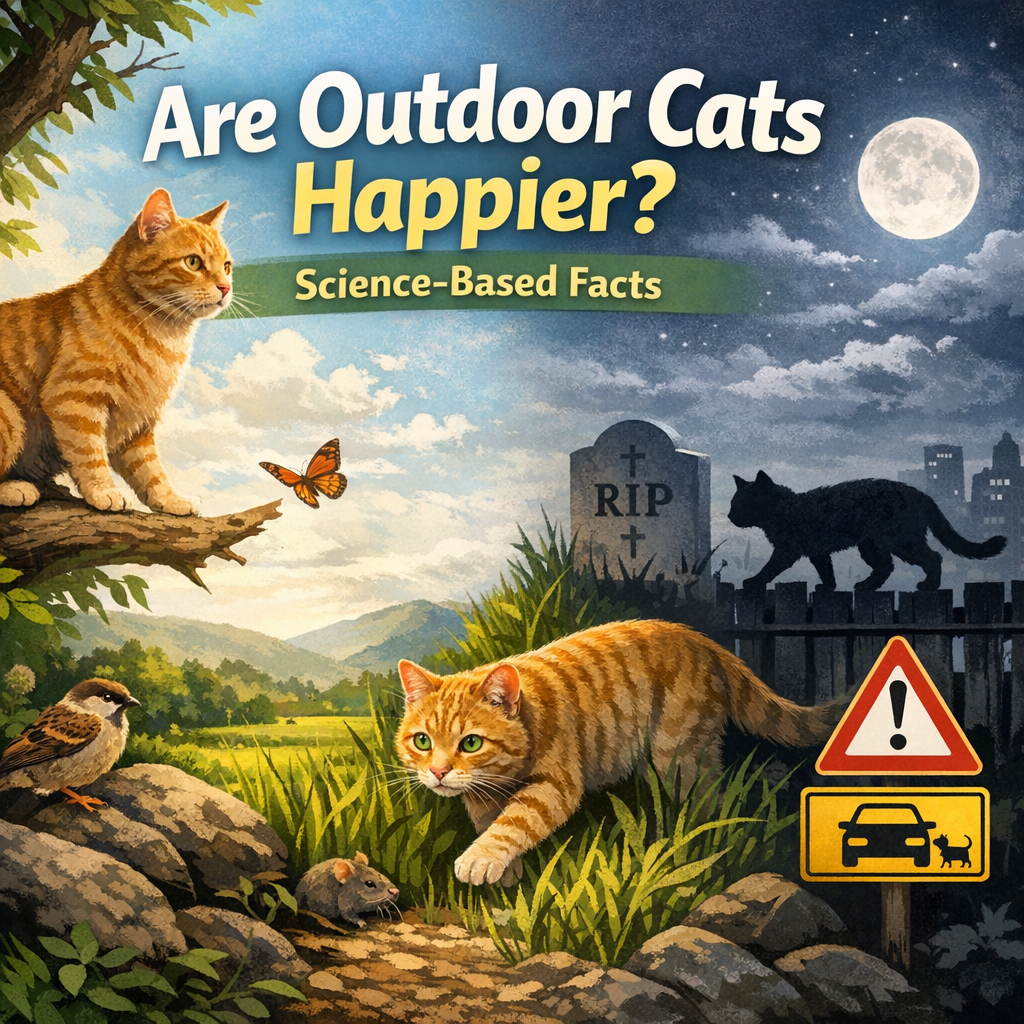
- Safety vs. Instinct: While outdoor access allows cats to express natural behaviors like hunting and climbing, it significantly reduces their average lifespan to under 5 years compared to 12–20 years for indoor cats.
- Major Hazards: Free-roaming felines face extreme risks from vehicle collisions (causing 87% of sudden deaths), fatal diseases like FeLV and FIV, predation by wildlife, and exposure to toxins like antifreeze.
- Environmental Impact: Domestic cats are efficient predators that cause substantial mortality in local bird and small mammal populations, disrupting delicate ecosystems.
- The Middle Ground: Experts recommend “controlled outdoor access” via “catios” or leash walking, combined with indoor enrichment (vertical spaces and interactive play), to satisfy feline instincts without the life-threatening dangers.
Table of Contents
- Are Outdoor Cats Happier? Science-Based Facts
- Benefits of Outdoor Access for Natural Behaviors
- Risks of Disease and Parasite Transmission
- Risks of Trauma and Vehicle Collisions
- Predation by Wildlife and Dogs
- Chemical and Toxic Substance Exposure
- Contributing to Feral and Stray Cat Populations
- Wildlife Impact and Predation
- Indoor Enrichment Alternatives and Cat Safety
- The Benefits of Outdoor Access for Natural Behaviors
- Risks of Disease and Parasite Transmission
- Risks of Trauma and Vehicle Collisions
- Predation by Wildlife and Dogs
- Chemical and Toxic Substance Exposure
- Contributing to Feral and Stray Cat Populations
- Trauma Risks and Safety Concerns
- The Great Debate: Comparing Indoor and Outdoor Lifestyles
- Impact on Local Wildlife and the Environment
- Environmental Enrichment Strategies for Happy Felines
- Controlled Outdoor Access: The Middle Ground
- Frequently Asked Questions
Are Outdoor Cats Happier? Science-Based Facts
Deciding whether your feline friend should roam the great outdoors or stay snuggled on the sofa is a major crossroads for any pet parent. It is a debate that sparks plenty of passion in the cat community from the United States to the United Kingdom.
You want the best for your cat, but the choice between safety and freedom is rarely simple. In this guide, we look at the hard science and behavioral facts to see if those outdoor adventures truly lead to a happier life or if they just invite unnecessary danger.
Whether you are browsing YouTube for cat tips on your iPhone or consulting experts in Europe and Canada, the consensus on companion cats is evolving. We explore how uncontrolled outdoor access impacts feline health and the delicate balance of transitioning outdoor cats to indoors.
Benefits of Outdoor Access for Natural Behaviors
Recent estimates suggest that outdoor access allows cats to perform vital natural behaviors like hunting, exploring, and climbing. These activities provide essential mental stimulation and physical activity that are often hard to replicate perfectly inside a home.
By engaging in hunting behavior and exploring a wider territory, many cats show fewer behavioral problems related to boredom. This freedom can enhance mental and physical welfare, as some studies indicate increased physical activity levels compared to sedentary indoor cats.
Risks of Disease and Parasite Transmission
While the fresh air is nice, the health risks are significant. Studies show that outdoor cats interact with unfamiliar animals or wildlife 50 percent of the time, which drastically increases the risk of spreading communicable diseases.
For instance, the seroprevalence for Feline leukemia virus and Feline immunodeficiency virus is approximately 3.1 percent and 3.6 percent, respectively. Uncontrolled outdoor access is a primary risk factor for these conditions, along with Rabies and Bartonellosis.
Beyond viruses, free-roaming cats are frequently exposed to internal and external parasites. This includes risks for Lyme disease, flea allergy dermatitis, and various worms, which often require frequent visits to veterinary clinics for treatment.
Risks of Trauma and Vehicle Collisions
The modern world is not always built for cat safety. Research indicates that 45 percent of outdoor cats cross roads in suburban areas, putting them at extreme risk for traffic injury or fatal accidents.
On average, 39 percent of sudden cat deaths are due to trauma, with 87 percent of those cases caused by vehicle accidents. These collisions often lead to severe lesions and broken bones, resulting in long-term disability or immediate death.
Predation by Wildlife and Dogs
The great outdoors presents a world of predators. Research shows that urban coyotes in places like the United States often prey on feline companions, with cat remains found in 1.2 percent to 13.6 percent of coyote scats.
Predation by dogs and other larger animals is a significant welfare concern that can lead to terrifying encounters and fatal injuries. For many cat owners, the fear of their pet being hunted outweighs the benefits of roaming free.
Chemical and Toxic Substance Exposure
Outdoor environments are full of hidden dangers like toxic ingestion. Data points show that 36 percent of outdoor cats have ingested unknown liquids or solids while wandering through gardens or garages.
Ethylene glycol, commonly found in antifreeze, was involved in 29 percent of intoxication cases and caused death in 43 percent of those instances. Additionally, lilies and other common garden plants are highly toxic, leading to renal failure even in small amounts.
Contributing to Feral and Stray Cat Populations
Uncontrolled roaming contributes to the growing crisis of stray cat populations. In the United States, over 53 percent of cats in shelters are strays, and only 5 percent of those are ever returned to their original owners.
In Canada, statistics show that out of a total intake of 114,131 cats, an estimated 63,456 stray cats were not returned to a home. Outdoor access is a major factor in cats wandering too far, becoming lost, or being abandoned, which fuels the cycle of feral populations.
Wildlife Impact and Predation
We cannot ignore the wildlife impact caused by our feline friends. Cats are natural hunters, and their predation of small birds and mammals can disrupt local ecosystems in regions from France to New Zealand.
Even well-fed companion cats engage in hunting behavior. This environmental disturbance is a key reason why many conservationists advocate for supervised outdoor access or strictly indoor lifestyles to protect vulnerable local species.
Indoor Enrichment Alternatives and Cat Safety
If you choose to keep your cat inside for safety, environmental enrichment strategies are vital. You can provide climbing structures, window perches, and interactive toys to satisfy their instincts without the risks of parasites or traffic.
Supervised outdoor access, such as using a leash or a secure outdoor enclosure, offers a middle ground. This allows for exploring and mental stimulation while ensuring your cat remains safe from disease, predators, and toxic substances.
Expert Insight
“Indoor-only cats are often assumed to be the safest, but it is more challenging to meet their needs, impacting their physical and emotional health and resulting in more caregiver concerns about behavior.”, Dr. Ilona Rodan, Chair of the FelineVMA’s Feline Welfare Committee
The Benefits of Outdoor Access for Natural Behaviors
Recent estimates report that outdoor access allows companion cats to perform natural behaviors like hunting, exploring, and climbing. These activities are hardwired into feline DNA and can significantly enhance mental and physical welfare.
In the wild, your cat is essentially a tiny tiger. Being outside provides a level of physical activity that is difficult to replicate in a small apartment in the United States or Europe, potentially reducing the risk of feline obesity.
While happiness is subjective, outdoor access offers constant mental stimulation. However, many experts in the United Kingdom and Canada suggest that a well-enriched indoor environment can provide similar satisfaction through dedicated environmental enrichment strategies.
Risks of Disease and Parasite Transmission
Uncontrolled outdoor access exposes your pet to significant feline health risks. Studies show that outdoor cats interact with unfamiliar animals or wildlife 50 percent of the time, which dramatically increases the chance of disease transmission.
Research indicates that the seroprevalence for Feline leukemia virus and Feline immunodeficiency virus is approximately 3.1 percent and 3.6 percent respectively. Outdoor roaming is a primary risk factor for these communicable diseases.
Beyond viruses, cats face threats from internal and external parasites. They are at higher risk for flea allergy dermatitis, Lyme disease, Bartonellosis, and even Rabies, which remains a concern in many regions.
Risks of Trauma and Vehicle Collisions
The safety of free-roaming cats is often compromised by traffic. Studies indicate that 45 percent of outdoor cats cross roads in suburban areas, leading to a high rate of traffic injury.
On average, 39 percent of sudden cat deaths are due to trauma, with a staggering 87 percent of those cases caused by vehicle accidents. These collisions often result in severe lesions or broken bones.
Even if a cat survives a hit, the trauma can lead to long-term disability. This is why many cat owners are turning toward supervised outdoor access to balance freedom with cat safety.
Predation by Wildlife and Dogs
Your feline friend isn’t the only hunter out there. In many urban areas, predators like coyotes pose a massive threat. Research shows that 1.2 percent to 13.6 percent of urban coyote scats contain cat remains.
Predation by dogs and other larger animals is a significant welfare concern that can lead to immediate injury or death. This risk is particularly high in parts of the United States and New Zealand where wildlife overlap is common.
Protecting your cat from becoming prey is just as important as managing their own hunting behavior. Without a fence or supervision, they are vulnerable to the natural hierarchy of the local ecosystem.
Chemical and Toxic Substance Exposure
The great outdoors is full of hidden dangers, including toxic ingestion. Data points show that 36 percent of outdoor cats have ingested unknown liquids or solids while wandering.
Intoxication cases are often fatal; 29 percent of these cases involved ethylene glycol, which caused death in 43 percent of affected cats. This common antifreeze is sweet-tasting but deadly.
Common garden plants like lilies are also highly toxic. Ingesting even a small amount can lead to acute renal failure and death, making the backyard a potential minefield for an unsupervised cat.
Contributing to Feral and Stray Cat Populations
Outdoor access directly impacts the number of cats ending up in animal shelters. In the United States, over 53 percent of cats in shelters are strays, and only 5 percent are ever returned to their owners.
The situation is similar in Canada, where an estimated 63,456 stray cats from a total intake of 114,131 were not returned to their homes. This highlights how easily a roaming cat can become lost or abandoned.
Uncontrolled roaming often leads to the growth of feral populations, which further complicates cat welfare and increases the pressure on local veterinary clinics and rescue groups.
Trauma Risks and Safety Concerns
While your cat might have the agility of a ninja, the pavement is a dangerous playground. Traffic remains the single greatest threat to any feline with uncontrolled outdoor access.
In the United States and the United Kingdom, the statistics are sobering. Research indicates that 45 percent of outdoor cats cross roads in suburban areas, often ignoring the danger of oncoming cars.
Data shows that 39 percent of sudden cat deaths are caused by trauma. A massive 87 percent of those trauma cases are the direct result of vehicle accidents.
These collisions lead to devastating feline health issues. Many cats suffer from severe lesions, broken bones, or instant fatality when wandering too close to the curb.
Even if your companion cat survives a hit, the road to recovery is long. Permanent disability often follows, drastically reducing their quality of life and physical activity levels.
For many pet parents in Canada and Europe, this risk alone makes indoor life much more appealing. You can provide plenty of mental stimulation at home without the fear of a traffic injury.
If you want to keep your cat safe while still enjoying the sun, consider supervised outdoor access. It is the best way to prevent your furry friend from becoming another traffic statistic.
The Great Debate: Comparing Indoor and Outdoor Lifestyles
Choosing between an indoor or outdoor life for your companion cats is more than just a preference. It is a decision that impacts feline health, safety, and their overall lifespan.
While the call of the wild is strong, the data from the United States and Europe shows a stark contrast in outcomes. Let us break down the facts so you can make the best choice for your furry friend.
| Feature | Indoor Lifestyle | Outdoor Lifestyle |
|---|---|---|
| Average Lifespan | 12 to 20 years | Under 5 years (average) |
| Exercise Levels | Dependent on owner play | High (hunting and climbing) |
| Disease Risk | Low (controlled) | High (wildlife contact) |
| Mental Stimulation | Requires enrichment | Naturally occurring |
Impact on Local Wildlife and the Environment
Your little hunter might look adorable, but their impact on the ecosystem is significant. Domestic cats are incredibly efficient predators, and their hunting behavior is a leading cause of bird population decline globally.
In countries like France, Australia, and New Zealand, the environmental impact of free-roaming cats has reached a tipping point. This has led to strict local regulations to protect native species that simply are not adapted to feline predators.
While hunting is a natural behavior, the sheer number of companion cats in urban areas creates an artificial pressure. Many ecosystems in the United States, Canada, and Europe cannot sustain this level of predation on small birds and mammals.
The Reality of Predation and Wildlife Impact
Uncontrolled outdoor access allows cats to engage in hunting behavior that can devastate local biodiversity. Even well-fed cats often hunt because the instinct is so deeply ingrained in their feline health and psyche.
Research using animal-borne cameras shows that many cat owners are unaware of how often their pets hunt. These cameras reveal that predation of small birds and mammals happens far more frequently than the occasional gift left on your doorstep suggests.
Environmental Enrichment as a Greener Alternative
If you want to protect the birds while keeping your cat happy, environmental enrichment strategies are the way to go. You can provide mental stimulation and physical activity without letting your cat roam free.
Indoor cats can still enjoy climbing and exploring through the use of cat trees and interactive toys. This satisfies their natural behaviors while ensuring they do not contribute to the decline of vulnerable species in your neighborhood.
Expert Insight
“Free-ranging cats cause substantially greater wildlife mortality than previously thought and are likely the single greatest source of anthropogenic mortality for US birds and mammals: scientifically sound conservation and policy intervention is needed to reduce this impact.”, Dr. Scott Loss, Smithsonian Conservation Biology Institute
Environmental Enrichment Strategies for Happy Felines
If you choose to keep your cat indoors to avoid the dangers of the streets, you must prioritize Environmental Enrichment. This prevents boredom and common behavioral problems like over-grooming, furniture destruction, or redirected aggression.
Vertical space is essential for companion cat welfare. Use cat trees, shelves, and window perches to allow your cat to climb and observe their kingdom from above, mimicking their natural behaviors of surveying territory.
Interactive play is your best tool for mental stimulation. Use toys that mimic prey to satisfy hunting behavior and provide the physical activity they crave without the risks of the street or uncontrolled outdoor access.
Controlled Outdoor Access: The Middle Ground
You do not have to choose between total confinement and total freedom for your companion cats. Supervised outdoor access is a growing trend among responsible cat owners in the United States and Europe who want to balance cat welfare with safety.
Consider building a catio or using a harness and leash. These methods allow your cat to enjoy the fresh air and sunshine while remaining safe from traffic injury and predators like coyotes or stray dogs.
This approach provides the benefits of the outdoors, such as physical activity and mental stimulation, while maintaining a high vaccination protective rate. It keeps them away from communicable diseases like Feline leukemia virus, Feline immunodeficiency virus, and Rabies.
Frequently Asked Questions
Do indoor cats get depressed?
Indoor cats can experience boredom or lethargy if their environment is stagnant. However, with enough toys, climbing structures, and daily play, they can live highly fulfilled and happy lives.
In the United States and Europe, many owners use environmental enrichment strategies to prevent behavioral problems. Providing mental stimulation through food puzzles and vertical space ensures your companion cat stays sharp and cheerful.
Is it cruel to keep a cat inside?
No, keeping a cat inside is a responsible act of care supported by welfare organizations in the United Kingdom and Canada. It protects them from uncontrolled outdoor access risks like traffic injury and toxic ingestion.
Indoor cats are shielded from the Feline Leukemia Virus and Feline Immunodeficiency Virus. Avoiding these communicable diseases and parasites like Bartonellosis ensures a much longer, healthier life for your feline friend.
How can I tell if my cat is happy?
A happy cat shows relaxed body language, engages in regular play, and maintains a healthy appetite. Purring and seeking out your company are also great signs of a strong bond.
What are the biggest risks of uncontrolled outdoor access?
The risks are significant, ranging from disease risk to physical trauma. Studies show that 45 percent of outdoor cats cross roads in suburban areas, and vehicle accidents cause 87 percent of sudden cat deaths.
How does outdoor roaming impact feline health?
Free-roaming cats have a higher seroprevalence for Feline Leukemia Virus and Rabies due to interactions with unfamiliar animals. They are also prone to internal and external parasites, including Lyme disease and flea allergy dermatitis.