





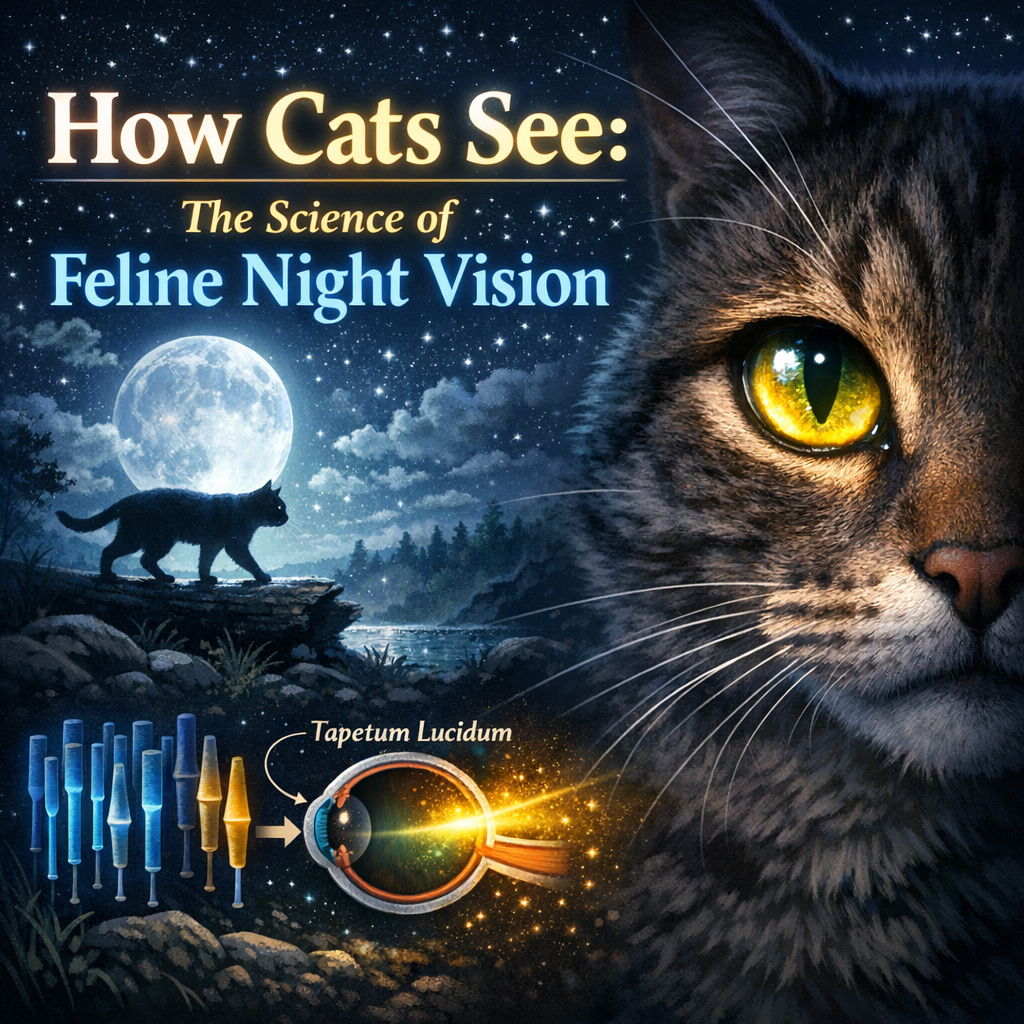
- Superior Night Vision: Cats have 6 to 8 times more rod cells than humans and a reflective layer called the tapetum lucidum, allowing them to see in 1/6th the light we require, though they cannot see in 100% darkness.
- Specialized Hunting Anatomy: Their eyes are optimized for motion detection and a wide 200-degree peripheral view, though they are naturally nearsighted and struggle to see objects clearly closer than 10 inches.
- Color & Clarity Trade-offs: While experts at night, cats see a limited color spectrum (mostly blues and yellows) and lack the daytime detail and vibrant red tones that human vision provides.
- Health & Nutrition: Maintaining feline eye health requires a meat-based diet rich in taurine; any signs of cloudiness or bumping into objects should be checked by a vet to prevent retinal degeneration.
Table of Contents
- Anatomy of a Cat Eye for Night Vision
- The Magic of the Tapetum Lucidum
- How Cats Really See in Darkness
- Light Sensitivity and Pupil Function
- Color Vision Limitations in Cats
- Motion Detection and World View
- Differences Between Human and Feline Night Vision
- The Evolution of the Crepuscular Hunter
- Cat Vision vs Human Vision: The Ultimate Showdown
- Supporting Cat Eye Health and Vision
- Frequently Asked Questions About Feline Vision
Ever wondered why your cat can sprint through a pitch black hallway without stubbing a toe? While you are busy fumbling for the light switch, your feline friend is navigating like a high tech spy.
It is not magic, it is biology. Cats possess a visual system that makes human eyesight look a bit basic in comparison, especially when the sun goes down.
Your cat is a biological masterpiece designed for the shadows. Let us dive into the science of how those glowing eyes actually work.
Anatomy of a Cat Eye for Night Vision
The secret to feline vision lies in their specialized cat eye anatomy. Unlike us, cats have eyes optimized for light absorption and motion detection.
Feline eyesight relies on a high photoreceptor concentration. Cats have six to eight times more rod cells than humans, which are the cells responsible for seeing in low light conditions, giving them superior night vision.
This massive number of rod cells allows them to detect shapes and movement where we see only darkness. Their retinal structure is a marvel of evolution for any crepuscular hunting specialist.
The Magic of the Tapetum Lucidum
Have you ever seen those glowing cat eyes in a dark room? That eerie shine comes from a thin layer of tissue called the tapetum lucidum located behind the retina.
The tapetum lucidum acts like a mirror, reflecting light back through the rod cells a second time. This process of light amplification gives the brain a second chance to process the image.
This retinal reflection is why cats only need about one sixth of the light humans require to see clearly. It is the ultimate biological night vision goggles for your favorite little predator.
How Cats Really See in Darkness
Despite their reputation, cats cannot see in total darkness. Like any optical system, feline vision requires at least a small amount of ambient light to function.
However, in near total darkness, they outperform us significantly. While we see a black void, their eyes use every available photon to map out the room.
This ability is what makes them elite crepuscular hunters. They are most active at dawn and dusk when their vision gives them a massive tactical advantage over prey.
Light Sensitivity and Pupil Function
A cat eye is dominated by its large pupils. These are not just for looking cute; they are highly efficient light regulators that maximize light intake.
In dim settings, a cat’s pupils can dilate into nearly full circles to let in every bit of light. This pupillary dilation is key to their superior visual acuity in the dark.
During the day, those pupils constrict into vertical slits. This protects their sensitive retina from glare while helping them maintain depth perception for a perfect pounce.
Color Vision Limitations in Cats
While they win at night, cats have some trade offs. Feline color perception is much more limited than ours because they have fewer cone cells.
Cats primarily see the world in shades of blue and gray. While they might not appreciate the vibrant red of a new toy, their vision is perfectly tuned for their environment.
Some research even suggests they can detect limited UV light. However, compared to humans, their world is much less colorful but far more detailed in terms of texture and movement.
Motion Detection and World View
Cats are built for the hunt. Their high concentration of rod cells does more than help them see in the dark; it provides incredible motion detection.
Even the slightest twitch of a mouse tail is amplified in their field of vision. This focus on movement is why interactive toys are so essential for their mental health.
Their peripheral vision is also wider than ours, spanning about 200 degrees. This wide view allows them to spot threats or snacks creeping up from the side with ease.
Differences Between Human and Feline Night Vision
When comparing cat vision vs human vision, it is a tale of two different worlds. Humans dominate the day with superior clarity and a full rainbow of colors.
However, once the sun sets, feline health and anatomy take the lead. Cats dominate low light environments where our eyes simply fail to resolve images.
While we rely on nightlights for cats or hallway lamps, your pet is navigating via light amplification and biological precision. They truly are the masters of the night.
The Evolution of the Crepuscular Hunter
The secret to feline night vision starts with the retina. This layer of tissue at the back of the eye contains specialized cells called photoreceptors that dictate how your pet processes the world.
Cats have a massive biological advantage here. Their eyes contain 6 to 8 times more rod cells than human eyes do. This high photoreceptor concentration is exactly why they are such elite crepuscular hunters.
Rod cells are responsible for detecting light and dark. Because cats have so many, they can pick up the tiniest traces of light that our eyes simply ignore. This allows for incredible light absorption in low light conditions.
That said, they have fewer cone cells. While cones help us see vibrant colors and fine details in the sun, cats traded that color clarity for superior low light performance. Their color perception is mostly limited to blues and grays.
The corneal structure of a cat is also much larger relative to their head size. This acts like a wide angle lens, pulling in every stray photon available in the room. This works in tandem with their large pupils to maximize intake.
Another critical feature of cat eye anatomy is the tapetum lucidum. This reflective layer behind the retina acts like a mirror, reflecting light back through the photoreceptors for a second chance at detection.
This retinal reflection is the reason for those glowing cat eyes you see in photos or at night. It provides the low light light amplification necessary for navigating a dark living room like a pro.
By combining a high density of rod cells with the tapetum lucidum, feline eyesight is optimized for motion detection. They can spot a twitching toy or a scurrying mouse when you can barely see your own hand.
While we might win at midday visual acuity, cats dominate the dawn and dusk. Their eyes are built for the hunt, ensuring their hunting instincts stay sharp even when the sun goes down.
Cat Vision vs Human Vision: The Ultimate Showdown
To understand the trade offs of feline eyesight, it helps to look at the data. While you might win a staring contest at high noon, your cat is the undisputed champion of the night shift.
| Feature | Human Vision | Feline Vision |
|---|---|---|
| Visual Field | 180 Degrees | 200 Degrees |
| Low Light Sensitivity | Standard | 6 to 8 times higher |
| Color Range | Full Spectrum (RGB) | Limited (Blues/Yellows) |
| Motion Detection | Average | Exceptional |
| Reflective Layer | None | Tapetum Lucidum |
| Photoreceptor Type | High Cone Concentration | High Rod Concentration |
As the table shows, the peripheral vision of a cat is significantly wider than ours. They can spot a flick of a tail out of the corner of their eye that would require you to turn your head completely.
Supporting Cat Eye Health and Vision
To keep those high tech night vision goggles working, your cat needs more than just a sense of adventure. Proper nutrition is the foundation of feline eyesight, and a taurine deficiency can lead to devastating cat eye issues, including retinal degeneration and permanent blindness.
Most premium cat foods are fortified with this essential amino acid, but it is one of the most vital feline health tips to remember: never skip the high quality protein your little hunter craves. Their corneal structure and retinal health depend on a meat based diet to maintain that famous visual acuity.
You should also keep a close watch on changes in cat behavior. If your crepuscular hunter starts hesitating before a jump or bumping into the coffee table at night, it might be a sign that their low light light amplification is fading and it is time for a professional check up.
Regularly inspecting the nictitating membrane, or the third eyelid, can help you spot infections or ocular health problems early. Clear, bright eyes that reflect light perfectly are the hallmark of a healthy pet and a happy, efficient hunter.
Frequently Asked Questions About Feline Vision
Still curious about how your little crepuscular hunter views the world? We have gathered the most common questions about cat eye anatomy and feline eyesight to help you understand your pet better.
Can cats see in 100% darkness?
No, they cannot. While feline vision is legendary, cats still require at least a small amount of light to function. In a completely sealed, windowless room with zero light source, a cat is just as blind as a human.
However, their light absorption is vastly superior to ours. Because of a high photoreceptor concentration, cats only need about one sixth of the light that humans do to navigate effectively in low light conditions.
Why do cats’ eyes glow in photos and at night?
That eerie, beautiful glow is known as eyeshine. It is caused by the tapetum lucidum, a thin reflective layer located behind the retina. This structure acts like a mirror, bouncing light back through the rod cells a second time.
This retinal reflection gives the cat a second chance to process every photon, which is why they excel at motion detection in the dark. When a camera flash hits this layer, it creates the bright reflection you see in pictures.
Do cats see more colors than humans do?
Actually, they see fewer. Human color perception is driven by three types of cone cells, whereas cats only have two. This means their world is mostly composed of blue and yellow hues.
While they may have a slight advantage in detecting limited UV light, they struggle with reds, oranges, and browns. To a cat, your bright red laser pointer might look more like a dull shade of grey or yellow.
Is my cat nearsighted?
Generally, yes. Feline eyesight is specialized for the hunt. Their visual acuity is best at a distance of 2 to 20 feet, which is the sweet spot for pouncing on prey.
Objects closer than 10 inches are often blurry. To compensate for this nearsightedness, cats use their whiskers and superior motion detection to navigate tight spaces and identify objects right under their noses.
How does cat vision compare to human vision?
In a cat vision vs human showdown, there is a clear trade off. Humans win during the day because our cone cells provide incredible detail and vibrant colors. We have much better depth perception for stationary objects.
Cats dominate in low light environments. Their large pupils and high density of rod cells allow them to see movement that we would completely miss. Their peripheral vision is also wider at 200 degrees compared to our 180 degrees.