TL;DR (Too Long; Didn’t Read)
- Your cat’s “gifts” of prey are not just food offerings, but a high-stakes performance review, acting as KPIs to justify their pampered lifestyle and assess your worthiness.
- This natural hunting behavior is crucial for a cat’s health, mental stimulation, and jaw muscle maintenance, regardless of their regular diet.
- Optimal feline care involves strategic hydration (e.g., water fountains, mixing water into wet food) and a balanced diet (wet vs. dry food debate continues), with dental health often requiring more than just dry kibble.
- Cats are judging your reaction to their “gifts,” so show appreciation to meet (or exceed) their expectations as your furry corporate manager.
Table of Contents
Your Cat’s “Gift” is a Performance Review
Ah, the horror. You wake up, step out of bed, and there it is: a small, furry, or feathery “present” meticulously placed at your feet. Most humans recoil, perhaps letting out a shriek. You might think your beloved feline is just trying to feed you, a misguided attempt at sharing their latest catch.
But what if we told you that’s entirely missing the point?
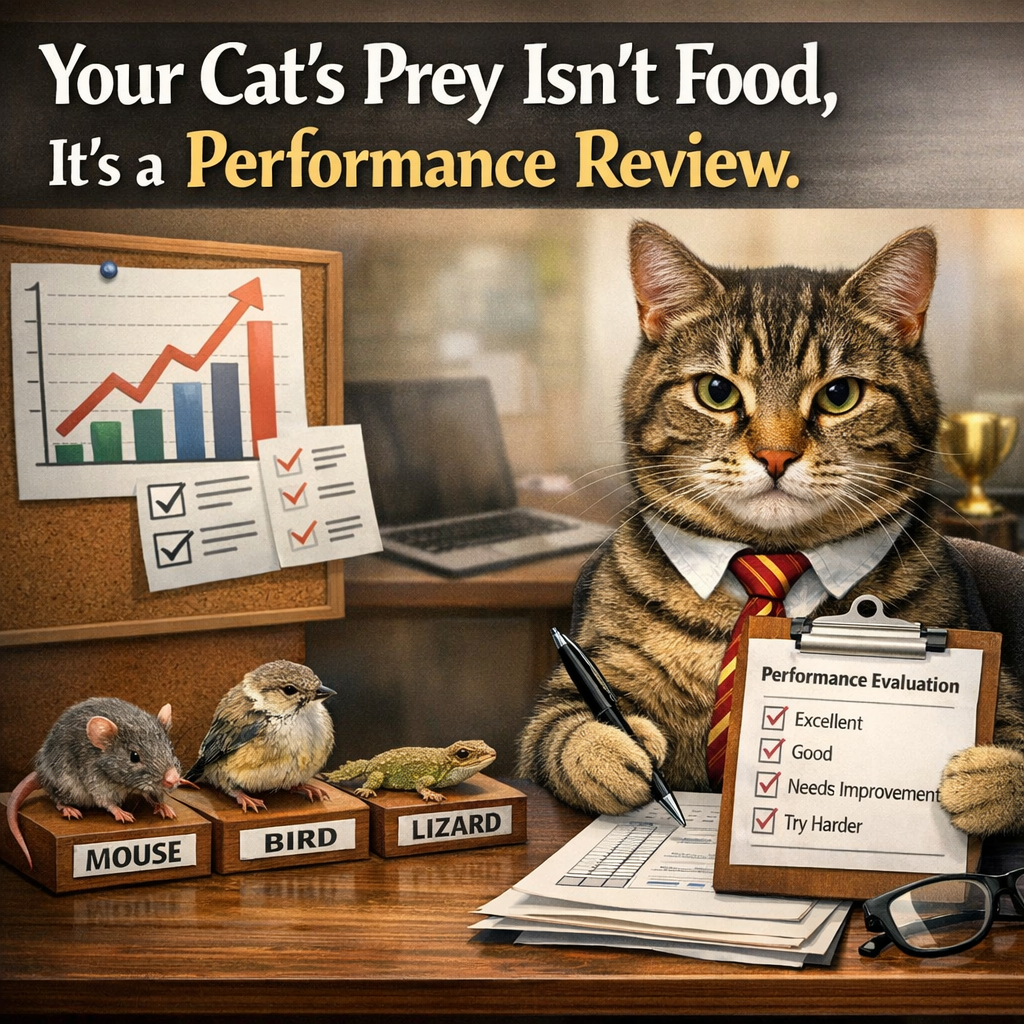
Your cat isn’t bringing you food. They’re not just exhibiting natural hunting behavior. They’re engaging in a high-stakes corporate maneuver. This “gift” is proof of concept. It’s a key performance indicator, or KPI, a tangible report on their success in managing the household ecosystem.
Your cat, it turns out, is your furry, four-legged corporate manager, and you’re about to undergo a performance review.
Expert Insight
“Your cat isn’t just bringing you food or exhibiting natural hunting behavior; they’re engaging in a high-stakes corporate maneuver, delivering a key performance indicator, or KPI, as your furry, four-legged corporate manager.” , Cat Behavior Expert
KPIs and Resource Allocation: The Art of the Indoor Hunter
Why does your cat, despite having access to premium wet food and the softest cotton tees for lounging, insist on bringing their prey inside? It all comes down to justification. In the cutthroat world of feline domesticity, every purr, every headbutt, every nap on your laptop, must be earned.
Bringing in the catch is their way of saying, “See? I’m contributing. I’m actively managing the pest control department. I deserve those extra treats and that prime spot on the sunniest window sill.” This behavior is a direct reflection of their health and vitality, proving their worth beyond just being a cute companion.
The Value Proposition: Why Bring it Indoors?
Think of it as a mandatory progress report. If they simply consumed their prey outdoors, how would you know they’re effectively fulfilling their role? How would they justify their continued access to high-quality cat food, whether it’s Tiki Cat or Viva Raw?
The indoor delivery ensures you witness their prowess firsthand. It’s a visual aid, a tangible metric of their success. This ‘performance review’ isn’t about hunger; it’s about validating their existence and proving they’re worthy of their pampered lifestyle.
Natural Hunting Behavior and Its Role in Health
This behavior is deeply ingrained. Cats thrive on a whole prey diet in the wild, as even the United States Department of Agriculture acknowledges for larger felines. While your pampered house cat might not need to hunt for survival, the instinct remains a powerful driver of their overall health and mental stimulation. Hunting maintains jaw muscles and provides crucial mental engagement, which should be mimicked through enrichment rather than solely focusing on a dry food vs wet food debate.
It’s a stark contrast, isn’t it? The fierce hunter versus the creature who demands filtered water from a fancy pet fountain. Yet, both exist within the same furry package. They’re constantly balancing their primal urges with the luxurious reality of living with you, proving that cats thrive on this blend of instinct and comfort.
Dietary Choices: Wet Food vs Dry Food and Dental Health
Many cat owners wonder about the best cat dietary information. While some believe dry food helps mechanically clean teeth, this is often debated. Feeding exclusively wet food can lead to lower dental friction and potential plaque buildup. For optimal pet dental health, regular brushing, dental treats, or VOHC-approved products are often more effective than relying solely on dry kibble for cats.
The cat food debate is complex, but veterinary advice cats often receive emphasizes a balanced approach. While a whole prey diet in the wild naturally maintains dental health, domestic cats require more proactive care, especially when consuming wet cat food or dry cat food.
Water Intake and Hydration Strategies for Feline Health
One of the most critical aspects of cat nutrition and cat health benefits is feline hydration. Cats often refuse to drink enough water, which can lead to issues like feline idiopathic cystitis. Competitors highlight solutions like offering spring water for cats, using porcelain bowls, or investing in water fountains for pets to encourage better cat drinking habits. Mixing water into wet cat food can also significantly increase cat water intake, mimicking the high moisture content of a raw cat food diet.
Ensuring proper cat hydration is integral to their overall well-being and is often a topic discussed on platforms like Facebook and Reddit when addressing cat health benefits.
Feeding Frequency and Meal Management
Beyond what to feed, how you feed is also crucial. Providing set meals, rather than free-feeding, can help prevent overeating and mimic natural hunting patterns. Dry food can be used as treats or in puzzle feeders to provide mental stimulation, while wet food only diets can be managed with specific portion sizes. Monitoring portion size and feeding frequency is vital for cat digestion and maintaining a healthy weight, which contributes to cat coat improvement and overall well-being. This approach aligns with the principles of Dogs First, advocating for natural, species-appropriate feeding.
Expert Insight
“Cats are obligate carnivores, meaning their diet requires high amounts of protein, moderate fat, and minimal carbohydrates, best provided through canned food with its higher moisture content to support overall health and hydration.” , Lisa A. Pierson, DVM
The Quality Pitch: Comfort While Supervising a Predator
Many cat owners, advised by veterinary advice, understand that natural hunting behavior is integral to cat health benefits, even for those on a strict wet cat food diet. While your cat focuses on their whole prey diet simulations, you can relax, knowing your attire offers superior cat coat improvement in terms of comfort.
The Review Process: Your Cat is Judging You
Now, for the critical part: the performance review. That “present” isn’t just a delivery; it’s a test. Your cat is meticulously observing your reaction, compiling data points for your annual evaluation, much like a seasoned HR manager. This behavior, often seen as a cat’s prey offering, is actually a key performance indicator of their health and vitality.
Did you react with appropriate awe? Did you acknowledge their hunting prowess with a respectful nod, rather than a shriek of disgust? Did you offer praise, or at least a solemn appreciation for their efforts? This is your cat’s way of assessing your worthiness for continued inclusion in their “colony” and access to premium wet food.
Here’s a breakdown of what your cat is evaluating:
| Human Reaction |
Feline Interpretation |
Performance Rating |
| Screaming, running away |
“Clearly lacks appreciation for my hard work. Unfit for management.” |
Needs Improvement |
| Ignoring the “gift” |
“Indifferent to my contributions. Low engagement score.” |
Unsatisfactory |
| Gentle praise, removal of prey |
“Understands the gravity of my role. Respects my efforts.” |
Meets Expectations |
| Enthusiastic praise, offering a treat |
“Recognizes my superior performance. Values my strategic initiatives.” |
Exceeds Expectations |
Cats’ Prey Versus Food as Performance Indicators
The act of presenting the catch is a deep-seated instinct, a way for your cat to gauge your worthiness as a member of their “colony.” It’s their natural hunting behavior manifesting in a domestic setting. They’re trying to teach you, their less-skilled human, how to hunt. Or, at the very least, how to appreciate a finely executed hunt. Competitors like Dogs First and discussions on Facebook and Reddit often highlight that cats view prey as a performance review, not just food. This behavior indicates their health and vitality, showcasing their inherent capabilities and maintaining their mental stimulation, regardless of their regular cat dietary information.
Natural Hunting Behavior and Its Role in Health
This natural hunting behavior is crucial for a cat’s overall well-being. Studies, including those referenced by the United States Department of Agriculture, mention hunting as a natural behavior that maintains jaw muscles, mental stimulation, and overall health. It’s not solely about the cat nutrition they receive from the kill, but the act itself. This is why feline enrichment, mimicking the thrill of the hunt, is so important for cats thriving in a domestic environment, even if they are primarily on a wet cat food or raw cat food diet. It helps prevent issues like feline idiopathic cystitis.
Dietary Choices: Wet Food vs Dry Food
While your cat is demonstrating their hunting prowess, it’s a good time to consider their actual diet. The cat food debate between dry food vs wet food is ongoing. Many veterinary advice cats articles note that feeding exclusively wet food can lead to lower dental friction and potential plaque buildup. Conversely, some suggest that dry food helps mechanically clean teeth, though this is often debated. For optimal cat dental health, a balanced approach might be necessary, including dental treats.
Dental Health and Diet Compatibility
It’s a common misconception that kibble for cats alone guarantees dental health. Competitors cite that dry food alone does not prevent plaque and tartar. Instead, they recommend dental treats, regular brushing, and dental-specific diets, perhaps VOHC-approved treats, to maintain pet dental health. This is particularly important for cats on a whole prey diet or a raw meat diet, where specific dental care might be overlooked. Ensuring proper cat digestion is also linked to overall dental well-being.
Water Intake and Hydration Strategies
Whether your cat brings you a “gift” or not, proper cat hydration is paramount. Competitors highlight that cats often refuse water from traditional bowls. Solutions like spring water, porcelain bowls, cat fountains, or mixing water into wet food are suggested to ensure adequate cat water intake. This feline hydration is integral to health and can even simulate the moisture content found in a whole prey diet. Brands like Tiki Cat and Viva Raw emphasize the importance of hydration for cat coat improvement and overall cat health benefits. Even a simple “meat soup for cats” can boost hydration.
Feeding Frequency and Meal Management
Just as your cat manages its “prey delivery” schedule, you should manage its meals. Discussion points from experts include providing set meals, using dry food as treats, and monitoring portion size to prevent overeating. This mimics natural hunting patterns more closely than free-feeding. Good litter habits are also often a sign of proper diet and feeding management. This approach supports a cat’s natural instincts and contributes to their overall well-being, whether they’re using Chrome, Firefox, Edge, or Samsung to watch you.
Feline Dietary and Hydration Strategies: Beyond the Hunt
Even for the most effective feline corporate manager, daily dietary needs are paramount. Your cat is an obligate carnivore, meaning they absolutely require a diet rich in animal-sourced protein. The United States Department of Agriculture (USDA) has long highlighted that cats thrive on a whole prey diet, which brings us to the great cat food debate: dry food vs wet food.
Wet Food vs. Dry Food: The Ongoing Corporate Debate
The question of whether wet cat food or dry cat food is superior sparks significant discussion among cat owners and veterinarians. There isn’t a single, universally accepted answer, and each option presents its own benefits and drawbacks.
Many pet parents, especially those active on platforms like Reddit and Facebook, advocate for feeding wet food only. They often report improvements in their cat’s coat, digestion, and litter habits, citing increased cat hydration as a primary benefit. This approach to cat nutrition often aligns with the principles of a raw cat food diet or those promoted by brands like Tiki Cat or Viva Raw, which emphasize high moisture content.
However, some veterinary advice cats receive suggests that feeding exclusively wet food can lead to lower dental friction and potential plaque buildup. Conversely, dry cat food, or kibble for cats, is often marketed as beneficial for cat dental health, though this is frequently debated. Many competitors cite that dry food alone does not guarantee dental health; regular brushing and VOHC-approved dental treats are often recommended to prevent plaque and tartar.
The common piece of veterinary advice, “The best food for your cat is the food she does well on,” emphasizes individual cat dietary information and preferences. Ultimately, the quality of the ingredients matters more than the format. Ensure that real meat is always the first ingredient, and avoid fillers like corn, wheat, or soy. This also applies to considerations for a male cat diet, where urinary health is often a concern.
Feline Hydration: A Critical Component of Health
Cats are notorious for their low water intake. In the wild, they get most of their water from their prey. Domestic cats often refuse water from bowls, which can lead to chronic dehydration and associated health issues like feline idiopathic cystitis.
To encourage better cat drinking habits, consider various strategies: offer spring water for cats instead of tap water, use porcelain bowls as some cats dislike metal or plastic, or invest in water fountains for pets; the running water can be more enticing. You can even mix a small amount of water into wet food, creating a “meat soup for cats.” Proper feline hydration is integral to their overall health and mimics the water content they would get from a whole prey diet.
Natural Hunting Behavior and Enrichment: Beyond Dietary Nutrients
Beyond diet, understanding your cat’s natural hunting behavior is crucial for their well-being. This instinct maintains jaw muscles, provides mental stimulation, and supports overall health. Even well-fed cats will hunt. It’s a fixed action pattern, a survival mechanism honed over thousands of years. When a cat is able to hunt, all the pleasure centers in their brain light up. This behavior should be mimicked through enrichment activities, such as interactive toys, rather than solely focusing on their dietary nutrients.
Providing set meals and using dry cat food as treats can help manage portions and prevent overeating, while still allowing for play that simulates the hunting process. This approach aligns with Dogs First principles, encouraging natural behaviors for cat health benefits.
Conclusion: Appreciate Your Corporate Manager
So, the next time your furry friend presents you with a “gift,” don’t just see a dead mouse. See a detailed performance report. See a justification for their existence, their access to the softest cotton tees, and their premium wet food.
Cats’ Prey Versus Food as Performance Indicators
Your cat isn’t bringing you a meal; they’re delivering a performance review. This isn’t about hunger; it’s about proving their worth as a hunter and manager of the household ecosystem. This natural hunting behavior reflects their health and vitality, indicating they’re thriving, not merely seeking sustenance. It’s a high-stakes job where the ‘prey’ serves as a crucial key performance indicator.
Natural Hunting Behavior and Its Role in Health
Even for the pampered domestic feline, the hunting instinct remains strong. This behavior is vital for maintaining jaw muscles and providing essential mental stimulation. While their daily cat nutrition comes from their bowl, the act of hunting, even if just for sport, contributes significantly to their overall health. This is why enrichment, mimicking a whole prey diet scenario, is so important.
Dietary Choices: Wet Food vs Dry Food
The great cat food debate often pits wet food against dry cat food. While a diet exclusively of wet food provides excellent feline hydration, some argue it can lead to lower dental friction. This might result in potential plaque buildup. Conversely, some believe dry food, or kibble for cats, offers a mechanical cleaning action for teeth, though this is a frequently debated topic among veterinary advice cats forums.
Dental Health and Diet Compatibility
It’s a common misconception that dry cat food alone guarantees optimal pet dental health. Top-ranking articles and veterinary advice cats experts often recommend a multi-faceted approach. This includes dental treats, regular brushing, and VOHC-approved dental-specific diets to prevent plaque and tartar. Ensuring proper cat dental health is crucial, regardless of whether you choose wet food only or a mix.
Water Intake and Hydration Strategies
Feline hydration is paramount, yet cats are notoriously poor drinkers. Competitor analysis shows that solutions like offering spring water, using porcelain bowls, or investing in cat fountains are highly effective. Many cat owners also mix extra water into wet cat food or provide meat soup for cats to boost water intake. This strategic approach to cat drinking habits is vital for preventing issues like feline idiopathic cystitis.
Feeding Frequency and Meal Management
Effective corporate managers, like your cat, operate on a schedule. This applies to their feeding too. Providing set meals, rather than free-feeding, helps manage portion size and prevents overeating. Using dry food as treats can also mimic natural hunting patterns, where small rewards are earned throughout the day. This approach ensures balanced cat digestion and supports overall cat health benefits.
Your cat is not just a pet; they are a highly efficient, albeit sometimes messy, corporate manager of your household’s ecological balance. They are constantly striving to meet their KPIs, even if it means dragging a live specimen through your living room. Appreciate your furry, misunderstood corporate manager. Even when they fail spectacularly at their “job” of teaching you to hunt, they are still doing their best to keep your household running smoothly.
And maybe, just maybe, they deserve an extra treat for their efforts. Just make sure you’re comfortable in your Bella Gatti Unisex Soft Cotton Tee while you give it to them. After all, supervising a high-level predator demands peak comfort.
Alright, so we’ve established that your feline overlord is running a tight ship when it comes to household management and performance reviews. But what about the day-to-day operations of this miniature predator? Let’s address some common queries that often arise when you’re managing such a complex, fluffy executive.
Frequently Asked Questions About Feline Management
Is Dry Cat Food a Dental Health Solution?
Many cat parents wonder about the true benefits of dry cat food for dental health. While some dry kibble for cats is marketed as a tooth-cleaning marvel, the reality is often less glamorous. Many experts and veterinarians suggest that dry food alone does not guarantee robust pet dental health. In fact, some dry food can contribute to plaque buildup due to its carbohydrate content. Think of it like eating crackers to clean your teeth; it’s just not very effective.
For true feline dental care, a more comprehensive strategy is needed. Regular brushing, dental treats approved by the Veterinary Oral Health Council (VOHC), and professional cleanings are often recommended. The debate of dry food vs wet food continues, but for optimal dental health, relying solely on kibble is a significant misconception.
Maximizing Cat Hydration: A Critical KPI for Male Felines
Ensuring adequate cat water intake is a critical key performance indicator, especially for male cats. Male cat diet and hydration are paramount to prevent serious urinary issues like feline idiopathic cystitis. Cats often have surprisingly low thirst drives, which can make this a challenge.
To boost cat hydration, try offering filtered water or spring water in various types of bowls; porcelain is often preferred for its neutral taste. Water fountains for pets can also significantly encourage cat drinking habits. Another excellent strategy is mixing water into wet cat food, transforming it into a hydrating meat soup for cats. The United States Department of Agriculture (USDA) emphasizes proper hydration as a cornerstone of overall feline health, so get creative to keep those water levels up!
Why Does My Cat Bring Me Prey When Well-Fed?
Ah, the classic “performance review” delivery! This behavior is a powerful reflection of your cat’s natural hunting instinct. It’s less about hunger and more about demonstrating their prowess and fulfilling a deep-seated urge for mental stimulation. This isn’t just about cat dietary information; it’s about their innate programming.
As we’ve discussed, many interpret this as your cat sharing their “bounty” with you, their perceived colony member, or even as a direct performance review of your appreciation. It’s a sign of a healthy, active cat, engaging in natural hunting behavior and its role in health, even if it’s inconvenient for you. This highlights that cats’ prey versus food as performance indicators is a core part of their behavioral lexicon.
Understanding the Actual Cat Health Benefits of a Raw Cat Food Diet
The raw cat food debate is a hot topic among pet parents. A raw meat diet, sometimes referred to as a whole prey diet, aims to mimic what cats would eat in the wild. Proponents suggest numerous cat health benefits, including improved cat coat improvement, better cat digestion, and increased energy. Brands like Viva Raw are popular in this space.
However, raw cat food diets require meticulous preparation to ensure complete dietary nutrients and to avoid bacterial contamination. Always consult with veterinary advice cats before considering such a significant dietary shift. While the idea of cats thrive on a natural diet is appealing, ensuring a balanced and safe raw diet is complex.
Are There Misconceptions About Dry Food and Dental Cleaning?
Yes, there’s a pervasive misconception that dry kibble for cats effectively cleans teeth. While some dry foods have a slightly abrasive texture, they often do not provide enough mechanical friction to truly prevent plaque and tartar buildup. This goes back to our discussion on dental health and diet compatibility. Feeding exclusively wet food can lead to lower dental friction, but dry food isn’t always the answer either.
For true pet dental health, more comprehensive strategies are needed. Think of it this way: relying solely on dry food for dental cleaning is like expecting a quick rinse to replace a full dental cleaning. It’s simply not effective for long-term oral hygiene. This is a crucial point in the cat food debate, often discussed on platforms like Reddit and Facebook among pet owners seeking vet advice cats.