TL;DR (Too Long; Didn’t Read)
- Cats’ eyes glow due to the tapetum lucidum, a reflective layer behind the retina that acts like a mirror, bouncing light back to photoreceptors and reflecting 130 times more light than human eyes.
- Feline eyes are evolutionarily optimized for hunting in low light, featuring 6 to 8 times more rod cells than humans and pupils that can dilate 50% larger to maximize light intake.
- While cats have superior night vision, needing only 16% of the light humans require, they cannot see in total darkness and sacrifice color detail for motion and light sensitivity.
- This biological “retroreflector” has inspired human innovations, most notably the “Catseye” road studs used worldwide to improve nighttime driving safety.
Table of Contents
Why Do Cats’ Eyes Glow in the Dark? Explained
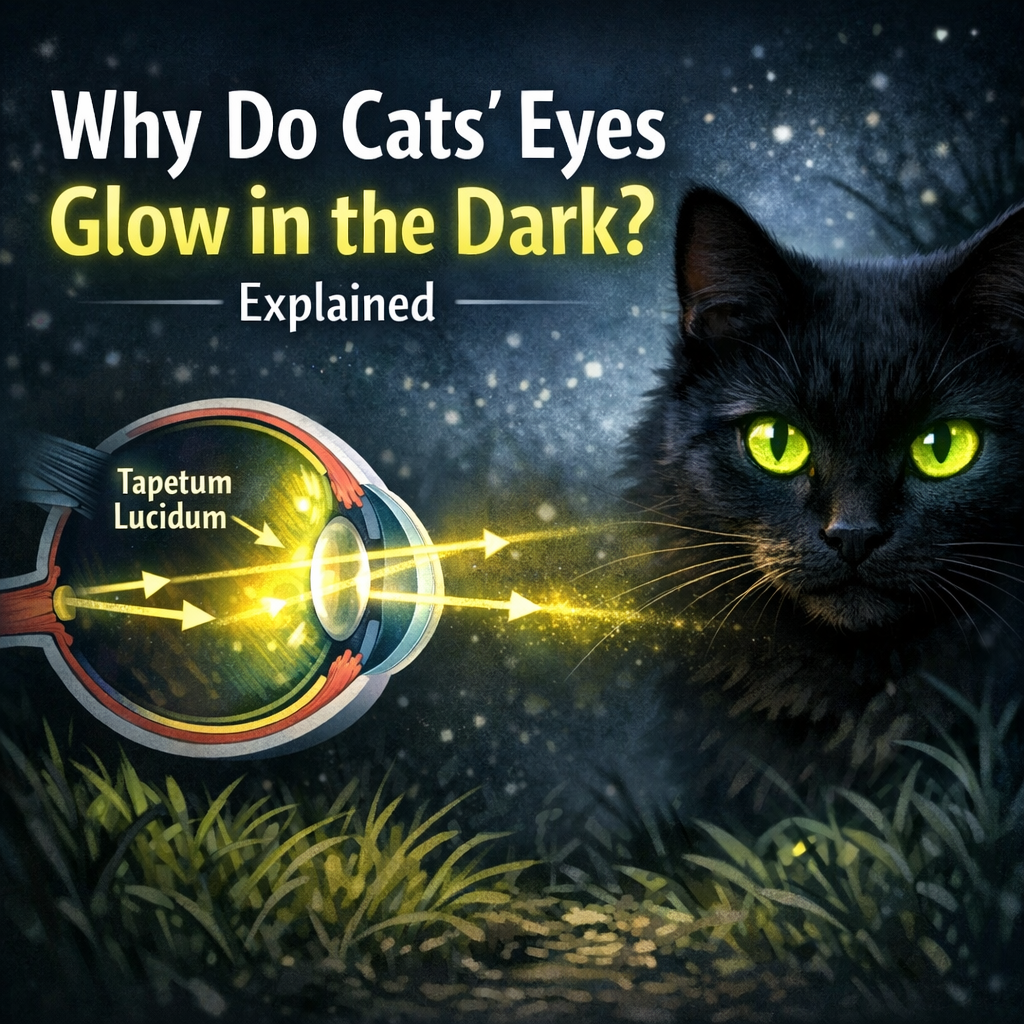
You are relaxing on the sofa when suddenly two luminous orbs peer at you from the hallway. It looks like a scene from a horror movie, but it is just your fluffy friend, whose eyes glow in the dark due to a special layer behind the retina called the tapetum lucidum. This fascinating adaptation reflects light, enhancing their night vision and making them excellent hunters in low-light conditions. Now, your cat is searching for a graphic of a black cat with glowing yellow eyes as a midnight snack.
Those glowing eyes have sparked legends for centuries. Ancient Egypt even believed cats held the sun inside their eyes after sunset to protect the world from darkness.
The truth is even more impressive than a myth. It is all about a specialized anatomical feature that turns your cat into a master of the night.
The Magic of the Tapetum Lucidum
The secret behind that eerie animal eyeshine, particularly in cats, lies in the fascinating role of the tapetum lucidum in cat vision, which involves a reflective layer known for its remarkable properties. This specialized structure, located directly behind the retina, acts like a high-performance mirror, significantly influencing the glow of cat eyes. By reflecting light that passes through the retina back into the eye, the tapetum lucidum enhances their ability to see in low light, thereby not only aiding their nocturnal vision but also giving those captivating eyes their distinctive luminescence that can mesmerize anyone who catches a glimpse.
When light enters the eye, it first passes through the photoreceptor cells. In humans, any light not absorbed is simply lost, which can limit night vision. In domestic cats, however, the concept of light reflection significantly enhances their vision; the tapetum lucidum bounces that light back for a second chance at detection, allowing them to see better in low light conditions. This remarkable adaptation illustrates how light reflection plays a crucial role in animal vision, especially in species adapted to hunting in the dark.
This incredible biological retroreflector allows cats to reflect about 130 times more light than the human fundus. This is why you see a brilliant, iridescent tapetum glow on TikTok or Instagram videos of your pets.
Anatomical Adaptations for Low Light Vision
Cat eyes are built for the hunt, with adaptations for low-light vision that enhance their prowess during dusk and dawn. Their eye anatomy includes larger corneas and pupils that are roughly 50 percent larger relative to their eye size than those of a human. This unique design allows more light to enter and improves their ability to see in dim conditions, making them formidable nocturnal predators.
Understanding the feline retina reveals that inside this remarkable structure, cats possess a much higher concentration of rod photoreceptor cells. In fact, they have six to eight times more rods than we do, which significantly enhances their sensitivity to motion and ambient light, enabling them to navigate their environments with exceptional skill.
This combination of a wide aperture and a massive rod count ensures that even the smallest amount of visible light is amplified. It is a masterpiece of animal adaptation that keeps them agile in a low light environment.
Evolutionary Advantages and Hunting Prowess
Whether it is a house cat or wild cats like those in the Panthera genus, this glowing effect is a sign of a predator. This trait evolved to support crepuscular behavior, meaning cats are most active at dawn and dusk, which coincide with low light environments that enhance their hunting skills. The impact of such dim settings influences not just their activity levels but also their overall behavior, as they adapt to thrive in conditions where their enhanced night vision gives them an advantage.
The tapetum lucidum provides a massive boost to night vision, allowing for legendary leopard hunting and tiger vision. While we stumble in the dark, cats use this reflected light to calculate distance and strike with precision.
This superior low light vision, a result of various adaptations of nocturnal animals for low light conditions, is why they have such a distinct advantage. Their ability to see in one sixth of the light level required by humans makes them the ultimate shadow dwellers, perfectly evolved to thrive in darkness.
Cats vs. Humans: A Vision Comparison
In a comparative analysis of cat and human vision, especially regarding night vision capabilities, the results are decidedly one-sided. Humans lack a tapetum lucidum entirely, which is why our eyes only show a dull red reflection in photos, while cats benefit from this reflective layer, enhancing their ability to see in low light conditions. Despite common misconceptions about cat vision suggesting that they can see in total darkness, the reality is that they are simply much more adept at seeing in dim light compared to humans.
While humans excel at seeing vibrant colors in bright daylight, cats sacrifice color detail for light sensitivity. Their retinas are packed with rods rather than the cones needed for a full color spectrum.
This trade off is what gives them their edge. While you are reaching for a flashlight, your cat is already halfway across the room, guided by the faint glow of the moon and their built in night vision goggles.
From Ancient Egypt to Modern Technology
The fascination with cat eyes has moved from the temples of Ancient Egypt to modern scientific research, where wildlife cameras play a crucial role in studying these captivating creatures. These cameras now capture intricate details of cat behavior in stunning clarity, providing invaluable insights for YouTube videos and educational documentaries.
Humans have even mimicked this biology to stay safe. Percy Shaw, an inventor from Yorkshire, England, was inspired by cat eyes to create the retroreflective road studs used worldwide today.
Whether you are admiring your cat’s glowing eyes in a dark hallway or wearing apparel featuring a feline design, you are celebrating one of nature’s coolest optical tricks that has inspired modern technology. The unique structure of cat eyes, allowing for exceptional night vision, has sparked innovations in camera design and low-light imaging systems, proving that even the simplest wonders of nature can lead to remarkable advancements.
Anatomy of Feline Night Vision
Cats are built for the dark. Their eye anatomy is a masterpiece of evolution designed for hunting prowess in low light environments. While you might struggle to find your way at 2 AM, your cat is navigating the house with ease.
The secret to this feline superpower lies in the presence and function of the tapetum lucidum. This reflective layer sits behind the retina and bounces light back through the photoreceptor cells a second time. It reflects about 130 times more light than the human fundus, which explains why their eyes look like high powered flashlights in digital videos.
The mechanism of eye reflection and the glowing effect is purely biological physics. When ambient light enters the eye, it passes the retina and hits the iridescent tapetum, which acts as a retroreflector. This animal eyeshine is the same principle used by Percy Shaw when he invented the Catseye road studs in Yorkshire, England, to help drivers stay on the road at night.
Evolutionary Advantages of the Tapetum Lucidum
Why did nature give cats this eerie glow? The answer lies in their predatory roots. The evolutionary advantages of the tapetum lucidum allow domestic cats and their wild cousins, like those in the Panthera genus, to excel at hunting. This adaptation ensures they can detect the slightest twitch of a mouse in the grass.
Most cats exhibit crepuscular behavior, meaning they are most active during dawn and dusk. Because they hunt in these transition times, their eyes must maximize every bit of visible light available. This trait is shared by many nocturnal animals and is a primary focus for wildlife researchers who study animal behavior.
Beyond the reflective layer, cats have massive pupils that can become up to 50 percent larger than human pupils in dim settings. This anatomical adaptation for low light vision allows a flood of light to reach the retina. Their vertical slit pupils also provide a sharp depth of field, perfect for pouncing on a target.
Comparing Night Vision Capabilities Between Cats and Humans
When comparing night vision capabilities between cats and humans, humans have a clear disadvantage. Cats possess a high concentration of rod photoreceptor cells (roughly six to eight times more than humans). These rods are sensitive to low light and motion, while our eyes prioritize cone cells for vibrant color vision.
Data shows that cats can see in just 16 percent of the light that humans require to function. While we see a dark hallway, they see a bright landscape. To a cat, the world at night is a high contrast playground where they have the ultimate tactical advantage.
| Feature |
Domestic Cats |
Humans |
| Tapetum Lucidum |
Present (Highly Reflective) |
Absent |
| Rod Cells |
High Density (6 to 8 times more) |
Lower Density |
| Pupil Expansion |
Up to 50% larger |
Standard expansion |
| Light Sensitivity |
Sees in 16% of light we need |
Poor low light vision |
Whether you are watching a documentary or looking at ancient Egyptian art, it is clear we have always been fascinated by these glowing orbs. From the streets of England to the temples of the Nile, the cat eye remains one of the most successful designs in the natural world.
So, the next time you see those luminous eyes reflecting the glow of your smartphone or computer screen, remember you are looking at a biological retroreflector. It is peak feline engineering at work.
Frequently Asked Questions About Glowing Cat Eyes
Do cats see in total darkness?
No, cats cannot see in 100 percent darkness. While they are masters of a low light environment, they still require at least a small amount of ambient light to navigate.
The tapetum lucidum acts as a retroreflector, bouncing existing light back through the retina. In a room with zero visible light, your cat is just as blind as you are.
However, their crepuscular behavior means they only need about one sixth of the light humans require to see clearly, making them elite hunters at dawn and dusk.
Why do my cat’s eyes look green on social media?
When you record a video using a flash, the light hits the reflective layer behind the retina directly. This creates the bright animal eyeshine seen on camera.
This iridescent tapetum reflects the light back out through the pupil, usually appearing as a vivid green or gold glow in most domestic cats.
Wildlife cameras often capture this same effect in wild cats like a tiger or leopard, highlighting their specialized eye anatomy for hunting prowess in the dark.
Is it bad if my cat’s eyes stop glowing?
If you notice a sudden change in how your cat’s eyes reflect light, it could indicate a health issue. A dim or missing glow might suggest a problem with the retina or the tapetum lucidum itself.
Conditions like cataracts or retinal degeneration can block the light from reaching the reflective layer. You should consult a vet if the glow disappears, looks cloudy, or changes significantly.
Maintaining your cat’s eye health ensures they keep that supernatural night vision and the signature sparkle that makes them so unique.
What makes cat eyes different from human eyes?
The biggest difference is the presence of the tapetum lucidum, which humans lack. Cats also have a much higher concentration of rod photoreceptor cells, roughly six to eight times more than we do.
These rods are the photoreceptor cells responsible for detecting light and motion. While humans have better color vision and detail in bright light, cats dominate in low light vision.
Additionally, cats have larger corneas and pupils that can dilate up to 50 percent larger than ours, allowing every bit of available light to hit the back of the eye.
How has cat eye anatomy inspired human technology?
The way a cat’s eye reflects light inspired Percy Shaw to invent the Catseye road stud in Yorkshire, England. These reflectors help drivers see the road layout in the dark by mirroring car headlights.
This animal adaptation has also influenced modern optics and wildlife observation tools. Scientists study the iridescent tapetum to improve low light imaging and camera sensors.
From Ancient Egypt to modern digital searches, the mystery of the glowing cat eye continues to fascinate—and if you’re curious about other eerie cat behaviors, check out Why Cats Stare at Nothing: Super Senses or Health Warning?—and if you enjoyed this, you might also like Can Cats See in Total Darkness? Myths vs. Facts. and push the boundaries of human innovation.