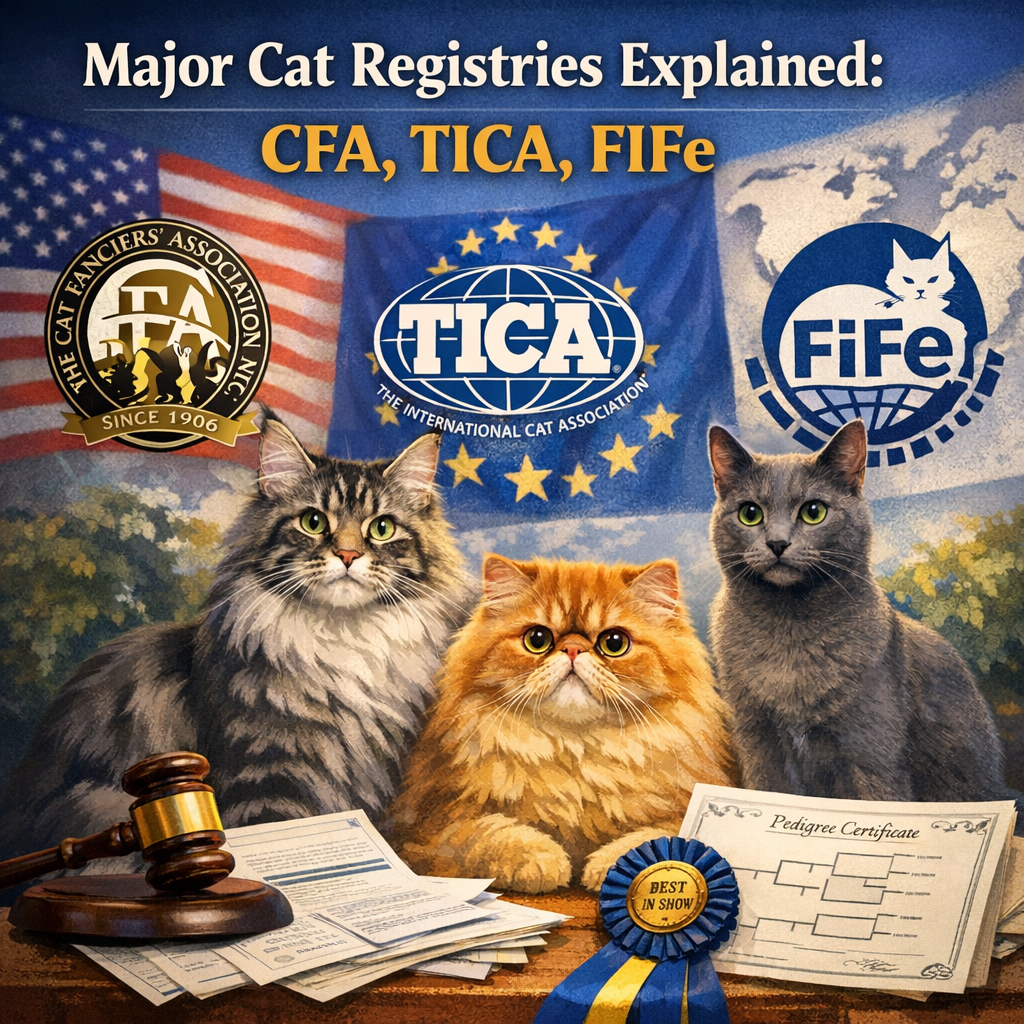
- CFA, TICA, and FIFe are major cat registries with distinct histories, scopes, and breed standards that influence how cats are recognized, shown, and bred.
- Registration involves ownership proof, pedigrees, transfers, and region-specific rules; cross-registration is common for broader show opportunities and lineage visibility.
- Practical guidance covers choosing the right registry, maintaining meticulous records, handling show eligibility, and avoiding registration pitfalls.
Table of Contents
If you’re thinking about pedigree, breed types, or even just understanding how cat clubs work, you’ll want a quick read on the big three registries. And if you’re also curious about one of the most common “looks” you’ll see discussed in breed circles, check out 15 Fun Facts About Orange Tabby Cats for a quick, just-for-fun detour on color patterns and popularity. And while you’re sorting out paperwork and standards, it’s also worth bookmarking Ghosting Your Vet? Microchip Mistakes Kitten Owners Make so you don’t miss the everyday ID details that matter just as much as registration. CFA, TICA, and FIFe shape what breeders aim for and what you should expect as a prospective owner or admirer.
How they classify and recognize breeds
Each registry has its own criteria for recognizing a breed, but they share the goal of standardizing appearance, temperament, and health traits so a breed is consistently identifiable across regions. If you want the baseline definitions first, read What Is a Cat Breed? Definitions and Classifications.
Here’s how they typically approach it:
- Standard development: Breeds are described with detailed breed standards, covering coat, color, body type, and movement.
- Trial and documentation: Breeders submit breed proposals, examples, and often health and temperament data before a breed earns recognition.
- Regional emphasis: Some registries focus more on certain regions or lines, which can influence how widely a breed is recognized.
Criteria and standards in practice
When a breed is evaluated, you’ll typically see convergence on a few core elements that registries emphasize to ensure consistency across regions.
- Conformational criteria: Physical attributes such as body proportions, coat type, and facial structure that define the breed’s typical silhouette.
- Genetic health considerations: Mandatory health testing and guidelines on breeding practices to minimize hereditary risks.
- Temperament notes: Descriptions of expected behavior and suitability for homes, shows, and handling during judging.
- Documentation needs: Pedigrees, transfer records, and lineage details are commonly required for official recognition and show eligibility.
What ownership should know about pedigree
Pedigree information matters beyond show circles. It informs care, breeding decisions, and health planning (see Cat Health Basics: Essential Care All Cats Need for a practical checklist of core care—and Ghosting Your Vet? Microchip Mistakes Kitten Owners Make to avoid common ID and record-keeping slips).
- Verification: Registries track lineage to prevent misattribution and protect breed integrity.
- Health history: A clear pedigree helps identify inherited risks and guides proactive care.
- Show eligibility: Many events require documented pedigrees to compete or be listed as a breed.
- Breeding decisions: Registries provide standards that guide responsible breeding and help avoid close inbreeding.
Want to understand how a breed fits your home? Review each registry’s recognition progress on their sites and talk with breeders who regularly work with the registry you’re considering.
Introduction
What readers will learn about major cat registries
You’ll get a clear, side by side look at CFA, TICA, and FIFe. We’ll break down each group’s history, scope, and how they judge and recognize breeds. Expect plain language on what counts as a recognized breed, how shows work, and what you need to register a cat or kitten.
Why cat enthusiasts and breeders care about registrations
Registrations are more than paperwork. They impact lineage, show eligibility, and breeding decisions. A solid registry history can add pedigree credibility, influence perceived value, and guide owners through cross border moves and partnerships.
In this section, you’ll see:
- The core purpose of each registry
- How breed standards are set and updated
- What ownership should expect when pursuing registration
Expert Insight
“Registrations shape more than paperwork: they determine lineage credibility, show eligibility, and guide breeders and owners through cross-border journeys by aligning standards, history, and recognition across major registries.” , Industry Analyst
1. The Cat Fanciers’ Association (CFA)
Overview and history
The CFA stands as one of the oldest cat registries, rooted in a network of regional clubs that evolved into a nationwide authority on breed standards and show organization. It maintains a long-standing influence across North America, formalizing breed definitions and judging criteria.
Registry purpose and breed standards
CFA keeps a catalog of officially recognized breeds and updates standards through expert committees. Standards describe the ideal physical attributes, temperament, and breed-type characteristics, with an emphasis on consistent conformation and movement in licensed shows.
Domestic vs. pedigree cats
CFA differentiates between general pet cats and those with documented bloodlines. Domestic cats can show in certain classes, but full pedigree recognition requires proper registration and transfer of ownership records. Pedigree cats carry lineage information that CFA records across generations.
Key requirements for registration and documentation
- Proof of ownership or breeder declaration for the cat or kitten
- Completed registration application with individual cat details
- Registration fees and a unique registration number
- Pedigree or lineage documents when applying for certain categories
- Transfer of ownership upon resale or relocation
2. The International Cat Association (TICA)
Overview and history
TICA operates as a global registry with a strong emphasis on international participation and broad breed coverage. It supports pedigree documentation and event organization across borders, helping breeders track lineage and maintain show eligibility.
Registry scope and breed recognition
The association recognizes a wide range of breeds, including many newer and international varieties. Standards cover appearance, temperament, and overall breed type, with updates that reflect evolving trends and member input. Experimental or new breed proposals are often welcomed alongside established categories.
Show eligibility and judging criteria
Shows follow a structured judging system focused on breed ideals, movement, and presentation. Eligibility hinges on current registration status, proof of ownership, and adherence to show rules. Judges compare conformation to standardized criteria and note necessary allowances or disqualifications.
Registration process and records management
Registration typically involves submitting owner details, pedigrees, and applicable fees. TICA maintains digital records for easy access, transfers, and cross-registration checks. Accurate documentation supports lineage tracing and future show eligibility.
Expert Insight
“Standards guide appearance, temperament, and overall breed type, with updates that reflect evolving breeds and community input.” , Industry Analyst
3. Fédération Internationale Feline (FIFe)
Overview and history
FIFe functions as a federation of national clubs that harmonizes breed criteria across member organizations. It unifies breed definitions while allowing regional associations to handle local governance. The federation coordinates breed development through its committees and member clubs.
European focus and global reach
The FIFe network reflects its European cat fancier heritage, with numerous member clubs across the continent. It also welcomes clubs from outside Europe and supports cross-border registrations, exchanges, and show participation among international exhibitors.
Breed standards and official ranking
FIFe publishes comprehensive breed standards covering anatomy, movement, coat, color, and temperament. Technical commissions update standards to reflect breed evolution. Official rankings assess conformational quality at approved shows and contribute to titles within the FIFe framework.
Cross-border registration and cooperation among clubs
Cross-border processes enable cats registered in one country to be recognized by FIFe member clubs elsewhere. Cooperative rules govern pedigrees, transfers, and the sharing of lineage data, supporting international breeding networks while preserving breed integrity across regions.
Expert Insight
“FIFe harmonizes European breeding traditions with a global network, ensuring cross-border registration and cooperative pedigree sharing while maintaining breed standards and transparent rankings across approved shows.” , Industry Analyst
4. Comparing Core Standards Across CFA, TICA, and FIFe
Breed recognition differences
Registries differ in which breeds they officially recognize and how they classify new varieties. CFA maintains a traditional core set with periodic updates. TICA tends to add newer or experimental breeds and invites broader global input. FIFe operates as a federation with input from member clubs, aiming for standardized definitions across regions.
Show formats and judging styles
Judging reflects each registry’s culture. CFA emphasizes conformance to breed ideals and movement within structured classes. TICA highlights detailed breed standards at shows and periodically updates judging sheets. FIFe uses commission driven standards with ranked titles and a European show circuit aligned to its criteria.
Registration requirements and fees
Requirements vary by stage. CFA generally requires proof of ownership, transfer records, and pedigree documentation. TICA handles ownership details, pedigrees, and show eligibility with digital records. FIFe coordinates cross border registrations through member clubs, with regional fees and transfers governed by federation rules.
Impact on breeding programs and pedigrees
Breeders plan around the standards and lineage tracking of their chosen registry. CFA emphasizes long standing breed identities and documented lineages. TICA supports broader genetic exploration with a wider breed list. FIFe links breeding activity to cross border cooperation and standardized pedigrees across countries.
| Aspect |
CFA |
TICA |
FIFe |
| Breed recognition |
Traditional set; updates slower |
Wide, includes new varieties |
Standardized across member clubs |
| Show format |
Conformation focused |
Breed standards emphasized |
Commission driven, title based |
| Registration flow |
Ownership, transfer, pedigree |
Ownership, pedigree, digital records |
Cross border registration via clubs |
| Breeding impact |
Established lineages |
Broader breed exploration |
International pedigree coherence |
5. Practical Considerations for Cat Breeders and Owners
Choosing the right registry for your cat
Your choice shapes breed recognition, show eligibility, and pedigree traceability. Start by aligning registry standards with your breeding goals and the breed profiles you work with. Consider how active the registry is in your region and whether its member clubs support the shows you plan to attend.
How registrations affect pet ownership and breeding rights
<pRegistration status can influence eligibility for breeding programs, transfers, and ownership documentation. Some registries require evidence of lineage or adherence to health and welfare guidelines to permit breed specific matings. Understand transfer rules and how a name and number attach to your cat's official record.
Documentation best practices for buyers
- Keep a centralized file with pedigree papers, transfer receipts, and health certificates.
- Record all show results and judge comments linked to the cat’s registry number.
- When selling, provide a clear history of registrations across participating registries.
Impact on show opportunities and prestige
Registration choice directly affects which shows you can enter and how a cat is classified. Some registries emphasize international shows or certain title ladders, which can signal the strength of a line. Maintaining consistent records helps preserve lineage credibility over time.
6. Registration Etiquette and Common Pitfalls
Common mistakes in applying for registrations
Begin with precise records. Double-check ownership details, ensure names match across documents, and confirm litter or lineage information before submission. Incomplete transfer proofs or missing health certificates can delay or derail approvals.
Managing multiple registrations for a single lineage
Maintain a clear system for CFA, TICA, and FIFe records. Assign distinct registry numbers to each cat and keep cross-reference notes. Notify clubs promptly if a name changes or a transfer occurs to avoid mix ups.
Maintaining accurate records over time
Record keeping is ongoing. Update registrations after shows, transfers, or breeding plans. Save digital copies securely and retain physical backups of key certificates and transfer receipts.
Dealing with discrepancies and disputes
Discrepancies in identity or lineage can arise. Gather supporting documents, ask the registry clear, specific questions, and request written corrections. Log communications and resolutions to streamline future registrations.
FAQ
What is the purpose of registering a cat with a major registry? You gain an official pedigree, show eligibility, and access to standardized recordkeeping that helps verify lineage and transfer history.
Do CFA, TICA, and FIFe recognize the same breeds? Not always. Each registry maintains its own list of recognized breeds and may acknowledge newer varieties at different times.
Can a cat be registered with more than one registry? Yes, many breeders and owners hold registrations with multiple bodies. Cross registration allows broader show opportunities and pedigree visibility but requires careful record coordination.
What documents are typically required for registration? You generally need proof of ownership, transfer records, and for breeding cats, documentation of lineage and health certifications as mandated by the registry.
How do show eligibility rules differ among registries? Show eligibility is tied to breed recognition, standing in the registry’s pedigree records, and adherence to breed standards. Judging criteria align with each registry’s emphasis on conformation, breed type, or title ladders.
What should I do if there is a discrepancy in records? Gather all supporting documents, contact the registry with precise questions, and request a formal review or correction. Maintain a written trail of communications and resolutions.
Conclusion
Summary of key differences and practical takeaways
Choosing CFA, TICA, or FIFe shapes breed recognition, show eligibility, and pedigree management. Consider regional activity, show opportunities, and how each registry frames breed standards. CFA offers broad domestic reach with established lineage expectations. TICA prioritizes broad show eligibility across many breeds and evolving title ladders. FIFe centers on European participation and cross-border cooperation with a defined ranking system. Align your goals with the registry that matches where you plan to show and the pedigree visibility you want for your line. If you enjoyed this, you might also like The Ultimate Guide to Cat Breeds and Types for a broader look at breed categories and how they differ.
- Breed recognition can vary by registry, affecting which cats qualify for specific shows.
- Show formats and judging styles influence how your cats are assessed and how pedigrees are presented.
- Registration requirements and fees differ, so plan your record-keeping and budget accordingly.
Final recommendations for readers
Map your breeding objectives to registry strengths. If you want strong national presence, CFA may serve you well. For broad international exposure, consider TICA or FIFe depending on your target regions. Maintain unified records across registries to safeguard lineage credibility. If you want to round out the day-to-day side of ownership too, you might also like Nutrition for Cats: Diet, Feeding, and Life Stages. Stay proactive with transfers, health documentation, and cross-registry notes to minimize disputes and maximize show readiness. For a practical baseline to keep those records meaningful, revisit Cat Health Basics: Essential Care All Cats Need.