




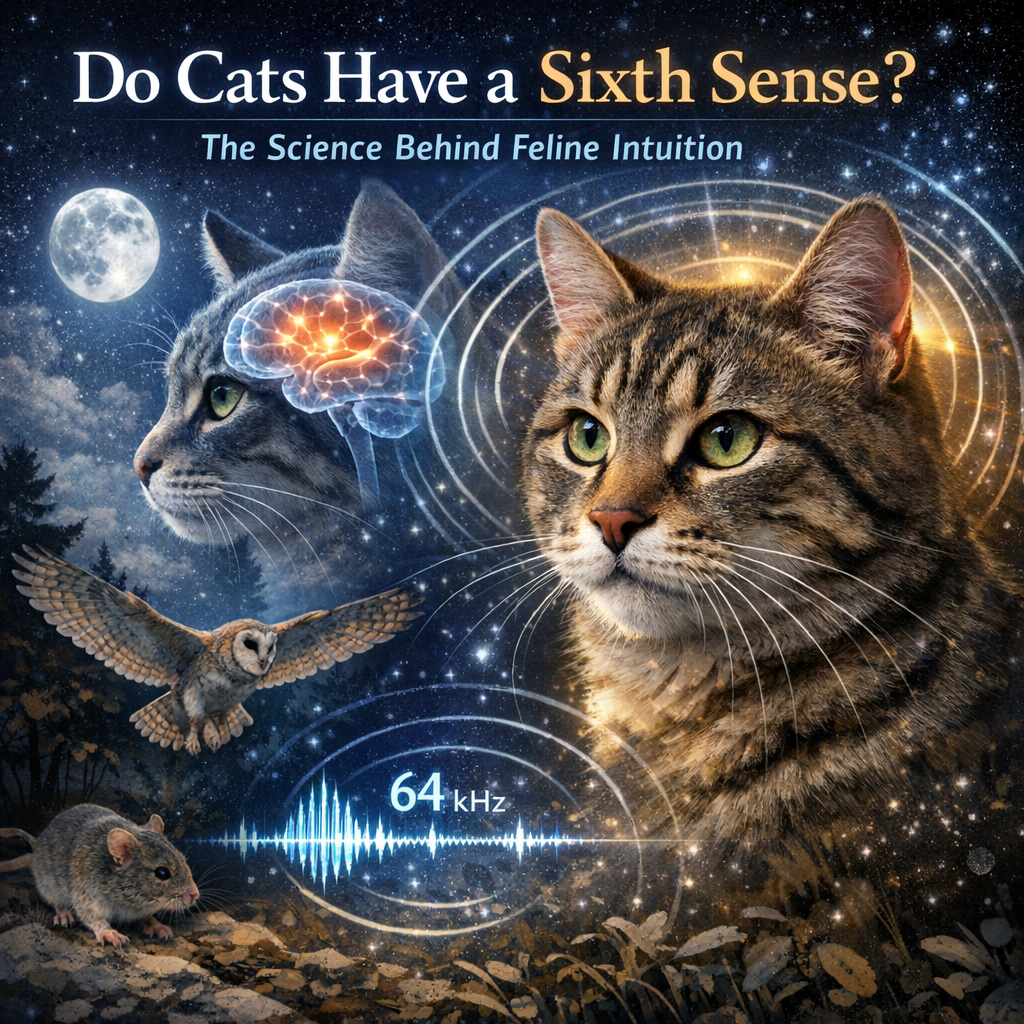
- Biological Superiority: What often appears as “Feline ESP” is actually a result of highly tuned biological hardware, including ultrasonic hearing (up to 64 kHz), night vision, and a sense of smell 40 times stronger than a human’s.
- Sensory Radar: A cat’s whiskers (vibrissae) act as a sophisticated radar system that detects minute changes in air currents, while their “proprioception” and inner ear provide a literal sixth sense for perfect balance and the famous righting reflex.
- Emotional and Health Intuition: Cats utilize pheromone communication and acute observation of body language to detect human emotions, stress, and even physical illnesses or metabolic changes before they are medically diagnosed.
- Evolutionary Survival: These “psychic” behaviors are evolutionary adaptations from their history as natural hunters, allowing them to remain hyper-aware of environmental shifts to avoid predators and stalk prey effectively.
Table of Contents
- Feline ESP and ExtraSensory Perception
- Evolutionary Adaptations for Intuition
- Keen Sensory Perception: Sight, Smell, and Hearing
- The Power of Cat Whiskers and Vibrissae
- Empathy in Cats: Detecting Human Emotions and Pheromones
- Predicting Health Issues and Detecting Illness
- Proprioception and the Righting Reflex
- The Mystery of Negative Energy Perception
- Feline ESP and ExtraSensory Perception
- Evolutionary Adaptations for Intuition
- Keen Sensory Perception: Sight, Smell, and Hearing
- The Power of Cat Whiskers and Vibrissae
- Detection of Human Emotions and Pheromones
- Cats’ Ability to Predict Illness or Physical Changes
- Body Language and Behavioral Cues
- Proprioception and Balance as a Sixth Sense
- Righting Reflex and Gravity Defying Abilities
- Evolutionary Adaptations for Intuition
- Keen Sensory Perception: Sight, Smell, Hearing, and Touch
- Ultrasonic Sound Detection and High Frequency Hearing
- Vibrissae Sensory Function and Nerve Endings
- Detection of Human Emotions and Pheromones
- Cats’ Ability to Predict Illness or Physical Changes
- Body Language and Behavioral Cues
- Proprioception and Balance as a Sixth Sense
- Righting Reflex and Gravity Defying Abilities
- Keen Sensory Perception: Sight, Smell, and Hearing
- Detection of Human Emotions and Pheromones
- Cats’ Ability to Predict Illness or Physical Changes
- Proprioception and Balance as a Sixth Sense
- Cats’ Ability to Predict Illness or Physical Changes
- Body Language and Behavioral Cues
- Proprioception and Balance as a Sixth Sense
- Righting Reflex and Gravity Defying Abilities
- Detection of Human Emotions and Pheromones
- Evolutionary Adaptations for Intuition
- Proprioception and Balance as a Sixth Sense
- Righting Reflex and Gravity Defying Abilities
- Evolutionary Adaptations for Intuition
- Scientific Exploration into Feline Intuition
- Righting Reflex and Gravity Defying Abilities
- Evolutionary Adaptations for Intuition
- Keen Sensory Perception: Sight, Smell, and Hearing
- Detection of Human Emotions and Pheromones
- Predicting Health Issues and Physical Changes
- Comparing Feline and Human Senses
- Evolutionary Adaptations for Intuition
- High Frequency Hearing and Ultrasonic Sound Detection
- Vibrissae Sensory Function and Nerve Endings
- Proprioception and Balance as a Sixth Sense
- Detecting Human Emotions and Pheromones
- Interspecies Empathy and Predicting Health Issues
- Cat Body Language and Feline Communication
- Senior Cat Wellness and Cognitive Changes
- The Role of Whiskers and Vibrissae Sensory Function
- Evolutionary Adaptations for Intuition and Hunting
- Proprioception and Balance as a Sixth Sense
- Righting Reflex and Gravity Defying Abilities
- Keen Sensory Perception: Sight, Smell, and Hearing
- Detection of Human Emotions and Physical Changes
- Cats’ Ability to Predict Illness or Health Issues
- Senior Cat Wellness and Biological Intuition
- Frequently Asked Questions About Feline ESP and Intuition
- The Final Verdict on Feline Intuition
You have seen it before. Your cat stares at a blank wall or bolts from the room seconds before your phone rings. It feels like they are tuned into a frequency you simply cannot hear.
Is it magic? Or is it just high performance biology? At Bella Gatti US Shop, we love the mystery of our feline friends. Whether they are acting like tiny psychics or just being weird, their intuition is legendary.
Let us dive into the science of Feline ESP and see why your favorite predator is basically a living, breathing radar system. From their evolutionary history to their role as natural hunters, there is a lot to unpack.
Feline ESP and Extra Sensory Perception
At Kyoto University in Japan, scientists have studied how feline instincts allow cats to predict the location of objects. This biological “sixth sense” makes them masters of their environment and expert stalkers of prey.
Evolutionary Adaptations for Intuition
The cat sixth sense is not a lucky accident. It is the result of millions of years of evolutionary history. As natural hunters, cats had to be one step ahead of both their lunch and their enemies.
These evolutionary hunting instincts allowed their ancestors to survive in the wild. Today, your house cat uses those same skills to know exactly when you are about to open a can of tuna from three rooms away.
Their ability to detect subtle environmental changes is a survival mechanism. This legacy of avoiding predators ensures that even a pampered indoor cat stays alert to every creak and shadow in your home.
Keen Sensory Perception: Sight, Smell, and Hearing
Cats are equipped with high frequency hearing that far exceeds our own, a testament to the science behind cats’ heightened senses. They can detect ultrasonic sound detection levels, allowing them to hear the tiny squeaks of rodents or the hum of electronic devices, showcasing their remarkable auditory capability that has evolved to enhance their hunting skills.
Their vision is equally impressive. While they may not see colors like we do, their night vision is optimized for low light. This allows them to see movements in the dark that seem like ghosts to us.
Combine this with an elite sense of smell and olfactory sensitivity, and you have a creature that lives in a world of data. They use pheromone communication to understand the social dynamics and territory marking of other animals.
The Power of Cat Whiskers and Vibrissae
A cat’s whiskers, or vibrissae, are not just cute hairs. They are highly sensitive tactile organs packed with nerve endings. These vibrissae sensory function as a specialized radar system for the cat.
Whiskers can detect minute changes in air currents. This helps cats navigate in total darkness and judge the distance of nearby objects without even touching them. It is a vital part of their cat behavior and hunting strategy.
By sensing these vibrations, cats can “feel” the world around them. This tactile feedback is why they can move through a cluttered room at high speeds without knocking over your favorite Bella Gatti US Shop mug.
Empathy in Cats: Detecting Human Emotions and Pheromones
Have you ever noticed your cat cuddling up right when you feel sad? This is not a coincidence; it is interspecies empathy. Cats are highly tuned into human body language and feline communication cues.
They can differentiate between human emotional expressions and recognize their owner’s voice. This emotional intelligence in animals allows them to sense when you are stressed, likely by detecting chemical signals like pheromones.
This cat empathy creates deep emotional bonds. Whether they are sensing fear or joy, your cat is often more aware of your mood than your human roommates are. They are masters of reading the room.
Predicting Health Issues and Detecting Illness
There is significant anecdotal evidence suggesting cats can predict health issues. Some cats have been known to alert owners to physical changes or illnesses before a medical diagnosis is ever made.
This feline health prediction likely stems from their superior sense of smell. They may notice subtle changes in body odor caused by chemical shifts in a sick person. It is a form of biological intuition that feels like a miracle.
From Senior Cat Wellness to detecting a sudden fever, cats are often the first to know when something is wrong. Organizations like Pettsie and various creators often share stories of these incredible life saving behaviors.
Proprioception and the Righting Reflex
Cats possess an exceptional proprioceptive ability. This is the internal sense of their own body position and movement. It is what gives them such incredible balance and spatial awareness.
The famous righting reflex allows a cat to almost always land on their feet. This gravity defying ability is a complex interaction between their inner ear and their flexible spine, ensuring they land safely from falls.
This sense of balance is often considered a literal sixth sense. It allows them to navigate complex environments and perform precise movements that seem to defy the laws of physics during active hunting behavior.
The Mystery of Negative Energy Perception
Many owners believe their cats are capable of negative energy perception. While science focuses on ultrasonic hearing and pheromones, many people feel cats react to “bad vibes” or environmental tension.
Whether it is a change in the static electricity of the air or a reaction to subtle behavioral responses, cats are sensitive to routine and environmental changes. They thrive on stability and notice when the energy shifts.
At the end of the day, whether it is science or a bit of feline magic, cats are extraordinary. You can find more stories of these amazing creatures on sites like CatCurio Pet Store or by searching for the latest feline research.
Expert Insight
“Cats understand many things as well as dogs do, but they are more cautious in their behavior, where recent research shows that they are able to recognize their owners through body odor alone.”, Hidehiko Uchiyama, Professor of Animal Science at Tokyo University of Agriculture
Feline ESP and ExtraSensory Perception
Many owners swear their pets possess feline ESP. While it sounds like a plot from a science fiction movie, there is a deep scientific plausibility to these claims. Cats are not necessarily reading your mind, but they are reading the world through extrasensory perception that humans simply cannot access.
This cat sixth sense is actually a result of evolutionary hunting instincts. Their biological intuition allows them to pick up on subtle environmental cues. In reality, they are biological marvels with highly tuned hardware designed for survival.
Evolutionary Adaptations for Intuition
The evolutionary history of cats defines them as natural hunters. Their ancestors relied on keen feline instincts to track stalking prey while simultaneously avoiding predators. This constant state of high alert passed down traits that we now interpret as cat intuition.
According to research in the Animal Cognition Journal, these evolutionary adaptations mean cats are constantly scanning for changes. Whether it is a shift in air pressure or a tiny movement in the grass, their biological intuition is always active.
Keen Sensory Perception: Sight, Smell, and Hearing
Cats possess acute senses that dwarf our own. Their ultrasonic hearing allows for ultrasonic sound detection, catching frequencies far above the range of human ears. This is why your cat might bolt toward a “blank” wall; they likely hear a rodent scuttling behind the plaster.
Their sensory perception includes incredible night vision and a superior sense of smell. This olfactory sensitivity helps them navigate social dynamics and territory marking. At CatCurio Pet Store or Pettsie, you might find toys that stimulate these senses, but nothing beats their natural high frequency hearing.
The Power of Cat Whiskers and Vibrissae
Cat whiskers, or vibrissae, are not just cute hairs. They are sophisticated vibrissae sensory function tools packed with nerve endings. These allow cats to detect minute changes in air currents, helping them navigate in total darkness.
This tactile sensory perception acts as a radar system. It is part of the feline communication suite that tells a cat exactly where they are in relation to their surroundings. It is a key component of their evolutionary hunting instincts.
Detection of Human Emotions and Pheromones
Have you noticed your cat comforting you when you are sad? Kyoto University in Japan has conducted studies on animal cognition showing cats recognize human voices and cat body language. They are masters of interspecies empathy.
They likely use pheromone communication to sense emotional intelligence in animals. By detecting chemical signals like pheromones associated with stress or fear, they display a high level of cat empathy. This creates deep emotional bonds between you and your feline friend.
Cats’ Ability to Predict Illness or Physical Changes
There is significant anecdotal evidence regarding feline health prediction. Some cats are famous for detecting illness or predicting health issues before they become apparent to humans. This is often attributed to their olfactory sensitivity and ability to smell metabolic changes.
In the world of senior cat wellness, noticing a cat’s reaction to a person can be a clue. They may sense negative energy perception, which is often just a reaction to a change in a person’s scent or cat body language. This makes them appear to have extrasensory perception regarding human health.
Body Language and Behavioral Cues
Cat behavior is a complex language of twitches and stares. They are experts at interpreting cat body language in humans, responding to our moods and environmental sensitivity. If you are tense, your cat knows it before you say a word.
This feline communication is a two way street. By watching their behavioral responses during routine and environmental changes, we can learn a lot about our own homes. Their environmental sensitivity makes them the ultimate mood ring for your living room.
Proprioception and Balance as a Sixth Sense
Cats have an exceptional proprioceptive ability. This is the biological intuition of knowing where their limbs are in space. It allows them to navigate complex environments and narrow ledges with uncanny accuracy.
This sense of proprioception is what makes them such natural hunters. Whether they are on a curated cat tree or a high shelf, their sensory perception keeps them perfectly balanced. It is a physical manifestation of their cat sixth sense.
Righting Reflex and Gravity Defying Abilities
The famous righting reflex allows cats to almost always land on their feet. This is a biological intuition linked to their inner ear and proprioception. It is a gravity defying skill that reinforces their evolutionary hunting instincts.
This reflex is a vital part of feline instincts for avoiding predators and surviving falls. It is another example of how their acute senses and biological intuition work together to create what we call a cat sixth sense. Whether they are stalking prey or just playing, their righting reflex is always on standby.
Expert Insight
“Cats have a super power sense called proprioception, a multi-component feedback system that allows them to precisely judge distances and make rapid adjustments to their body position, even in the midst of a fall.”, Mark Vette, Animal Behaviourist
Evolutionary Adaptations for Intuition
The evolutionary history of cats is a masterclass in survival. Your living room lion is a direct descendant of natural hunters who survived on a knife edge where every rustle in the grass was a matter of life or death.
These evolutionary hunting instincts were passed down through generations. When your cat seems to have a sixth sense for danger, they are simply using biological intuition to process threats before you even notice a shift in the room.
This negative energy perception is rarely about ghosts. It is actually their brain reacting to minute environmental changes that triggered a survival response in their ancestors millions of years ago.
Keen Sensory Perception: Sight, Smell, Hearing, and Touch
What we call cat intuition is often just high performance biology. Cats possess acute senses that make human perception look like it is stuck in slow motion.
Their sensory perception includes night vision that can see in near total darkness and a sense of smell far superior to ours. This allows them to detect chemical changes in the air that we completely miss.
They use these tools for stalking prey and avoiding predators with surgical precision. At Bella Gatti US Shop, we think this makes them the ultimate biological machines, even if they spend most of the day napping.
Ultrasonic Sound Detection and High Frequency Hearing
Have you ever seen your cat bolt from a deep sleep for no reason? They likely heard a sound from the neighbor’s house that you could never detect.
Cats are equipped with ultrasonic hearing, allowing them to pick up high frequency hearing ranges used by small rodents. This ultrasonic sound detection is a key part of their feline instincts.
While you are watching a movie or browsing online, your cat is monitoring a secret world of sound. Their ears can rotate 180 degrees to pinpoint the exact location of a noise with terrifying accuracy.
Vibrissae Sensory Function and Nerve Endings
Cat whiskers, or vibrissae, are not just cute hair. They are highly sensitive tactile organs packed with nerve endings that act like a personal radar system.
The vibrissae sensory function allows a cat to detect tiny changes in air currents. This helps them navigate tight spaces and sense the movement of nearby objects without even touching them.
This tactile feedback is so sophisticated that it helps them identify the size and shape of prey in the dark. It is one of the many reasons why feline communication with the physical world is so much deeper than our own.
Detection of Human Emotions and Pheromones
Research published in the Animal Cognition Journal suggests that cats are experts at reading human moods. They can differentiate between a smile and a frown by observing cat body language and facial cues.
Beyond sight, they use pheromone communication to sense your internal state. When you are stressed, your body releases chemicals that your cat can literally smell.
This biological connection creates deep emotional bonds. Whether it is through Kyoto University studies in Japan or observations from the CatCurio Pet Store, experts agree that cats are tuned into our emotional frequency.
Cats’ Ability to Predict Illness or Physical Changes
There are countless stories on blogs and Pettsie forums about cats predicting health issues. Some cats seem to know when an owner is sick before the symptoms even show up.
This feline health prediction is likely due to their ability to sense subtle changes in body odor or behavior. They are masters of detecting illness through their superior olfactory sensitivity.
While it feels like magic, it is actually a form of empathy in cats combined with intense observation. This cat empathy allows them to provide comfort exactly when their favorite human needs it most.
Body Language and Behavioral Cues
Feline communication is a complex language of tail flicks and ear positions. By watching your cat body language, you can see how they interpret the world around them.
Cats are constantly scanning for behavioral cues from their owners. They learn your routine and can predict when you are about to leave the house or head to the kitchen for a snack.
This level of social dynamics and territory marking makes them highly sensitive to any environmental changes. If you move a chair, your cat will be the first to notice and investigate.
Proprioception and Balance as a Sixth Sense
If you have ever seen a cat leap across a gap with zero hesitation, you have witnessed proprioception. This is the internal sense of where their body parts are in space.
This incredible balance allows them to navigate complex environments with ease. It is a biological intuition that helps them stay agile and safe from falls.
Whether they are climbing a bookshelf or a cat tree, their brain is constantly calculating distances. This spatial awareness is a vital part of their physical sixth sense.
Righting Reflex and Gravity Defying Abilities
The famous righting reflex is why cats almost always land on their feet. This is a complex physical adaptation involving their inner ear and flexible spine.
This ability is essential for any senior cat wellness plan as they age and need to stay mobile. It shows how their bodies are hardwired for gravity defying stunts and danger avoidance.
From the wild forests of their ancestors to your living room rug, these traits ensure the cat remains the most graceful hunter in the animal kingdom. At Bella Gatti US Shop, we celebrate that elegance with every design we create.
Keen Sensory Perception: Sight, Smell, and Hearing
A cat’s sensory perception is vastly superior to ours, acting like a suite of high tech sensors. Their acute senses are fine tuned for survival, allowing them to process environmental data that humans completely miss.
Take their night vision, for example. While we stumble in the dark, cats catch every flicker of movement. This biological intuition makes them appear psychic, but they are simply seeing the world in high definition.
Their olfactory sensitivity is equally mind blowing. Through complex pheromone communication, they can detect the neighbor’s dog or a change in the social dynamics of the street from inside your living room.
The Power of Ultrasonic Sound Detection
Cats possess high frequency hearing ranges that remain silent to the human ear. This ultrasonic sound detection allows them to hear the tiny squeaks of rodents or even the subtle hum of your home electronics.
If your cat stares at a blank wall, they aren’t seeing a ghost. They are likely tracking a bug or a mouse behind the drywall using their specialized auditory nerve endings to pinpoint the exact location of the sound.
This ability to hear what we cannot is a pillar of feline ESP. It is why they often bolt toward the door before a guest even pulls into the driveway, reacting to frequencies we haven’t registered yet.
Vibrissae Sensory Function: The Ultimate Touch
Your cat’s whiskers, or vibrissae, are not just cute facial hair. They are highly sensitive tactile organs rooted deep in the skin, packed with nerve endings that detect minute changes in air currents.
This vibrissae sensory function allows cats to navigate in total darkness without bumping into furniture. It provides them with a constant stream of data about their surroundings, contributing to their reputation for feline intuition.
By sensing shifts in air pressure, a cat can detect an approaching predator or a closing door. It is like having a personal radar system built right into their face, perfect for a natural hunter.
Proprioception and the Righting Reflex
Beyond the five standard senses, cats excel at proprioception. This is the internal sense of where their body parts are in relation to each other and the space around them, allowing for gravity defying acrobatics.
Their famous righting reflex is a result of this extreme spatial awareness. Research shows how cats use their inner ear to orient themselves mid air almost instantly.
This sense of balance ensures they almost always land on their feet. It is a biological masterpiece of evolution that helps them navigate complex environments with a level of accuracy that feels like a sixth sense.
Detection of Human Emotions and Health
Cats are experts at reading cat body language, but they are also surprisingly skilled at interspecies empathy. They can differentiate between human emotional expressions, recognizing when you are sad, happy, or stressed.
Studies from Kyoto University in Japan suggest that cats recognize their owner’s voice and can sense subtle chemical signals. This feline health prediction allows some cats to detect illness or physical changes before a person even feels symptoms.
Whether it is emotional intelligence in animals or simply detecting stress pheromones, your cat knows your mood. At Bella Gatti US Shop, we see this bond every day, which is why our apparel celebrates the deep connection between cats and their humans.
Evolutionary Hunting Instincts and Survival
The evolutionary history of the cat is defined by their role as natural hunters. To survive, they had to be masters of stalking prey while simultaneously avoiding predators that were much larger than them.
These evolutionary hunting instincts are hardwired into their DNA. When your cat reacts to “negative energy,” they might actually be sensing a subtle environmental change that triggered their ancient survival drive.
From senior cat wellness to the playful energy of a kitten, these instincts remain sharp. Even a pampered house cat uses these biological tools to stay one step ahead of everything in their kingdom.
Detection of Human Emotions and Pheromones
Have you ever noticed your cat suddenly decides to cuddle you right when you are feeling down? This is empathy in cats at work. They are masters of feline communication and can recognize their owner’s voice, mood, and even facial expressions with surprising accuracy.
Research from Kyoto University in Japan has explored how cats process human signals. These studies suggest that feline intuition is backed by a sophisticated understanding of their social companions. They are not just pets: they are tiny, furry mood rings that respond to your emotional intelligence in animals.
Cats likely rely on pheromone communication to read the room. When you are stressed or anxious, your body releases specific chemicals. Your cat detects these subtle changes through their olfactory sensitivity, showing a level of biological intuition that feels like a sixth sense.
Cats’ Ability to Predict Illness or Physical Changes
Beyond simple moods, many owners report their cats predicting health issues before a medical diagnosis is ever made. This phenomenon of detecting illness is likely tied to their acute senses. A change in a person’s scent or daily routine can trigger a protective response in a senior cat wellness check-in.
By noticing minute shifts in body odor or behavioral cues, cats demonstrate an incredible ability for interspecies empathy. Whether it is a drop in blood sugar or a brewing migraine, your cat’s feline instincts often pick up on the physical shift before you do.
This deep emotional bond allows them to act as early warning systems. While it might look like feline ESP, it is actually a combination of high-frequency hearing and a superior sense of smell working together to monitor your health status.
Proprioception and Balance as a Sixth Sense
If you have ever seen a cat twist mid-air to land perfectly, you have witnessed their exceptional proprioceptive ability. This is their internal sense of where their body parts are in relation to space and gravity. It is a vital part of their evolutionary hunting instincts.
Their righting reflex is a gravity defying ability that allows them to navigate complex environments with uncanny accuracy. This sense of balance is so precise that it functions like a specialized sensory perception, keeping them safe during high-speed chases or daring leaps.
At Bella Gatti US Shop, we celebrate these agile, intuitive creatures. Whether they are stalking prey in the garden or showing off their natural hunters’ grace, their physical intuition is just as impressive as their emotional intelligence. Just like a Unisex Soft Cotton Tee, a cat’s skills are perfectly tailored for every situation.
Expert Insight
“With an olfactory system far more sensitive than a human’s, cats can detect physiological and emotional changes, especially fear, long before they become noticeable to people, suggesting they understand our internal states through scent.”, Feline Behavioral Researchers
Cats’ Ability to Predict Illness or Physical Changes
There are countless stories regarding feline health prediction that sound like something straight out of a movie. Some cats seem to know when a person is sick long before a doctor makes a formal diagnosis. This isn’t magic, it is biological intuition at its finest.
By using their superior olfactory sensitivity, cats are capable of detecting illness through scent. When a human body undergoes a metabolic change due to disease, it often releases subtle chemical shifts. Your cat uses its acute senses to pick up on these changes in your body odor or pheromone communication.
Research published in the Animal Cognition Journal and studies from Kyoto University in Japan suggest that cats are far more observant than we previously thought. They are masters of tracking our daily routines and monitoring our physical health with alarming precision. In fact, sudden aggression is often caused by pain or illness.
This biological intuition is a remnant of their evolutionary history as natural hunters. In the wild, noticing a slight change in an animal’s scent or movement was the difference between a meal and a missed opportunity. Today, that same drive helps them form deep emotional bonds with their owners.
Whether they are sensing negative energy or simply reacting to a change in your pheromones, cats use their feline instincts to provide comfort. They are experts at recognizing when their favorite human is under the weather, often staying close to offer a purr-filled healing session.
At Bella Gatti US Shop, we find these stories of feline ESP fascinating. It makes you look at your fluffy roommate a little differently, doesn’t it? If your cat is acting like a tiny nurse, they might just be tuned into a frequency you haven’t noticed yet.
While your cat focuses on senior cat wellness and monitoring your health, you can focus on looking great. Our Unisex Soft Cotton Tee is the perfect way to celebrate the mysterious, intuitive nature of your favorite feline companion.
Body Language and Behavioral Cues
Cats are absolute experts at reading cat body language and yours too. They notice if your breathing rhythm changes or if you tensed your shoulder muscles before even you realize it. This interspecies empathy helps them react to your intentions with lightning speed.
If you are even thinking about getting up to find a snack, they see the micro movements in your legs. To you, it feels like cat intuition. To them, it is just watching a very slow and loud primate prepare to move.
Proprioception and Balance as a Sixth Sense
While we marvel at their feline ESP, cats possess a literal sixth sense called proprioception. This is their exceptional ability to sense their exact position and movement in space. It allows them to perform precise movements and navigate complex environments with uncanny accuracy.
This internal GPS is why your cat can walk along a thin curtain rod without a second thought. It is a level of spatial awareness that makes humans look clumsy by comparison. Their evolutionary hunting instincts have refined this sense to ensure they are always ready for action.
Righting Reflex and Gravity Defying Abilities
Have you ever watched a video of a cat twisting mid-air? That is the famous righting reflex. Cats almost always land on their feet thanks to a complex vestibular apparatus in their inner ear that acts as a biological leveling tool.
This skill is deeply linked to their sense of balance and spatial awareness. By reinforcing their intuitive adaptation to physics and danger avoidance, they seem to defy gravity. It is just another reason why feline communication with the physical world is so much more advanced than ours.
Detection of Human Emotions and Pheromones
Research published in the Animal Cognition Journal and studies from Kyoto University in Japan show that cats can differentiate human emotional expressions. They recognize their owner’s voice and can sense subtle chemical signals like pheromone communication.
When you are stressed or afraid, your body releases specific hormones. Your cat’s olfactory sensitivity picks up on these changes instantly. This emotional intelligence in animals is often mistaken for extrasensory perception, but it is actually biological intuition at its most impressive.
At Bella Gatti US Shop, we think this cat empathy is what makes them the perfect companions. Whether they are sensing negative energy perception or just want a lap to nap on, their social dynamics and territory marking are always fascinating to watch.
Evolutionary Adaptations for Intuition
The evolutionary history of cats reveals they were natural hunters long before they were internet stars. Their ancestors relied on keen feline instincts for hunting and survival. They passed down traits like acute senses and the ability to detect tiny environmental changes.
These evolutionary hunting instincts are why a senior cat wellness routine often includes monitoring how they react to their surroundings. Even as they age, their sensory perception remains a vital part of their identity. They are built to be stalking prey and avoiding predators at all times.
Whether you are browsing for a new Unisex Soft Cotton Tee or watching CatCurio Pet Store videos, it is clear that feline intuition is a mix of high-frequency hearing and ultrasonic sound detection. They aren’t just pets; they are high-performance biological machines.
Proprioception and Balance as a Sixth Sense
One of the most amazing feline traits is proprioception. This is their biological intuition to sense their position and movement in space. It is often called their true sixth sense because it functions beyond the standard five.
This system provides constant feedback to their brain. It allows them to navigate complex environments with uncanny accuracy. They know exactly where every paw is at all times, making them natural hunters that move like shadows.
This internal GPS is a result of their evolutionary history. Their ancestors needed extreme spatial awareness to survive. Today, this biological intuition helps your cat jump onto a narrow shelf without knocking over a single glass.
Righting Reflex and Gravity Defying Abilities
Have you ever noticed how cats almost always land on their feet? This is thanks to the righting reflex. It is a skill deeply linked to their sense of balance and spatial awareness. It is almost like they are defying the laws of physics.
This reflex starts in the inner ear. It tells the cat which way is up the moment they start to fall. This allows them to twist their flexible spine in midair. It is a key part of their evolutionary hunting instincts, allowing for safe landings during high speed chases.
At Bella Gatti US Shop, we see this grace every day. Whether they are stalking prey or just pouncing on a toy, their movement is a masterpiece of sensory perception. This ability to avoid danger is what makes them such successful predators.
Evolutionary Adaptations for Intuition
The feline ESP we see today is not just luck. It is a set of evolutionary adaptations for intuition. Cats evolved as solitary hunters. They had to be hyper aware of every rustle in the grass or shift in the wind.
Their acute senses were passed down through generations. This includes their high frequency hearing and their ability to detect subtle environmental changes. These traits were vital for avoiding predators and catching a meal in the wild.
This evolutionary history explains why your cat seems to have a sixth sense. They are hardwired to notice things we miss. From the smallest vibration to a change in air pressure, their biological intuition is always turned on.
Scientific Exploration into Feline Intuition
Researchers are constantly looking into the mystery of cat behavior. Studies in the Animal Cognition Journal and work at Kyoto University in Japan have explored how cats perceive the world. These studies often focus on feline communication and social intelligence.
The scientific community is fascinated by feline extrasensory perception. While we call it magic, experts look at things like ultrasonic sound detection and vibrissae sensory function. These physical tools allow cats to gather data that seems invisible to humans.
Videos often show cats reacting to things before they happen. While some call it negative energy perception, science points to their superior sensory perception. They are simply tuned into a different reality than we are.
Righting Reflex and Gravity Defying Abilities
The feline righting reflex is a true miracle of physics. This biological intuition allows your cat to twist their body mid air and land on their feet with stunning precision. It is a specialized survival skill that showcases their mastery over the physical world.
This gravity defying ability is deeply tied to their vibrissae sensory function and the vestibular apparatus in their inner ear. These systems act like a high tech internal compass, providing constant feedback on their orientation. This evolutionary history of agility ensures they can navigate high perches while avoiding predators or stalking prey.
By combining their acute senses with incredible flexibility, cats manage to survive falls that would be catastrophic for other animals. This environmental sensitivity is a core part of their feline instincts. They are built to handle the physical world with total grace and a bit of a “look at me” attitude.
At Bella Gatti US Shop, we appreciate this level of athletic perfection. Just like a cat sticking a landing from the top of a bookshelf, our Unisex Soft Cotton Tees are designed to look effortless and high quality. Whether your cat is a natural hunter or a professional napper, their biological intuition is always working behind the scenes.
Evolutionary Adaptations for Intuition
To understand feline ESP, you have to look at the evolutionary history of these natural hunters. Their ancestors relied on keen instincts to survive in the wild, passing down a toolkit of acute senses that feel like magic to us. This biological intuition is what makes them so successful at detecting subtle environmental changes.
These evolutionary adaptations allow cats to function as highly tuned sensors. From their ultrasonic hearing to their ability to detect pheromone communication, every part of their body is designed for awareness. This history of stalking prey and avoiding predators has turned them into masters of sensory perception.
This deep rooted cat intuition is why your feline friend seems to know things before they happen. It is not just luck; it is a legacy of survival. Their ability to read the room and react to unseen stimuli is a testament to their sophisticated evolutionary path.
Keen Sensory Perception: Sight, Smell, and Hearing
Cats possess a level of sensory perception that puts human abilities to shame. Their ultrasonic hearing allows them to pick up high frequency sounds that are completely silent to us. This makes them incredible at detecting the tiny rustle of a mouse or the hum of an electronic device.
Their vision is equally impressive, especially in low light. While they might not see colors as vibrantly as we do, their night vision and motion detection are elite. This allows them to track movement with a level of focus that supports their reputation as the ultimate natural hunters.
Don’t forget their olfactory sensitivity. A cat’s sense of smell is far superior to ours, allowing them to interpret complex social dynamics and territory marking through scent alone. This combination of sight, smell, and hearing creates a detailed map of the world that feels like a sixth sense.
Detection of Human Emotions and Pheromones
Research into animal cognition and emotional intelligence in animals shows that cats are highly sensitive to their owners. They can differentiate between various human emotional expressions and recognize the specific tone of your voice. This cat empathy allows them to form deep emotional bonds with their human families.
Beyond just watching your face, cats may be sensing subtle chemical signals. They can likely detect pheromones associated with stress, fear, or sadness. This ability to pick up on internal changes makes them excellent at detecting illness or providing comfort when you feel down.
This interspecies empathy is why your cat might suddenly become extra cuddly when you are having a bad day. They are not just guessing; they are reading your biological and behavioral cues. It is a beautiful display of feline communication and social connection.
Predicting Health Issues and Physical Changes
There are countless stories of cats predicting health issues or physical changes in their owners long before a doctor does. This feline health prediction is likely a result of their heightened senses detecting minute changes in body odor or behavior. They notice the things we are too busy to see.
Senior cat wellness often depends on this same sensitivity. Cats are masters at hiding their own pain, but they are incredibly observant of yours. Whether it is a change in blood sugar or a shift in heart rate, their biological intuition keeps them tuned into your physical state.
This ability to sense “negative energy” or physical distress is a major part of the mystery surrounding feline ESP. While science continues to explore these behaviors, many owners swear by their cat’s ability to act as a living, purring early warning system.
Comparing Feline and Human Senses
To understand feline ESP and that mysterious cat sixth sense, we have to look at the hardware. While we are busy scrolling through our devices, our cats are processing a completely different version of reality.
Their sensory perception is tuned to a frequency that makes human capabilities look like outdated technology. From their evolutionary history as natural hunters to their modern role as masters of the living room, their biology is designed for total environmental awareness.
| Sense | Human Capability | Cat Capability |
|---|---|---|
| Hearing | Up to 20 kHz | Up to 64 kHz (Ultrasonic) |
| Vision | Excellent color, poor night | Superior night vision, wide field |
| Smell | 5 million receptors | 200 million receptors |
| Touch | Fingertips | Vibrissae (Whiskers) with nerve endings |
Evolutionary Adaptations for Intuition
The secret to cat intuition lies in their evolutionary hunting instincts. Their ancestors survived by being the ultimate natural hunters, passing down acute senses that detect the slightest environmental changes.
This biological intuition was a matter of life or death. Detecting a predator or stalking prey required a level of sensory perception that humans simply never needed to develop for survival.
High Frequency Hearing and Ultrasonic Sound Detection
When it comes to hearing, cats are basically living satellite dishes. Their ultrasonic hearing allows them to detect high frequency sounds that are completely silent to us, like the tiny squeaks of a mouse or the hum of an electronic device.
This high frequency hearing is why your cat might bolt toward a door before you even hear a car pull into the driveway. They are not psychics; they just have a front row seat to a world of sound we cannot access.
Vibrissae Sensory Function and Nerve Endings
Cat whiskers, or vibrissae, are not just cute facial hair. They are highly sophisticated sensors packed with nerve endings that detect subtle changes in air currents and pressure.
This vibrissae sensory function allows them to navigate in total darkness and sense the shape and distance of objects without touching them. It is a tactile form of extrasensory perception that helps them avoid predators and move with ghostly silence.
Proprioception and Balance as a Sixth Sense
If you have ever seen a cat navigate a crowded shelf without knocking over a single glass, you have witnessed proprioception. This is their internal sense of where their body parts are in relation to space.
This specialized biological intuition works alongside their inner ear to maintain perfect balance. It is what allows them to perform those gravity defying maneuvers that look like they are breaking the laws of physics.
Detecting Human Emotions and Pheromones
Research into animal cognition and social dynamics shows that cats are experts at pheromone communication. They can detect subtle chemical signals that humans release when they are stressed, fearful, or happy.
This ability to sense pheromones is often mistaken for empathy in cats. While they do form deep emotional bonds, they are also literally smelling your mood changes before you even realize you are upset.
Interspecies Empathy and Predicting Health Issues
Can cats really predict illness? Many owners report that their pets become extra clingy when someone is sick. This is likely due to their olfactory sensitivity detecting chemical changes in the body.
By noticing these tiny shifts in body odor or behavioral cues, cats show a level of emotional intelligence in animals that feels like magic. They are experts at detecting illness or physical changes long before a doctor gets involved.
Cat Body Language and Feline Communication
Cats are masters of reading body language. They watch our every move, from the way we hold our shoulders to the tone of our voice, to understand our intentions and the general vibe of the room.
This constant observation helps them react to negative energy perception or environmental changes. Whether it is a new guest or a sudden shift in the household routine, their feline instincts keep them one step ahead of the drama.
Senior Cat Wellness and Cognitive Changes
As cats age, maintaining senior cat wellness becomes a priority. Just like humans, their sensory perception can shift over time, which might change how they interact with their environment and their owners.
Studies from the Animal Cognition Journal and researchers at Kyoto University in Japan suggest that even senior cats retain a high level of social intelligence. Their ability to navigate their world remains a testament to their incredible evolutionary history.
The Role of Whiskers and Vibrissae Sensory Function
Cat whiskers, or vibrissae, are not just hair. They are deeply rooted nerve endings that act as a sophisticated radar system for your feline friend.
This sensory perception is vital for stalking prey and avoiding predators. If a cat’s whiskers touch something, their brain gets an instant 3D map of their surroundings.
It is a tactile sixth sense that works 24/7. These specialized hairs detect tiny air currents, allowing cats to see in the dark without using their eyes.
Evolutionary Adaptations for Intuition and Hunting
To understand cat intuition, we look at their evolutionary history. Natural hunters like the ancestors of our modern pets relied on acute senses to survive in the wild.
This biological intuition was passed down through generations. It explains why your cat might suddenly bolt from a nap as if they sensed a ghost in the hallway.
Whether they are chasing a laser or a real mouse, their hunting behavior is powered by millions of years of refined feline instincts.
Proprioception and Balance as a Sixth Sense
Cats have an exceptional proprioceptive ability. This is the internal sense of where their body parts are in relation to the world around them.
This skill allows them to perform precise movements and navigate complex environments with uncanny accuracy. It is why they rarely knock over your coffee mug.
Combined with their sense of balance, this spatial awareness makes them the ultimate gymnasts of the animal kingdom, always ready for action.
Righting Reflex and Gravity Defying Abilities
You have likely heard that cats always land on their feet. This is thanks to the righting reflex, a complex biological function tied to the inner ear.
This reflex is a key part of their feline ESP. It allows them to twist their bodies mid air to avoid injury during a fall.
By reinforcing their intuitive adaptation to physics, this ability helps them survive dangerous leaps that would leave humans feeling very dizzy.
Keen Sensory Perception: Sight, Smell, and Hearing
Feline communication goes way beyond meowing. Cats use a superior sense of smell and pheromone communication to understand the social dynamics of their territory.
Their high frequency hearing and ultrasonic sound detection allow them to hear the tiny squeaks of rodents that are totally silent to us.
While you use search engines to find answers, your cat uses olfactory sensitivity and night vision to process a version of reality that feels like magic.
Detection of Human Emotions and Physical Changes
Research from Kyoto University in Japan suggests cats can differentiate human emotional expressions. They are masters of reading cat body language and ours too.
Many owners report cat empathy when they are sad. This emotional intelligence in animals might be linked to detecting subtle chemical signals like pheromones.
By noticing changes in body odor or vocal cues, cats excel at predicting health issues or shifts in their owner’s mood before a word is even spoken.
Cats’ Ability to Predict Illness or Health Issues
There is fascinating anecdotal evidence regarding feline health prediction. Some cats seem to know when a person is sick or even pregnant.
This is likely not magic, but a result of their acute senses detecting hormonal changes or shifts in senior cat wellness within the home.
Whether it is detecting illness or sensing negative energy, their biological hardware is tuned to a frequency that keeps them one step ahead of us.
Senior Cat Wellness and Biological Intuition
As your feline friend enters their golden years, senior cat wellness becomes a top priority for every pet parent. Even as physical sight might fade, their biological intuition often remains incredibly sharp. Older cats become masters of social dynamics and territory marking to compensate for slower reflexes.
Experts emphasize that keeping aging cats engaged is vital for their cognitive health. Even a senior cat uses deep-seated feline instincts to navigate their home with a grace that defies their age. They remain the undisputed masters of their domain by relying on a lifetime of sensory data.
Evolutionary Adaptations for Feline Intuition
The cat sixth sense is not just a myth; it is rooted in evolutionary history. Their ancestors were natural hunters that relied on keen instincts for survival. These traits were passed down, giving modern cats an uncanny ability to detect subtle environmental changes that humans completely miss.
This evolutionary hunting instinct allows cats to process information at a lightning-fast pace. Whether they are stalking prey in the backyard or avoiding predators in the wild, their extrasensory perception is a tool for survival. It is high-performance biology refined over millions of years.
Keen Sensory Perception and Ultrasonic Hearing
Cats possess acute senses that far outclass our own. Their ultrasonic hearing allows them to detect high-frequency sounds made by small rodents that are silent to human ears. This high-frequency hearing is a cornerstone of their hunting behavior and overall feline communication.
Beyond sound, their olfactory sensitivity and night vision provide a constant stream of data. When your cat reacts to something invisible, they are likely responding to a scent or a sound on a frequency you cannot access. This level of sensory perception is what we often mistake for magic.
Detecting Human Emotions and Pheromones
Have you ever noticed your cat cuddling up right when you feel down? Research into animal cognition shows that cats can differentiate human emotional expressions. They are highly sensitive to pheromone communication and subtle chemical changes in our bodies.
By detecting illness or stress through scent, cats demonstrate a profound level of empathy. This interspecies empathy allows them to form deep emotional bonds with their owners. They aren’t just reading your face; they are sensing your biological state through emotional intelligence.
Predicting Health Issues and Physical Changes
There is significant anecdotal evidence suggesting cats can predict health issues before they become obvious. By noticing tiny changes in body odor or cat body language, they may alert owners to physical changes. This ability to sense negative energy or illness is a testament to their refined internal radar.
Organizations like the Animal Cognition Journal and researchers at Kyoto University in Japan have explored how cats perceive the world. Their findings suggest that feline health prediction is a result of their intense focus on routine and environmental sensitivity. They notice when the “vibe” of a room shifts because their survival once depended on it.
Proprioception, Balance, and the Righting Reflex
A major part of a cat’s intuitive power is their incredible sense of proprioception. This is the ability to sense their own position and movement in space with extreme accuracy. It is what allows them to navigate narrow ledges and perform gravity defying leaps without a second thought.
The famous righting reflex is a perfect example of this biological intuition in action. Thanks to a complex vestibular apparatus, cats can almost always land on their feet. This mastery of balance and spatial awareness is a physical sixth sense that keeps them safe from falls and agile during a hunt.
“Cats are not just reacting to the world: they are experiencing a version of reality that is much more detailed than our own.”
Frequently Asked Questions About Feline ESP and Intuition
Can cats see ghosts or negative energy?
While many owners believe their pets are detecting negative energy perception or spirits, science offers a different take. Research suggests cats are reacting to ultrasonic sound detection or tiny dust motes.
Their acute senses allow them to pick up frequencies and movements that humans simply cannot process. What looks like a cat staring at a phantom is usually a display of evolutionary hunting instincts directed at a microscopic level.
Why does my cat know I am coming home before I walk in?
Your cat is a master of biological intuition and high frequency hearing. They can recognize the specific acoustic signature of your car engine or the unique rhythm of your footsteps from incredible distances.
This feline intuition is often mistaken for psychic ability, but it is actually a result of their evolutionary history as natural hunters. They are constantly monitoring their environment for familiar patterns and social dynamics.
Do cats sense natural disasters like earthquakes?
Yes, cats often exhibit strange cat behavior before storms or earthquakes. They use their vibrissae sensory function to detect subtle vibrations in the ground and shifts in atmospheric pressure that precede major events.
By using their cat whiskers and sensitive nerve endings, they perceive environmental changes long before we do. This sensory perception was vital for avoiding predators and surviving in the wild throughout their history.
Can cats really predict health issues or human illness?
There is significant anecdotal evidence and research from the Animal Cognition Journal suggesting cats can detect illness. They may notice changes in body odor or pheromone communication that indicate a shift in your physical state.
Feline health prediction is often a result of their olfactory sensitivity. By detecting subtle chemical signals, they show an uncanny ability for predicting health issues or emotional distress in their favorite humans.
Is it true that cats have a superior sense of balance?
Absolutely. Cats possess an incredible proprioception and balance system that functions like a literal sixth sense. This allows them to understand their body position in space with millisecond precision.
Their famous righting reflex and gravity defying abilities are powered by the vestibular apparatus in their ears. This ensures they almost always land on their feet, showcasing their specialized evolutionary adaptations for survival.
Do cats feel empathy or sense my emotions?
Studies from Kyoto University in Japan have shown that cats have high emotional intelligence in animals. They can differentiate between human facial expressions and recognize their owner’s voice and mood changes.
This interspecies empathy creates deep emotional bonds. Whether you are wearing your favorite unisex soft cotton tee from Bella Gatti US Shop or lounging in your pajamas, your cat uses cat body language to mirror your energy.
By combining pheromone detection with acute observation of your movements, they provide a level of cat empathy that feels truly magical. It is not just feline ESP; it is a deep, biological connection built on thousands of years of companionship.
For more insights into feline instincts and senior cat wellness, check out the latest guides at Pettsie or the CatCurio Pet Store. Understanding your cat’s sensory world makes life with these tiny hunters even more rewarding.
The Final Verdict on Feline Intuition
In short: cats are biological masterpieces. What we call a cat sixth sense is actually a sophisticated combination of ultrasonic hearing, highly sensitive vibrissae, and acute senses. They are perfectly designed natural hunters, honed by an evolutionary history that prioritized survival in the wild.
At Bella Gatti US Shop, we know your cat is more than just a pet; they are a tiny, furry enigma. Whether they are stalking prey in the hallway or sensing your mood before you even speak, their feline instincts are always at work. It is not just magic; it is high-performance biology wrapped in a soft, purring package.
Evolutionary Adaptations for Intuition
The mysterious ways of the modern house cat are rooted in their evolutionary hunting instincts. Their ancestors relied on keen sensory perception to survive, passing down the ability to detect subtle environmental changes. This biological intuition allows them to process information that humans simply miss, making them seem like they have extrasensory perception.
These natural hunters use their acute senses to navigate the world with precision. From their high-frequency hearing to their night vision, every part of their body is tuned for awareness. This evolutionary legacy is why your cat seems to know exactly when a storm is coming or when a mouse is moving behind a distant wall.
Keen Sensory Perception: Sight, Smell, and Touch
Cats possess extraordinary sensory perception that far exceeds our own. Their sense of smell is superior, and their eyes are designed to catch the tiniest movements in low light. This allows them to engage in complex hunting behavior and avoid predators with ease, often reacting to stimuli we cannot even see.
Their whiskers, or vibrissae, are packed with nerve endings that detect air currents and vibrations. This vibrissae sensory function acts like a radar system, helping them navigate tight spaces and sense nearby objects. It is this physical awareness that contributes to the legend of feline ESP and their uncanny ability to “see” the invisible.
Detection of Human Emotions and Pheromones
Research from institutions like Kyoto University in Japan suggests that cats are masters of interspecies empathy. They can differentiate human emotional expressions and recognize their owner’s voice. This emotional intelligence in animals allows them to form deep emotional bonds with their human companions.
Beyond visual cues, cats may use pheromone communication to sense our internal states. They might pick up on chemical signals associated with stress, fear, or joy. This cat empathy is why your feline friend often appears by your side exactly when you need a little extra comfort or a distraction from a bad day.
Cats’ Ability to Predict Illness or Physical Changes
There is fascinating anecdotal evidence regarding feline health prediction. Many owners report cats detecting illness or physical changes in humans long before a medical diagnosis. This is likely due to their olfactory sensitivity, allowing them to smell subtle changes in body odor or detect shifts in routine and behavior.
While science continues to explore this, the Animal Cognition Journal has noted how cats respond to the physiological states of their caregivers. Whether it is a change in blood sugar or a spike in cortisol, your cat’s acute senses make them excellent at noticing when something is “off” with their favorite human.
Body Language and Behavioral Cues
Feline communication is a complex language of tail flicks, ear positions, and subtle movements. By mastering cat body language, we can better understand how they interpret our own moods. They are constantly reading our movements to decide if it is time for play, food, or a quiet nap.
This sensitivity to behavioral cues explains why they react to environmental changes so quickly. If you are stressed, your cat might mirror that energy or offer a calming presence. Their ability to decode our non-verbal signals is a testament to their social dynamics and the strength of the bond you share.
Proprioception and Balance as a Sixth Sense
One of the most impressive feline traits is proprioception, the ability to sense their own position and movement in space. This biological intuition allows them to perform gravity-defying leaps and navigate complex environments with total accuracy. It is a vital part of their senior cat wellness to maintain this coordination as they age.
This sense of balance is what makes a cat a cat. It allows them to move with a grace that seems almost supernatural. Whether they are balancing on a thin fence or jumping to the top of a bookshelf, their internal GPS is always calibrated for success.
Righting Reflex and Gravity Defying Abilities
The famous righting reflex is a perfect example of feline intuition in action. This innate ability allows cats to twist their bodies mid-air to land on their feet. It is a combination of skeletal flexibility and a highly developed inner ear that manages balance and spatial awareness.
This reflex reinforces their intuitive adaptation to danger avoidance. While it might look like magic, it is a feat of physics and evolution. So, the next time you see your cat make an impossible landing, remember you are watching thousands of years of biological perfection at work.