TL;DR (Too Long; Didn’t Read)
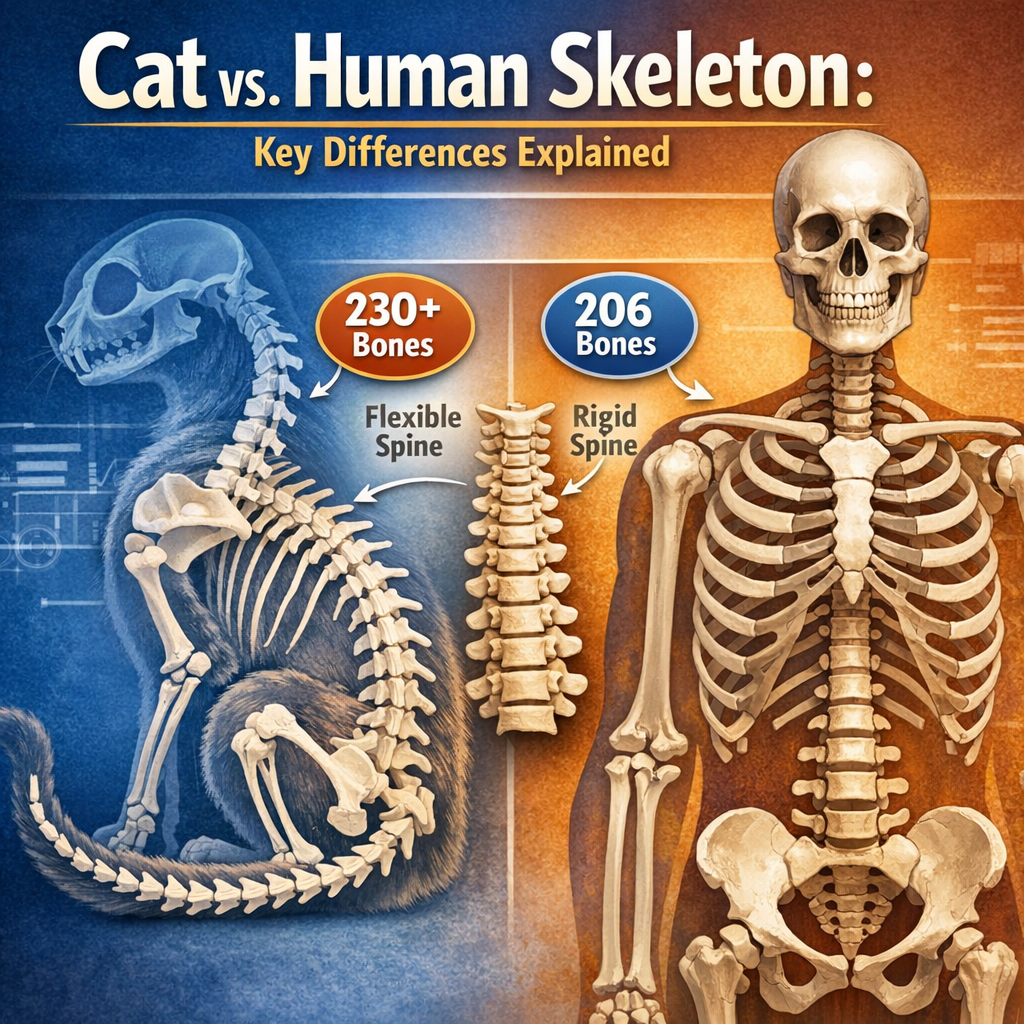
- Bone Count & Structure: Despite being much smaller, cats have more bones (~230-244) than humans (206), with a highly flexible spine containing roughly 20 extra vertebrae for superior agility.
- Unique Adaptations: Cats possess “floating” collarbones and a digitigrade (toe-walking) stance, allowing them to squeeze through tight gaps and move with silent, explosive speed.
- Specialized Skulls: While human skulls are designed to house a large brain, cat skulls are optimized for hunting, featuring massive eye sockets for night vision and powerful jaw attachments.
- Shared Functions: Both species rely on their skeletons for organ protection, mineral storage, and vital red blood cell production within the bone marrow.
Table of Contents
Cat vs. Human Skeleton: Key Differences Explained
Ever wondered why your feline friend can squeeze through a tiny gap or land a jump with such grace while you struggle to touch your toes? It all comes down to the bones. At Bella Gatti US Shop, we love a good graphic tee, but we also love the science behind our favorite subjects.
Whether you are wearing a Unisex Soft Cotton Tee featuring a cool feline design or just curious about feline anatomy, understanding the skeletal system is fascinating. March 28, 2026, is a great day to dive into the structural secrets of the human skeleton and the cat skeleton. Let us break down how these two mammals compare from head to tail.
Skeleton Function and Structure in Mammal Bones
The skeletal system serves as the biological scaffolding for both humans and cats. This framework is critical for protecting internal organs, providing movement leverage, and acting as a warehouse for mineral storage. While you might see a cat skeleton as just a smaller version of your own, their skeletal structure is a masterpiece of evolutionary biology.
In both species, bone marrow plays a vital role in health. Human anatomy shows that our bones produce roughly 2.6 million red blood cells every second. Similarly, feline bones are essential for red blood cell production and storing vital minerals like calcium and phosphate, ensuring your kitty stays healthy and active.
While we share these internal processes, the quadruped skeleton of a cat is built for agility and speed, whereas the bipedal structure of a human is designed for upright stability. Organizations like the Cornell Center for Medical Research and Provet often highlight these fundamental similarities in mammal bones despite their vastly different outward appearances.
Size and Bone Count Differences
When comparing a human skeleton to a cat skeleton, size is the most obvious factor. An average human is roughly 20 to 25 times larger than a domestic cat. However, bigger does not mean more bones. In fact, cats actually have more bones than you do.
A standard human skeleton consists of 206 bones. In contrast, a cat has approximately 230 bones. This higher vertebrae count is primarily concentrated in the vertebral column and the tail, providing the cat flexibility that makes them such formidable predators. Sites like Sciencing.com and PetPlace note that these extra bones are key to a cat’s survival in the wild.
This difference in bone density and count is a classic example of evolutionary adaptation. While humans traded bone count for a heavy, bipedal structure to support our weight on two legs, cats retained a high number of small, versatile bones to maximize their range of motion and predatory efficiency.
Vertebral Column and Exceptional Cat Flexibility
The vertebral column is where the two species truly diverge. Humans possess between 32 and 34 vertebrae. Cats, however, boast an impressive 52 to 53 vertebrae. This includes 7 cervical vertebrae, 13 thoracic vertebrae, 7 lumbar vertebrae, 3 sacral vertebrae, and a varying number of caudal vertebrae in the tail.
This high concentration of bones in the spine allows for extreme agility and speed. Unlike the relatively rigid human spine, a cat’s spine can arch and twist significantly, acting like a spring during a chase. This predator anatomy is often showcased in educational videos on YouTube or high quality photography from iStock and Getty Images.
The caudal vertebrae specifically provide balance, acting as a rudder when a cat is sprinting or climbing. Whether they are leaping onto a high shelf or balancing on a fence, their vertebral column provides the grace that has inspired artists since the era of the Ancient History Encyclopedia.
Cat Skull vs. Human Skull: Predatory vs. Brain-Centric Design
The cat skull and human skull are both well formed protective cases, but they serve different primary goals. A human skull is proportionally larger to accommodate a complex brain. It features maxillary sinuses and a structure built for an omnivorous diet and upright sensory input.
A cat skull is short and wide, featuring massive eye sockets to house eyes equipped with a tapetum lucidum for night vision. Their skull is designed to anchor powerful jaw muscles and sharp teeth for hunting. You can find detailed 3D models of these differences on Google or via resources at The Bone Museum.
Furthermore, feline mouths are equipped with keratin based papillae on the tongue for grooming, a feature supported by the specialized jaw structure. While the human skull protects our cognitive centers, the cat’s cranial skeletal system is a finely tuned tool for a predatory structure.
The Floating Shoulder Bones and Squeezing Through Gaps
One of the most mind blowing facts in feline anatomy is the floating collarbone. Humans have a solid, functional collarbone (clavicle) that connects the shoulder to the breastbone, supporting our upright posture. Cats, however, have a tiny, vestigial collarbone buried in their shoulder muscles.
This floating shoulder bones adaptation allows the cat’s front legs to move independently and their shoulders to collapse inward. This is why a cat can squeeze through any gap as wide as its head. It is a specialized predatory structure that humans simply do not possess.
This lack of a rigid shoulder attachment also aids in shock absorption. When a cat lands a jump, their skeletal structure and muscular attachments act as natural springs, protecting their mammal bones from the impact of a high fall. This is a level of cat flexibility that leaves human athletes in awe.
Limb and Gait Specializations: Digitigrade vs. Plantigrade
Humans and cats walk very differently. Humans have a plantigrade gait, meaning we walk on the soles of our feet. Cats utilize a digitigrade stance, meaning they walk on their toes. This adaptation is a hallmark of predator anatomy, allowing for stealthy movement and explosive bursts of speed.
A cat’s limbs are equipped with metacarpal pads for silent stalking and retractable claws for gripping prey. Their skeletal system comparison also reveals backward facing elbows and specialized joints that allow for precise, swift actions. These features are often studied by researchers when observing wild felids.
While humans use their limbs for long distance walking and tool manipulation, cats use theirs for quadruped locomotion and vertical climbing. Their bones are lighter and their joints more flexible, facilitating the agility and speed required to be nature’s perfect hunters. This functional role of the skeleton is why cats remain one of the most successful mammals on the planet.
Skeleton Function and Structure
Both cats and humans rely on a sophisticated skeletal framework to stay upright and active. This system is far more than just a collection of mammal bones. It is a living organ that provides essential support, movement leverage, and vital organ protection.
Inside the bone marrow, both species produce red blood cells. In fact, the human skeleton is a busy factory, producing about 2.6 million red blood cells every single second. This bone function is a cornerstone of human anatomy and feline health alike.
Beyond blood production, the skeletal system serves as a primary hub for mineral storage. Both you and your cat store calcium and phosphate within your bones to maintain muscle tone and skeletal integrity. Whether you are browsing iStock for feline anatomy diagrams or wearing your favorite Unisex Soft Cotton Tee, these biological processes are happening right under the surface.
While a bipedal structure and a quadruped skeleton look different, their cellular makeup is remarkably similar. We both possess a complex vertebral column and specialized appendages designed for our specific environments. This skeletal system comparison shows how evolutionary biology tailors every bone for survival.
Researchers at the Cornell Center for Medical Research and contributors to Sciencing.com often highlight these functional roles of the skeleton. From the thoracic vertebrae protecting the heart to the lumbar vertebrae facilitating movement, the design is a masterpiece of predator anatomy and human endurance.
Understanding skeletal structure helps us appreciate why cats move with such grace. While we walk to the office with a steady bipedalism, cats use their quadruped locomotion to stalk toys with unmatched agility and speed. It is a fascinating look at how mammal bones adapt to different lifestyles.
Size and Bone Count Differences
Size can be quite deceiving when comparing these two mammals. You might assume that because a human is 20 to 25 times larger than a domestic cat, our skeletal system would naturally contain more bones. However, the reality of feline anatomy tells a much different story.
An adult human typically has 206 bones, a number that stays fairly consistent once we reach maturity. In contrast, the average cat boasts approximately 230 to 244 bones. This higher bone count in a much smaller body is a primary driver of cat flexibility and their legendary predatory prowess.
Most of these extra bones are located within the vertebral column and the tail. While human bones are built for bipedalism and carrying significant vertical weight, feline bones are optimized for the hunt. This evolutionary biology makes them the perfect predator anatomy model for agility and speed.
The Vertebral Column and Flexibility
The spine is where the most dramatic differences occur. Humans possess between 32 to 34 vertebrae, whereas cats have 52 to 53. This includes a high concentration of cervical vertebrae, thoracic vertebrae, lumbar vertebrae, and the caudal vertebrae that form the tail.
This dense skeletal structure allows a cat to arch its back and twist its body in ways that would be impossible for a human skeleton. This specialized vertebral column is why your cat can perform mid air acrobatics while you are just trying to look cool in your Unisex Soft Cotton Tee.
Research from institutions like the Cornell Center for Medical Research and resources like Sciencing.com and PetPlace highlight how these vertebrae contribute to a cat’s survival. The extra spacing and bone count provide the leverage needed for sudden bursts of speed and high impact landings.
Limb Adaptations and the Floating Collarbone
One of the most fascinating features of the cat skeleton is the presence of floating shoulder bones. Unlike the human skeleton, which has a solid and fixed collarbone to support an upright posture, the feline collarbone is tiny and buried in the shoulder muscles.
This lack of a functional collarbone allows cats to squeeze their bodies through any gap large enough to fit their cat skull. This adaptation is a hallmark of predator anatomy, allowing them to pursue prey into tight spaces where other mammals might get stuck.
Furthermore, cats utilize a digitigrade stance, meaning they walk on their toes. Humans use a plantigrade gait, walking flat on the feet. This digitigrade locomotion, combined with specialized joints and retractable claws, ensures stealth and rapid acceleration during a hunt.
| Feature |
Human Skeleton |
Cat Skeleton |
| Total Bone Count |
206 |
230 to 244 |
| Locomotion |
Bipedal (Two legs) |
Quadruped (Four legs) |
| Collarbone |
Solid and fixed |
Floating and small |
| Gait |
Plantigrade (Flat foot) |
Digitigrade (On toes) |
| Vertebrae Count |
32 to 34 |
52 to 53 |
| Primary Function |
Weight bearing/Postural |
Agility and Speed |
Whether you are browsing Getty Images for feline photography or watching educational videos on YouTube and Google, the structural superiority of the cat’s spine is undeniable. From the sacral vertebrae to the tip of the tail, every bone is a masterpiece of evolutionary adaptation.
At Bella Gatti US Shop, we appreciate the intricate details of the skeletal system. Much like the precision in feline anatomy, we focus on the fine details of our graphic designs to ensure you look as sharp as a cat’s hunting instincts.
Vertebral Column and Flexibility
The vertebral column is where the real magic happens for feline anatomy. While a human skeleton typically contains between 32 and 34 vertebrae, the average cat boasts 52 to 53. This significantly higher vertebrae count is the secret behind that liquid grace you see in videos on Google or YouTube.
A cat’s spine is a masterpiece of evolutionary biology designed for agility and speed. It includes 7 cervical vertebrae, 13 thoracic vertebrae, 7 lumbar vertebrae, and 3 sacral vertebrae. The most impressive part is the tail, which contains up to 22 or 23 caudal vertebrae, acting as a furry rudder for perfect balance.
The connections between these mammal bones are much looser than ours. While human anatomy is built for a sturdy bipedal structure, cats utilize a quadruped skeleton with elastic discs between each bone. These act as high performance shock absorbers, which is why your pet can land a massive jump with more poise than a gymnast.
Their lumbar vertebrae are especially flexible, allowing the spine to curve and straighten like a powerful spring. This skeletal system adaptation contributes to their explosive sprinting power and predatory structure. It is the reason they can survive high falls and perform the acrobatic feats documented by researchers.
At Bella Gatti US Shop, we appreciate this incredible skeletal structure. Whether you are browsing Getty Images for cat photography or wearing our Unisex Soft Cotton Tee, it is hard not to admire the predator anatomy that allows for such extreme flexibility. Their spine truly defines the difference between human rigidity and feline fluidity.
Unlike the bipedalism of humans, which requires a more locked vertebral column for upright support, the cat skeleton is built for movement. From the cervical vertebrae in the neck to the caudal vertebrae in the tail, every bone functions to maximize range of motion. This is why cats can twist mid air, a feat of grace that remains a marvel of the natural world.
Skull and Cranial Differences
When you compare a cat skull to a human skull, the priorities of nature become crystal clear. Human skulls are proportionally larger to accommodate our brain size and maxillary sinuses, reflecting an evolutionary adaptation toward high level intelligence and bipedal stability.
In contrast, a cat’s skull is short, wide, and built for the hunt. You will notice massive eye sockets that house the tapetum lucidum, which helps them see in the dark. This predatory structure supports powerful jaw muscles and specialized teeth designed for a strictly carnivorous diet.
The zygoma or cheekbone area in feline anatomy is also highly specialized. It influences ear placement and provides a large surface area for the muscles that operate the jaws. This allows for a much stronger bite force relative to their size than what you find in human anatomy.
According to researchers, these cranial differences highlight the split between a bipedal strategist and a quadruped skeleton built for speed. While we focus on facial expression, the cat is all about sensory input and efficiency.
If you search for 3D models on Google or YouTube, or browse high quality images on iStock or Getty Images, the contrast is striking. The human face is flat and rounded, while the feline face is a compact, forward facing weapon system.
Even the bone density and the way the skull protects the bone marrow vary between species. While both skulls protect the vital command center of the skeletal system, the cat skull is light enough to maintain agility and speed during a chase.
Whether you are studying feline anatomy for a school project or just appreciate the evolutionary biology behind your pet, the skull is where the feline personality begins. It is the perfect blend of grace and power, much like the designs we feature on our Unisex Soft Cotton Tees.
The Magic of the Floating Shoulder
One of the most fascinating aspects of feline anatomy is the presence of floating shoulder bones. While you might be familiar with the human skeleton and its rigid structure, cats operate on a different level of agility and speed.
Unlike humans, who possess a sturdy, fixed collarbone to support an upright posture, cats have a vestigial floating collarbone. This tiny bone is buried deep within the shoulder muscles rather than being bone anchored to the rest of the skeletal system.
This unique evolutionary adaptation allows a cat to narrow its shoulders significantly. It is the reason why, if their head fits through a tight gap, their entire body usually follows. It is pure predatory geometry at work.
Bipedal Structure vs. Quadruped Agility
In contrast, the human collarbone is vital for bipedal locomotion and stability. It provides a necessary brace for our arms, allowing us to lift heavy objects or reach overhead while maintaining a balanced, upright stance.
We essentially traded the ability to squeeze through backyard fences for the ability to carry groceries or a heavy backpack. While humans rely on a plantigrade gait, cats utilize a digitigrade stance, walking on their toes for stealth.
This skeletal system comparison highlights how bone function dictates lifestyle. While our bones produce millions of red blood cells to fuel our endurance, feline bones are optimized for the explosive grace seen in high speed chases.
Bone Density and Evolutionary Adaptation
When studying mammal bones at a place like The Bone Museum, you can see how bone density and structure vary between species. A cat skeleton is lightweight and flexible, built for climbing and pouncing with effortless ease.
Human anatomy focuses on weight bearing and long term durability. Our skeletal framework must support our entire weight on just two limbs, whereas a cat distributes its weight across four specialized joints and a highly mobile vertebral column.
Whether you are browsing images on Getty Images or watching a documentary on YouTube, the predatory structure of the cat is unmistakable. Their floating shoulders are just one piece of a complex puzzle that makes them nature’s perfect hunters.
Limb and Gait Specializations
The way you and your cat hit the pavement is completely different. Humans utilize a plantigrade gait, meaning you walk on the soles of your feet. This bipedal structure provides a stable base for standing still and walking long distances, a hallmark of human anatomy and evolutionary biology.
Cats use a digitigrade stance, meaning they essentially walk on their toes. This adaptation, combined with specialized metacarpal pads, allows for incredible stealth and quick movements. It is like they are wearing permanent sprinting spikes, a feature often discussed by experts.
Their limbs also feature retractable claws and backward facing elbows on the front legs. These skeletal system tweaks make them masters of climbing and grasping prey. These are predator anatomy features that are entirely absent in the human skeleton, which is built for upright stability rather than pouncing.
Movement and Bone Function
When comparing a cat skeleton to a human skeleton, the functional roles of the bones are strikingly different. While both skeletal structures protect vital organs and provide movement leverage, the cat is built for agility and speed. This is why a cat can leap several times its own height with ease.
The feline anatomy includes specialized joints and bone density levels that support high impact landings. While human bones are busy producing 2.6 million red blood cells per second in the bone marrow, cat bones are equally busy acting as a mineral storage powerhouse for calcium and phosphate to fuel their explosive predatory structure.
According to resources like the Bone Museum and various Getty Images anatomical studies, the quadruped locomotion of a cat is far more efficient for rapid acceleration than our bipedalism. This is why your cat can zoom across the room while you are still trying to find your sneakers.
Whether you are researching feline anatomy for a school project or just admiring the design on your Unisex Soft Cotton Tee from Bella Gatti US Shop, it is clear that every bone has a purpose. From the cervical vertebrae to the metacarpal pads, cats are nature’s perfect little athletes.
Functional Roles of the Skeleton: More Than Just Movement
Beyond providing agility and speed, your skeleton and your cat’s skeleton act as a high tech warehouse. In both species, the skeletal system houses bone marrow, which serves as a vital factory for red blood cell production.
Human bones are incredibly busy, producing roughly 2.6 million red blood cells every second. This essential bone function ensures that oxygen reaches every part of the body, a process mirrored in feline anatomy to support their high energy predatory lifestyle.
The Bone Museum often showcases how these structures adapt to survive in diverse environments. In Kenya, wild felines exhibit even greater bone density to endure the physical rigors of the savannah and the force of a high speed hunt.
Domestic cats share this specialized predatory structure with their wild cousins. Even if your cat only uses its skeletal framework to leap onto the kitchen counter, its bones are designed for maximum efficiency and mineral storage.
Both humans and cats rely on their bones to store critical minerals like calcium and phosphate. This skeletal system comparison highlights how evolution has perfected a framework that protects internal organs while acting as a metabolic reservoir.
Whether it is the skull protecting the brain or the vertebral column shielding the spinal cord, the skeleton is a masterpiece of evolutionary biology. It is the silent, sturdy partner in every move you or your cat makes.
At Bella Gatti US Shop, we appreciate the intricate design of the feline form. Just as a cat’s skeleton is built for purpose, our Unisex Soft Cotton Tee is designed for comfort and style, celebrating the beauty of nature and science.
Understanding these functional roles helps us appreciate the complexity of mammal bones. From the digitigrade stance of a kitten to the bipedal structure of a human, every bone plays a part in the grand design of life.
If you are curious to see these differences in action, platforms like Google, YouTube, and Getty Images offer incredible visual deep dives into skeletal mechanics. Research from Sciencing.com and the Cornell Center for Medical Research further confirms these fascinating biological links.
Whether you are browsing iStock for anatomy references or shopping for your next favorite graphic shirt, remember that the skeletal system is the foundation of everything we do. It is what allows a cat to move with such grace and a human to stand tall.
Frequently Asked Questions
Do cats have more bones than humans?
Yes, cats generally have between 230 and 244 bones, whereas the adult human skeleton consists of 206. This higher vertebrae count in the feline vertebral column, especially in the caudal vertebrae of the tail, provides the incredible flexibility seen in predatory anatomy.
While a human is 20 to 25 times larger than a domestic cat, those extra feline bones are specialized for agility and speed. You can see this sleek skeletal structure celebrated on our favorite graphic tees, perfect for any fan of evolutionary biology.
Why don’t cats have a solid collarbone?
Unlike the human skeleton, which features a sturdy, fixed clavicle to support a bipedal structure, cats possess a floating collarbone. These floating shoulder bones are held in place by muscle rather than being anchored to other bones.
This unique feline anatomy allows the cat to squeeze its body through any gap large enough to fit its cat skull. It also enhances their stride length, making them elite hunters. It is a classic example of predatory structure meeting peak performance.
What is a digitigrade stance?
A digitigrade stance means an animal walks on its toes rather than the flat of its feet. While humans use a plantigrade gait, cats walk on their phalanges, which keeps their movement silent and incredibly fast.
How does a cat’s spine help with jumping?
The feline vertebral column is a masterpiece of engineering, featuring extra lumbar vertebrae and thoracic vertebrae compared to the human anatomy. These bones are joined by elastic discs that act like high tech springs.
When a cat leaps, its spine stores and releases energy, while the sacral vertebrae provide the necessary stability for a powerful takeoff. This skeletal system allows them to land with the grace you see in high resolution photography or a viral YouTube clip.
What are the main functions of the skeletal system?
In both humans and cats, the skeleton provides a framework for organ protection and movement leverage. Beyond support, bone marrow acts as a factory for red blood cell production, a process vital for oxygenating the body.
Human bones are particularly active, producing roughly 2.6 million red blood cells every second. Additionally, the skeletal system serves as a warehouse for mineral storage, keeping levels of calcium and phosphate balanced for overall health.
How do cat skulls differ from human skulls?
The human skull is proportionally larger to accommodate a complex brain, while the cat skull is short, wide, and optimized for hunting. Cats have large eye sockets to support the tapetum lucidum, which aids their night vision.
Feline jaws are also built for power, featuring sharp teeth and deep attachments for strong muscles. Whether you are browsing Sciencing.com or visiting a bone museum, the differences in cranial anatomy highlight how each species evolved to thrive.