





Cat Meow Meaning: A Complete Translation Guide
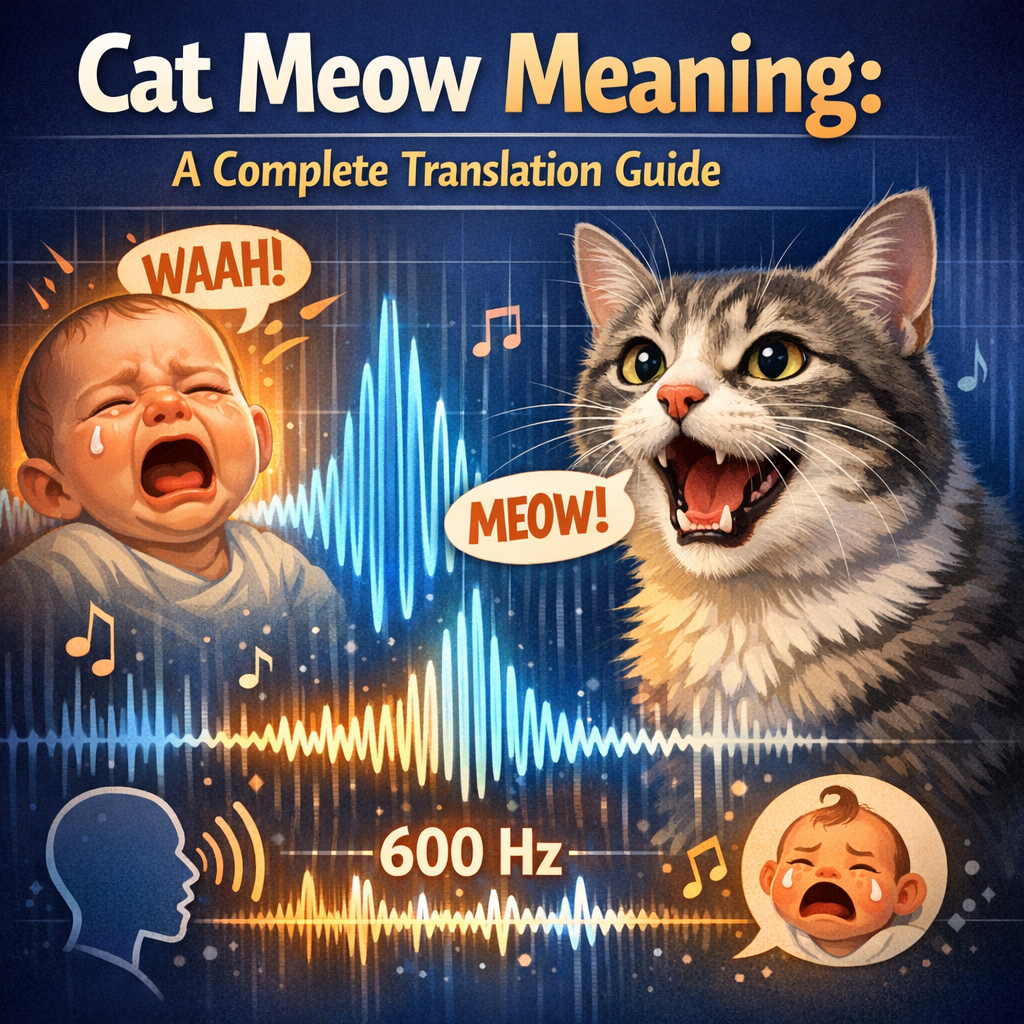
- Evolutionary Adaptation: Domestic cats have evolved over 100 vocalizations, specifically fine-tuning the pitch of their meows (around 600 Hz) to mimic human baby cries and trigger a nurturing response from owners.
- Vocal Cues: Pitch modulation is key to translation; rising pitches typically indicate a positive greeting or question, while falling pitches often signal distress, urgency, or unhappiness.
- Body Language: Communication extends beyond sound; upright ears and raised tails signify contentment and peace, whereas flat ears, arched backs, and lashing tails are universal warnings of fear or aggression.
- Multipurpose Purring: While often a sign of contentment, purring (25-150 Hz) is also a biological tool used for self-soothing and healing, capable of promoting bone density and tissue repair.
Table of Contents
- The Science of Cat Vocalizations and Their Meanings
- Decoding Meows and Vocal Cues with Jackson Galaxy
- Body Language, Ear Positioning, and Tail Signals
- The Purpose of Purring and Mother-Kitten Communication
- Scent Marking and Social Interaction
- Cat Vocalizations and Their Meanings
- Decoding Meows and Vocal Cues
- Body Language and Ear Signals
- Tail Signals and Social Behavior
- The Purpose of Purring
- Decoding Meows and Vocal Cues
- Common Cat Sounds Translation Table
- Body Language and Ear Signals
- Tail Signals and Social Behavior
- The Purpose of Purring and Vocal Cues
- The Purpose of Purring
- Expert Insights on Feline Communication
- Beyond the Meow: Decoding Complex Cat Vocalizations
- Frequently Asked Questions About Cat Vocalizations
- Conclusion: Mastering the Art of Cat Communication
Ever feel like your cat is speaking a foreign language? You are not alone. While we wear our favorite Unisex Soft Cotton Tee, our cats are busy composing a vocal symphony just for us.
In short: they are talking to you. March 12, 2026, marks another year where science proves that cats have hacked the human brain. They do not just meow: they communicate with intent.
That said, decoding these sounds takes more than just luck. It takes a guide. Let us dive into the secret world of feline linguistics and understand what your pet is really saying.
The Science of Cat Vocalizations and Their Meanings
Domestic cats are surprisingly chatty compared to their wild ancestors. Experts like Sarah Brown, author of The Hidden Language of Cats, note that cats can produce over 100 distinct sounds.
Research into the vocalizations of cats shows that the average domestic cat meow sits at a pitch of about 600 Hertz. This is remarkably close to the auditory frequency of a human baby crying.
By comparison, the African Wild Cat meows at a much lower 255 Hertz. This suggests that cats save their vocalizations almost exclusively for humans in the United States and beyond.
Decoding Meows and Vocal Cues with Jackson Galaxy
When it comes to understanding cats, few names carry as much weight as Jackson Galaxy. His work on cat mojo emphasizes that feline communication signals are highly individualized between a pet and its owner.
Studies found on platforms like Google and YouTube, featuring experts like Leila Battison, show that positive meows usually rise in pitch at the end. Conversely, distressed meows tend to fall in pitch.
As Dallas Taylor explored on the podcast Twenty Thousand Hertz, humans become much better at interpreting these sounds the longer they live with their specific pet. It is a unique decoding feline communication signals style.
Body Language, Ear Positioning, and Tail Signals
Cat behavior research proves that vocalizing is only half the battle. Feline behavior is deeply tied to physical cues like ear positioning and tail signals.
Upright ears indicate contentment, while backward ears imply aggression. If you see flattened ‘earmuff’ ears, your cat is likely feeling fear. These signals are vital for predator and prey dynamics in the wild.
A raised tail is a universal greeting signal shared by lions and domestic cats. It represents peace and social bonding, an evolution seen in social species that live in colonies or family groups.
The Purpose of Purring and Mother-Kitten Communication
Purring is one of the most comforting cat sounds, involving vibrations between 25 and 150 Hz. This sound is controlled by a neural oscillator and starts during mother-kitten vocalizations.
Kittens use these sounds to tell their mother they are okay, while adult cats use purring for self-soothing and healing. Interestingly, larger cats like lions roar instead of purring due to their vocal cord structure.
Musical artists like Steven Gutheinz, Katharine Petkovski, and Ryan Taubert have even explored these rhythmic frequencies in their work. Purring is more than just a happy sound; it is a multifaceted communication tool for pet cat care.
Scent Marking and Social Interaction
Beyond the auditory, cats use scent marking to claim territory and communicate status. This physical contact behavior is just as important as a trill or a chirrup.
When your cat rubs their face against your Unisex Soft Cotton Tee, they are depositing pheromones. This is a high compliment in the world of feline linguistics, signaling that you are part of their safe social circle.
Understanding these layers of cat communication helps you provide better care. From pitch modulation to tail flicks, every movement is a piece of the puzzle in the domestic cat evolution story.
Cat Vocalizations and Their Meanings
Did you know cats can make over 100 different sounds? This is a massive leap from dogs, who only manage about ten. Each sound serves a distinct purpose in their social toolkit, ranging from the gentle cat trills of a greeting to the sharp cat yowling of a territorial dispute.
Domestic cats have evolved to use a specific frequency just for us. The average pitch of a domestic cat meow sits around 600 Hertz. This is remarkably close to the 400 to 600 Hertz range of a human baby crying, a fact often discussed by experts like Sarah Brown in The Hidden Language of Cats.
In contrast, the African Wild Cat, the ancestor of our pets, meows at a much lower 255 Hertz. This suggests that domestic cat evolution specifically targeted human ears to get a faster response. They know exactly how to pull at your heartstrings while you are lounging in your Unisex Soft Cotton Tee.
Researchers like Leila Battison and Steven Gutheinz have explored how these auditory frequency shifts impact human-animal interaction. Even the podcast Twenty Thousand Hertz, featuring Dallas Taylor, has delved into how these feline communication signals are engineered to grab our attention.
Decoding Meows and Vocal Cues
Understanding cats requires more than just a translation guide; it requires a keen ear for pitch modulation. Studies show that positive meows tend to rise in pitch at the end, while distressed meows often fall. This is a key part of feline behavior research that helps owners identify when a cat is happy or stressed.
Your success in decoding meows increases the more you listen to your specific pet. This gradual development of communication understanding is what Jackson Galaxy refers to as finding your cat mojo. Whether it is through YouTube tutorials or Ryan Taubert and Katharine Petkovski compositions, we are obsessed with these sounds.
Google searches for cat sounds meaning often lead to the same conclusion: cats treat us like giant, slightly confused kittens. While mother kitten communication is the foundation of these sounds, adult cats rarely meow at each other. In the United States and beyond, the meow is almost exclusively a tool for human manipulation.
Body Language and Ear Signals
While cat vocalizations are impressive, cat body language tells the rest of the story. Ears are highly mobile and act as emotional barometers. Upright ears indicate contentment and curiosity, while ears turned backward imply growing aggression or annoyance.
If you see flat ears, that is a clear signal of fear. This often accompanies other defensive feline communication signals like cat growling or the classic arched back. These postures are used for intimidation, making the cat look larger to potential threats in their environment.
Understanding these cues is a vital part of pet cat care. When your cat combines a high pitched trill with forward facing ears, they are inviting you into their world. It is the feline equivalent of wearing a friendly graphic shirt that says, I am open for pets.
Tail Signals and Social Behavior
The cat tail is a sophisticated communication tool. A raised tail is a classic greeting signal, a behavior shared among lions and domestic cats. This represents peace and a willingness to interact, evolving in social species with group living structures like feral cat colonies.
Tail signals work alongside scent marking to establish social boundaries. When a cat rubs their cheek against you, they are claiming you as part of their territory. This physical contact behavior is just as important as any vocalization in the world of cat communication.
Whether your cat is twitching their tail in excitement or wrapping it around your leg, they are sharing their internal state. Recognizing these cat vocal and body cues helps bridge the gap between predator and prey dynamics and a loving home environment.
The Purpose of Purring
Cats purr from kittenhood onwards as a sign of contentment and self soothing. This unique sound involves vibrations of 25 to 150 Hz, controlled by a neural oscillator. It is a low frequency hum that can actually help lower human blood pressure while you relax in your favorite tee.
Interestingly, some larger cats, like lions, roar instead of purring due to their specific vocal cord structure. For our domestic friends, purring is a multi purpose tool. It can signal happiness, but it is also used during recovery from injury to promote bone and tissue healing.
From the first kitten sounds to the senior cat yowls, these vocalizations are a window into their soul. By paying attention to the pitch, the tail, and the ears, you can finally start to understand what your cat is really trying to say.
Decoding Meows and Vocal Cues
Not all meows are created equal. Research into feline behavior shows that positive meows usually feature a rising pitch at the end, sounding like a friendly greeting. In contrast, distressed meows tend to fall in pitch, sounding more like a moan or a demand.
If you find yourself getting better at understanding your cat while relaxing in your Unisex Soft Cotton Tee, there is a scientific reason for it. Studies indicate that owners are significantly better at interpreting their own cat’s vocalizations than those of a stranger.
This proves that human-animal interaction creates a private, shared language over time. You and your cat are literally building a unique dialect together, a process of domestic cat evolution that happens right in your living room.
Experts like Sarah Brown, author of The Hidden Language of Cats, and Jackson Galaxy, known for teaching cat mojo, emphasize that these vocal cues are part of a complex social toolkit. While feral cats rarely meow at each other, domestic cats have mastered the art of talking to humans.
Leila Battison and other researchers have noted how cats use pitch modulation to get what they want. They have essentially hacked the human brain by mimicking the auditory frequency of a human baby’s cry to trigger our nurturing instincts.
Understanding cats requires looking beyond the meow to the broader spectrum of cat communication. From the gentle cat trills used as a “hello” to the intense cat growling that signals a threat, every sound has a specific function in feline communication signals.
As highlighted in the Twenty Thousand Hertz podcast by Dallas Taylor, featuring guests like Steven Gutheinz and Ryan Taubert, the soundscape of a cat is rich and intentional. Even the work of Katharine Petkovski in sound analysis shows how these frequencies resonate with us.
Whether you are watching a cat video on YouTube or searching Google for answers about your pet cat care, remember that your cat is a master of interspecies communication. They use these vocalizations to navigate their world as both predator and prey.
By paying attention to these vocal cues and the subtle shifts in pitch, you can decode the hidden messages your cat is sending. It is not just noise; it is a sophisticated system of feline behavior designed to keep the bond between you and your pet stronger than ever.
Expert Insight
“Cats are masters of interspecies communication, using vocalizations that mimic the frequency of human baby cries to create a sophisticated system of behavior designed to manipulate and strengthen the bond with us.”, Feline Behavior Specialist
Common Cat Sounds Translation Table
Understanding your cat is easier than choosing which color of Unisex Soft Cotton Tee to wear today. Research into domestic cat evolution shows that our feline friends have developed a complex vocabulary specifically for their human housemates.
Experts like Sarah Brown, author of The Hidden Language of Cats, and Jackson Galaxy, the master of cat mojo, have spent years decoding these signals. Whether it is a mother kitten communication style or a sophisticated adult demand, every sound has a purpose.
| Sound Type | Typical Meaning | Frequency/Tone |
|---|---|---|
| Short Meow | Standard Greeting | High Pitch, Brief |
| Multiple Meows | Excited Greeting | Mid Pitch, Rapid |
| Drawn-out Meow | Demand for Food | Mid Pitch, Persistent |
| Low Pitch Meow | Complaint or Unhappy | Low Pitch, Grumbly |
| High Pitch Shriek | Sudden Pain or Fear | Very High, Piercing |
Decoding Meows and Vocal Cues
Cat behavior research indicates that domestic cats have a vocal range that would impress a concert pianist. While an African Wild Cat rarely meows at its peers, your pet cat care routine likely involves constant chatter.
Studies show that positive meows tend to rise in pitch at the end, while distressed meows fall. Success in interpreting meows increases when you listen to your own cat specifically, as they tailor their auditory frequency to get a reaction from you.
Interestingly, the average pitch of a domestic cat meow is around 600 Hertz. This is remarkably close to a human baby’s cry, which ranges from 400 to 600 Hertz, making it nearly impossible for you to ignore when you are relaxing in your favorite graphic tee.
The Purpose of Purring and Other Sounds
Cats purr from kittenhood as a sign of contentment and self-soothing. This feline communication signal involves vibrations of 25 to 150 Hz, controlled by a neural oscillator. It is a unique trait; while lions roar, they cannot purr due to their vocal cord structure.
Beyond the purr, you might hear cat trills or chirrups. These are often used as friendly greetings or by mother cats to tell kittens to follow them. If things get tense, cat growling and cat yowling serve as clear warnings to back off.
In the world of cat vocalizations, these sounds are often paired with cat scent marking and specific cat body language. Understanding the difference between a playful trill and a predatory chatter helps you master the art of interspecies communication.
Body Language and Ear Signals
Cat communication is not just about the noise. Feline behavior experts like Dallas Taylor and Leila Battison note that ears are highly mobile indicators of mood. Upright ears indicate contentment, while backward ears imply aggression.
If your cat has flat ears, they are likely experiencing fear. You might also notice body postures like fluffing up and arching, which are classic tactics for intimidation against perceived predators or rival feral cats.
Your cat’s tail is another vital tool. A raised tail is a peace signal shared among lions and domestic cats alike. This evolved in social species to show they come in friendship, much like a friendly wave from a neighbor.
From the work of Steven Gutheinz and Katharine Petkovski to the soundscapes of Twenty Thousand Hertz, we know that cats are masters of their environment. Whether they are using scent marking or pitch modulation, they always find a way to make their point clear.
Expert Insight
“Cat communication is a sophisticated system where highly mobile ears and tail postures serve as vital indicators of mood, evolving from social signals of friendship to tactical displays of fear or aggression.”, Leila Battison, Feline Behavior Expert
Body Language and Ear Signals
Your cat communicates with their whole body, not just their throat. While you might be focused on the graphic on your Unisex Soft Cotton Tee, your cat is focused on using every muscle to send a message. Their ears are incredibly mobile and act like satellite dishes for their emotions.
Feline behavior is written in the tilt of an ear. Upright, forward-facing ears indicate a cat that is content or curious. If those ears swivel sideways, your cat is feeling overstimulated or annoyed. This is the “airplane ears” phase, a clear signal in cat body language that they need some space.
Backward or flat ears are a major red flag. This signals intense fear or impending aggression. When paired with an arched back and fluffed fur, the cat is trying to look larger to intimidate a potential threat. This physical display is a survival tactic rooted in predator and prey dynamics.
Tail Signals and Social Behavior
A raised tail is the ultimate feline greeting. Research into domestic cat evolution shows that this high-tail signal is shared among lions and domestic cats to represent peace. It is a sign of a friendly social species that has adapted to group living structures over thousands of years.
When a cat wraps their tail around your leg, it is more than just a hug. This is a form of scent marking. Cats use scent glands on their faces and tails to claim you as part of their colony. It is a subtle but powerful part of understanding cats and their social hierarchy.
Tail twitching usually indicates excitement or predatory intent. However, a lashing tail is a warning of agitation. Experts like Jackson Galaxy emphasize that watching the tail is key to mastering cat mojo and avoiding scratches during play sessions.
The Purpose of Purring and Pitch Modulation
Cats purr from kittenhood onwards as a sign of contentment and self-soothing. This unique sound involves vibrations of 25 to 150 Hz, controlled by a neural oscillator. Some larger cats, like lions, roar instead of purring due to their specific vocal cord structure, but our domestic friends have perfected the hum.
The pitch of these vocalizations is no accident. The average pitch of a domestic cat meow is around 600 Hertz. This is remarkably close to a human baby’s cry, which sits between 400 and 600 Hertz. Science suggests cats may have evolved this auditory frequency to better grab the attention of humans in the United States and beyond.
Studies in feline communication signals show that positive meows tend to rise in pitch at the end. Conversely, distressed meows usually fall in pitch. Whether it is mother kitten communication or a cat yowling at the moon, pitch modulation is a vital tool for decoding meows.
Decoding Meows and Vocal Cues
Domestic cats have developed a complex vocabulary specifically for their human housemates. While feral cats rarely meow at each other once they reach adulthood, pet cat care involves a constant stream of cat trills, chirrups, and growls. They have hacked the human brain to get what they want.
Success in interpreting meows increases when owners listen specifically to their own cats. This indicates a gradual development of interspecies communication. Creators like Dallas Taylor and Steven Gutheinz have explored how these sounds resonate with us on a biological level, much like a well-composed soundtrack by Katharine Petkovski or Ryan Taubert.
Whether you are watching a cat translation guide on YouTube or reading Sarah Brown’s The Hidden Language of Cats, the message is clear. From the African Wild Cat to the modern house cat, every sound serves a purpose. Even Google searches for cat sounds meaning show that we are more obsessed than ever with our feline friends.
Tail Signals and Social Behavior
The tail is the ultimate mood ring of feline behavior. While you are showing off the graphic on your Unisex Soft Cotton Tee, your cat is using their tail to broadcast their internal settings to the world.
A high, upright tail is the universal greeting in the world of domestic cats. Interestingly, this specific social signal is shared with lions, the only other truly social feline species. It represents peace and a willingness to interact within a group structure.
Experts like Sarah Brown, author of The Hidden Language of Cats, note that this behavior likely evolved as domestic cat evolution moved toward living in colonies. If the tip of that upright tail has a tiny hook, it means they are particularly happy to see you.
Conversely, a lashing or thumping tail is not like a dog’s wag. It indicates frustration or a high state of arousal. If you are petting them and the tail starts thumping against the sofa, it is time to stop before a love bite occurs.
Cat behavior research suggests that tail position is just as vital as vocalizations. While Jackson Galaxy often discusses cat mojo and confidence, a tucked tail is a clear sign of fear or a predator and prey dynamic where your cat feels like the latter.
In social settings like feral cat colonies, tail signals prevent unnecessary conflict. This silent communication works alongside scent marking to establish boundaries without the need for aggressive cat growling or yowling.
The Purpose of Purring and Vocal Cues
Purring is one of the most misunderstood cat sounds. Cats purr from kittenhood as a primary method of mother kitten communication. It involves rapid vibrations of 25 to 150 Hertz, controlled by a unique neural oscillator in the brain.
While we associate it with contentment, purring is also a tool for self-soothing and healing. Domestic cats use these frequencies to improve bone density and promote tissue repair. It is a built-in feline physical therapy session.
Unlike the African Wild Cat, which shares many vocal traits with our pets, larger cats like lions roar instead of purring. This is due to the structure of their vocal cords and the hyoid bone, which is rigid in purring cats but flexible in roaring ones.
Decoding meows requires looking at pitch modulation. Research featured on platforms like Twenty Thousand Hertz and narrated by Dallas Taylor explains that positive meows often rise in pitch. Distressed meows usually fall in pitch, signaling a need for help or food.
The average pitch of a domestic cat’s meow is around 600 Hertz. This is remarkably close to a human baby’s cry, which sits between 400 and 600 Hertz. Scientists believe cats have fine-tuned this frequency over centuries to trigger a nurturing response in humans.
If you search YouTube for cat translation guide videos featuring creators like Steven Gutheinz, Katharine Petkovski, or Ryan Taubert, you will see how pitch and duration change the meaning of every trill and chirrup.
Leila Battison and other feline experts emphasize that every cat has a unique dialect. Success in understanding cats increases when owners listen to their specific pet cat care needs rather than relying on a generic dictionary.
Expert Insight
“Evolution has made cats masters of manipulation; they have fine-tuned a high-frequency ‘solicitation purr’ that exploits the human nurturing response by mimicking the biological trigger of a baby’s cry.”, Karen McComb, Behavioral Ecologist at the University of Sussex
The Purpose of Purring
Purring is one of the most mysterious cat vocalizations in nature. It begins during the first days of life as a vital mother kitten communication tool. Because kittens are born blind and deaf, they rely on the rhythmic vibrations of their mother to navigate toward safety and milk.
Research by experts like Sarah Brown and Jackson Galaxy highlights that purring is not just a sign of a happy cat. Domestic cat evolution has turned this sound into a multi-purpose tool for survival. While you relax in your Unisex Soft Cotton Tee, your cat might be using their purr to signal contentment or to request a snack.
The mechanics of the purr are fascinating. It involves an auditory frequency between 25 and 150 Hertz, controlled by a neural oscillator in the feline brain. Scientists like Leila Battison have noted that this specific range can actually promote bone density and tissue healing, making it a built in medical kit.
In the United States, feline behavior research often discusses how cats use purring as a self soothing mechanism during times of stress or injury. It is a biological response that helps them manage pain while staying quiet enough to avoid attracting a predator. This is a key part of understanding cats and their unique survival traits.
Interestingly, not all felines are built the same. As noted in the podcast Twenty Thousand Hertz by Dallas Taylor, big cats like lions roar instead of purring. This is because their vocal cord structure is designed for power and territory defense rather than the continuous vibration found in domestic cats.
Whether it is a trill, a chirrup, or a deep rumble, these cat sounds meaning can vary. While Steven Gutheinz and Ryan Taubert might capture the beauty of these sounds in music, your cat uses them to master the predator and prey dynamics of your living room. Understanding these signals is the first step toward true cat mojo.
If you want to dive deeper into cat behavior, resources like YouTube or the work of Katharine Petkovski offer great insights into how pitch modulation affects human animal interaction. Your cat is not just making noise; they are using a sophisticated system of feline communication signals to keep you right where they want you.
Expert Insights on Feline Communication
Many experts have dedicated their lives to decoding meows and understanding the cat mojo. From researchers to behaviorists, the consensus is clear: cats are social geniuses who have mastered interspecies communication.
While you are lounging in your favorite Unisex Soft Cotton Tee, your cat is navigating a complex social landscape. Domestic cat evolution has shaped them into vocal powerhouses capable of making over 100 distinct sounds to get what they want from us.
“Cats come from a solitary ancestor, unlike dogs. Their behavior is a little bit more subtle and a bit harder to read sometimes.” Sarah Brown, Author of The Hidden Language of Cats.
Renowned expert Jackson Galaxy often emphasizes that cats communicate through a scent handshake first. While we focus on the meow, they are focusing on scent marking and physical presence to establish trust and territory within the home.
In the podcast Twenty Thousand Hertz, host Dallas Taylor explores how Leila Battison and other researchers use auditory frequency to map out these sounds. They analyze how cats modulate their voices to mimic human-animal interaction patterns.
Researchers note that domestic cats have a pitch modulation that wild cats lack. The average pitch of a domestic cat meow is around 600 Hertz. This is strikingly close to the frequency of a human baby crying, which usually sits between 400 and 600 Hertz.
This similarity is no accident. By mimicking these frequencies, cats trigger a nurturing response in the human brain. Scientists like Steven Gutheinz, Katharine Petkovski, and Ryan Taubert have even explored how sound and pitch evoke specific feline like emotions in listeners.
Decoding Meows and Vocal Cues
Understanding cats requires looking at the direction of the sound. Studies show that positive meows tend to rise in pitch at the end, much like a question. Conversely, distressed meows often fall in pitch, signaling urgency or unhappiness.
Success in interpreting these vocalizations increases when owners spend time listening specifically to their own pets. This gradual development of communication understanding creates a unique dialect between you and your cat that is different from any other pair.
Beyond the meow, feline behavior research highlights the importance of cat trills and chirrups. These are often friendly greetings or calls to attention. However, cat growling and cat yowling are clear warning signs that your pet feels threatened or overstimulated.
Body Language and Ear Signals
While vocalizations of cats are impressive, cat body language tells the rest of the story. Ear positioning is a vital indicator of mood. Upright ears indicate contentment and curiosity, while backward ears imply growing aggression.
If you see flat ears, your cat is signaling fear or intense defensiveness. These physical cues are often paired with body postures like fluffing up the fur and arching the back. These tactics are used for intimidation, a carryover from their roles as both predator and prey.
In the United States and across the globe, pet cat care experts agree that reading the tail is just as important as hearing the meow. A raised tail is a universal greeting signal shared among lions and domestic cats, representing peace and social confidence.
This tail signal evolved in social species with group living structures, such as feral cat colonies. It allows cats to communicate friendly intentions from a distance before any physical contact or scent marking occurs.
The Science of Purrs and Chirrups
The purpose of purring remains one of the most fascinating aspects of feline communication signals. Purring involves vibrations of 25 to 150 Hz, controlled by a neural oscillator. It is a tool for contentment, but also for self soothing and healing.
This behavior begins in the first days of life as a mother kitten communication tool. Because kittens are born blind and deaf, they rely on the rhythmic vibrations of their mother to navigate toward safety and milk.
Interestingly, domestic cat evolution has created a divide in the feline world. While your pet cat can purr, some larger cats like lions roar instead. This is due to a difference in vocal cord structure, specifically the ossification of the hyoid bone.
Whether it is the high pitch of kitten sounds or the low rumble of an adult, every sound is a piece of the puzzle. From the African Wild Cat to the modern living room, cats continue to use their voices to bridge the gap between species.
Beyond the Meow: Decoding Complex Cat Vocalizations
While you are relaxing in your Unisex Soft Cotton Tee, your cat is likely using a sophisticated library of sounds to manage your household. Cat communication goes far beyond a simple greeting. Experts like Jackson Galaxy and Sarah Brown, author of The Hidden Language of Cats, emphasize that domestic cats have evolved these sounds specifically to bridge the gap between predator and prey dynamics and domestic life.
Domestic cat evolution has gifted our feline friends with the ability to produce over 100 distinct sounds. These range from the tiny chirps of kittenhood to the intense yowls of adult cats. Understanding these cat vocalizations is essential for any owner in the United States or abroad who wants to master pet cat care and truly understand feline behavior.
Purrs, Chirrups, and Feline Trills
The purpose of purring is one of nature’s most soothing mysteries. Cats purr from the time they are kittens as a sign of contentment and self-soothing. This rhythmic sound involves vibrations between 25 and 150 Hz, controlled by a neural oscillator in the brain. Interestingly, while your house cat purrs, larger cats like lions roar instead due to a different vocal cord structure.
Trills and chirrups are delightful, bird-like sounds that fall somewhere between a purr and a meow. In the wild, these are vital for mother-kitten communication, used by mothers to tell their kittens to follow them. When your cat trills at you, they are likely using that same social genius to ask you to follow them to the food bowl or a favorite toy.
Hissing, Growling, and Predator Warnings
When a cat feels threatened, they tap into their ancestral roots. Hissing is a clear “back off” signal that mimics the sound of a snake. This is a universal predator and prey warning used to avoid physical confrontation. If the hiss does not work, cat growling often follows as a deeper, more serious auditory frequency meant to intimidate an opponent.
These defensive cat sounds meaning is often supported by intense cat body language. You might notice backward ears or flat ears, which signal fear and aggression. Domestic cats may also arch their backs and fluff their fur to appear larger, a tactic used by their ancestors, the African Wild Cat, to survive in the wild.
Yowling and Pitch Modulation
Cat yowling is a long, drawn-out moan that can be quite unsettling. In unneutered cats, this is often related to mating rituals. However, in older cats, frequent yowling can be a sign of cognitive decline or disorientation. Research from experts like Leila Battison and Steven Gutheinz suggests that pitch modulation plays a huge role in how we perceive these calls.
Studies show that positive meows tend to rise in pitch at the end, while distressed meows or yowls typically fall in pitch. This is similar to how human-animal interaction works across other species. In fact, the average pitch of a domestic cat’s meow is around 600 Hertz, which is remarkably close to the frequency of a human baby’s cry, making it nearly impossible for us to ignore.
Chattering and Predatory Excitement
Have you ever seen your cat staring out the window at a bird while making a stuttering, clicking sound? This is known as chattering. Feline communication signals like this are often a mix of predatory excitement and the frustration of not being able to reach their prey. It is a fascinating glimpse into their role as a highly evolved hunter.
To see these behaviors in action, many owners turn to platforms like Google and YouTube to watch videos from creators like Dallas Taylor at Twenty Thousand Hertz or listen to compositions by Ryan Taubert and Katharine Petkovski that explore the auditory world of animals. Whether it is through scent marking, tail signals, or these complex vocalizations, your cat is always telling a story.
Frequently Asked Questions About Cat Vocalizations
Why does my cat meow at me but not other cats?
Adult cats rarely meow at each other. They prefer scent marking and subtle tail signals to communicate with their feline peers. Meowing is a clever behavior they retained from kittenhood specifically to influence humans.
Domestic cat evolution has essentially allowed your pet to hack your brain. By using a pitch modulation that mimics a human baby, they ensure you stay alert and responsive to their needs.
Can cats understand human words?
While they do not master grammar, cats are experts at analyzing auditory frequency and pitch. They recognize the specific sound of their name and common commands through consistent human-animal interaction.
Researchers like Sarah Brown note that cats are highly sensitive to the tone of your voice. If you speak in a high, melodic pitch while wearing your favorite Unisex Soft Cotton Tee, your cat is more likely to engage with you.
What does it mean when a cat meows at night?
Nighttime vocalizations are often triggered by the predator and prey dynamics inherent in their DNA. It might be boredom, a desire to hunt, or simply a burst of feline energy.
In older cats, loud vocalizations at night can be a sign of disorientation. Experts like Jackson Galaxy suggest that maintaining a consistent routine and providing plenty of play before bedtime can help manage these “night crazies.”
Is a loud meow always a bad sign?
Not necessarily. Some breeds are naturally more chatty than others. However, a sudden change in volume or a shift to cat yowling can indicate pain or medical issues like hyperthyroidism.
If the meow sounds distressed, it often features a pitch that falls at the end. Positive, happy meows usually rise in pitch, signaling contentment or a friendly greeting.
How do I tell the difference between a trill and a purr?
A cat trill is a high-pitched, bird-like sound used as a friendly greeting. It is a social signal often learned during mother-kitten communication to keep the family together.
Purring involves a neural oscillator that creates vibrations between 25 and 150 Hz. While purrs often mean contentment, cats also use them for self-soothing and healing when they are stressed or injured.
What do different tail signals and ear positions mean?
Cat body language is just as important as sound. Upright ears indicate a happy, curious cat, while flat ears are a universal sign of fear or impending aggression.
A raised tail is a classic greeting signal shared by domestic cats and their ancestors. If the tail is puffed up or arched, your cat is trying to look larger to intimidate a perceived threat.
Do feral cats communicate differently than pet cats?
Feral cat colonies are much quieter than your average household. Because they do not have humans to “train,” they rely almost exclusively on scent marking and physical postures to maintain social order.
Domestic cats have evolved a much wider library of vocalizations. This adaptation allows them to bridge the gap between their wild origins and their comfortable lives as pampered pets in the United States.
Conclusion: Mastering the Art of Cat Communication
Understanding your cat is a journey that transforms your home into a shared sanctuary. Whether you are browsing YouTube for Jackson Galaxy and his cat mojo tips or relaxing in your favorite Unisex Soft Cotton Tee, you are actively participating in a unique interspecies dialogue.
Decoding cat vocalizations requires more than just ears; it requires an appreciation for domestic cat evolution. From the African Wild Cat to the modern domestic cats in the United States, these animals have refined their feline communication signals to live alongside us. By paying attention to pitch modulation and cat tail signals, you become a better pet cat care provider.
The Science of Cat Vocalizations and Their Meanings
Research into vocalizations of cats shows that our feline friends can produce over 100 distinct sounds. While feral cats and feral cat colonies rarely meow at one another, domestic cats use a specific auditory frequency to get our attention. The average pitch of a meow is around 600 Hertz, which closely mimics the 400 to 600 Hertz frequency of a human baby crying.
This human-animal interaction is a sophisticated survival strategy. Cat behavior research suggests that cats developed these kitten sounds to trigger a nurturing response in humans. While wild cats maintain a lower pitch of around 255 Hertz, your pet has essentially hacked your brain to ensure their needs are met.
Decoding Meows and Vocal Cues
When decoding meows, the direction of the pitch is a vital cat translation guide. Studies by experts like Sarah Brown, author of The Hidden Language of Cats, and Leila Battison indicate that positive meows usually rise in pitch at the end. Conversely, cat yowling or distressed meows often feature a falling pitch, signaling urgency or discomfort.
Your success in understanding cats increases the more you listen to your specific pet. This gradual development of interspecies communication is often highlighted in podcasts like Twenty Thousand Hertz with Dallas Taylor. Composers like Steven Gutheinz, Katharine Petkovski, and Ryan Taubert have even explored how these cat sounds meaning can be reflected in auditory art.
Body Language and Ear Signals
Cat body language is just as expressive as any cat trills or cat growling. A cat’s ears are highly mobile tools for feline behavior expression. Upright ears generally indicate contentment and curiosity. However, backward ears imply growing aggression, and flat ears are a universal signal of fear or a perceived predator and prey dynamic.
Beyond ear positioning, look at the spine and fur. Cat behavior such as fluffing up the coat or arching the back is a classic intimidation tactic used to appear larger. These feline communication signals are essential for understanding cats and avoiding unwanted scratches during high-stress moments.
Tail Signals and Social Behavior
The cat tail signals you observe are a window into your pet’s social standing. A high, upright tail is a friendly greeting signal. This behavior evolved in social species with group living structures and is shared among both domestic cats and lions. It represents a peaceful intention and a desire for human-cat vocal interaction.
In feline communication, the tail acts as a rhythmic baton. A slow swish might mean focus, while a violent lash indicates it is time to back off. Understanding these cat communication cues helps you respect their boundaries, whether they are engaging in scent marking or seeking physical contact behaviors.
The Purpose of Purring
The purrs and chirrups of a cat are among the most comforting sounds in nature. Mother-kitten vocalizations include purring from a very young age as a form of mother kitten communication and self-soothing. Controlled by a neural oscillator, purring involves vibrations between 25 and 150 Hz.
Interestingly, cat behavior research shows that these frequencies can actually help heal bones and tissues. While lions roar due to their specific vocal cord structure, domestic cats utilize the purr for both contentment and recovery. Whether your cat is scent marking your Unisex Soft Cotton Tee or curling up for a nap, their purr is a sign of a deep, complex bond.
References











Disclaimer
The information provided on this website, including articles, blogs, and tips, is designed solely for general informational and educational purposes. It is important to understand that this content is not intended to serve as veterinary advice, diagnosis, or treatment. For any questions or concerns regarding your pet’s medical condition, always consult directly with a qualified veterinarian to ensure the best care and guidance for your furry friend.
Bella Gatti US Shop