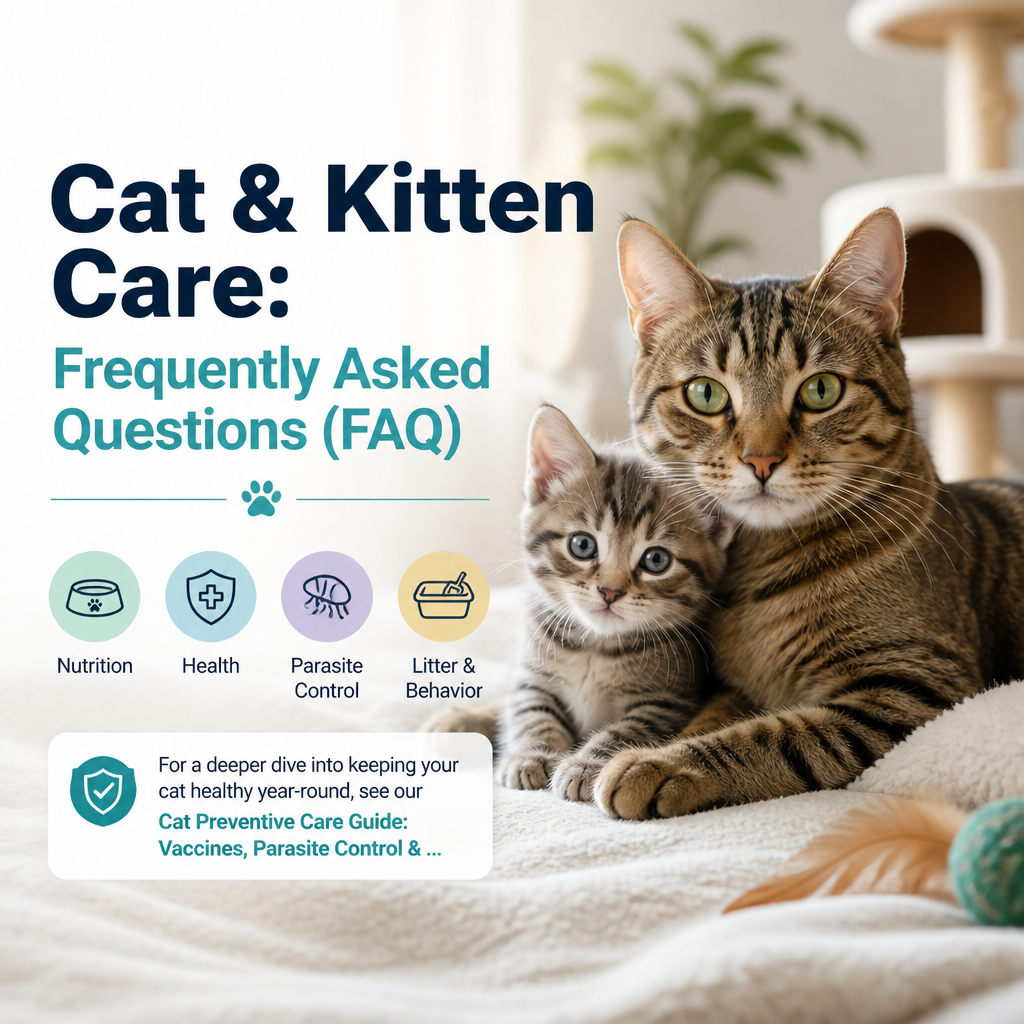
Cat & Kitten Care FAQ: Feeding, Vaccines, Behavior & Health
Welcome to our complete guide to cat and kitten care. For a deeper dive into keeping your cat healthy year-round, see our Cat Preventive Care Guide: Vaccines, Parasite Control & Wellness. Whether you are curious about your feline friend’s quirky habits or need veterinary-backed care advice for a new kitten, find clear, expert answers below. If you’re also watching for when “quirky” behavior might actually signal a health problem, see our guide to Warning Signs of Illness in Cats You Should Not Miss.
🐾 Part 1: Cat Behavior & Quirks
Why do cats purr?
Quick Answer: Cats purr primarily to communicate contentment, safety, and affection. However, purring is also an instinctual self-soothing and healing mechanism used when cats are frightened, stressed, in pain, giving birth, or recovering from an illness.
Contentment & Bonding: The most familiar purr happens when relaxing on your lap or nursing, reinforcing emotional safety and social connection.
Healing & Pain Relief: A cat’s purr vibrates at a specific frequency between 25 and 150 Hz. Veterinary research suggests this frequency range helps stimulate bone density, ease muscle tension, and speed tissue regeneration.
The “Solicitation Purr”: Cats can modify their purr by embedding an acoustic cry (similar in pitch to a human baby) when begging their owners for food.
Why do cats knead / make biscuits?
Quick Answer: Cats knead (rhythmically pushing their paws against soft surfaces) as an instinctual comfort behavior retained from kittenhood, as well as an effective way to mark territory using scent glands located in their paw pads.
Nursing Memory: Newborn kittens knead their mother’s abdomen to stimulate milk flow. Adult cats repeat this rhythmic motion when feeling entirely safe and content.
Scent Marking: Cats possess active scent glands between their toe pads. Kneading transfers their unique pheromones onto blankets, furniture, or your lap to establish safe territory.
Pre-Sleep Nesting: In the wild, feline ancestors trampled tall grasses and foliage to create a soft, concealed sleeping bed.
How long do domestic cats live?
Quick Answer: The average lifespan of a domestic indoor cat is 12 to 18 years, with many cats living into their early twenties with quality nutrition, daily mental enrichment, and preventative veterinary care (see Cat Health Basics: Essential Care All Cats Need).
Indoor vs. Outdoor: Indoor-only cats live significantly longer (12–18+ years) than free-roaming outdoor cats (average 2–5 years) due to lower exposure to traffic, predators, parasites, and infectious diseases.
Key Longevity Drivers: Routine preventative checkups, early senior blood screening (age 7+), moisture-rich nutrition, dental hygiene, and maintaining a healthy body weight directly maximize longevity.
Why do cats sleep so much?
Quick Answer: Cats sleep between 12 and 16 hours a day (and up to 20 hours for kittens and seniors) because their physiology is optimized for short, explosive bursts of predatory hunting rather than sustained daytime activity.
Crepuscular Nature: Cats are naturally crepuscular—most active at dawn and dusk. They nap throughout midday and the middle of the night.
Metabolic Energy Conservation: In nature, stalking, sprinting, and leaping demand immense caloric expenditure; deep rest conserves those vital reserves.
Light Napping vs. Deep REM: Roughly 70% of a cat’s rest is light “cat napping.” Their sensory organs remain fully alert to sudden sounds, scents, or movements.
Why do cats eat grass?
Quick Answer: Cats eat grass primarily to aid digestive health, induce vomiting to clear indigestible hairballs or prey feathers, and absorb trace micronutrients like folic acid.
Natural Digestive Emetic: Cats lack the enzymes needed to break down raw plant cellulose. Nibbling fibrous grass tickles the stomach lining, triggering regurgitation that expels accumulated hairballs.
Mild Laxative Effect: Fiber from swallowed grass travels down the GI tract, softening stools and promoting regular bowel movements.
Folic Acid Intake: Natural grass juice contains trace amounts of folic acid (Vitamin B9), which aids hemoglobin synthesis and healthy cellular function.
Why do cats hate water?
Quick Answer: Most cats dislike water because a soaked coat becomes heavy and cold, severely restricts their natural agility, and strips away their essential body scents that are crucial for territory and identity.
Heavy, Waterlogged Fur: Unlike water-retrieving dogs, domestic cat fur is not naturally waterproof. Saturated fur adds heavy drag, making rapid escape from perceived threats difficult.
Rapid Heat Loss: A wet undercoat dries very slowly, causing a drop in feline body temperature and physical discomfort.
Scent Disruption: Cats spend 30–50% of their waking hours grooming. Unfiltered tap water and soaps wash away their familiar pheromone markers.
🐱 Part 2: Kitten Care & Raising
How to tell kitten gender (male or female)?
Quick Answer: To tell a kitten’s sex, gently lift the tail and inspect the genital openings directly below the anus: a female resembles an upside-down exclamation mark (¡), while a male resembles a punctuation colon (:).
Gender
Shape
Anatomy & Spacing
Female (¡)
Inverted Exclamation Mark
Vertical genital slit located very close (<1 cm) directly beneath the anus.
Male (:)
Colon
Round penile opening separated by a noticeable gap (>1.5–2.5 cm) where testicles develop.
Note: While kitten sex can be identified early, it becomes most distinct to the eye around 3 to 4 weeks of age.
How much to feed a kitten by age / weight?
Quick Answer: Kittens require energy-dense kitten food fed across 3 to 4 small meals per day up to 6 months of age, gradually tapering to twice-daily feeding as they reach adult maturity at 12 months.
0–4 Weeks: Exclusively mother’s milk or Kitten Milk Replacer (KMR) every 2–4 hours (never feed cow’s milk).
4–8 Weeks (Weaning): High-protein wet kitten gruel offered 4–5 times daily (approx. 45–60 kcal per pound of body weight).
2–6 Months (Rapid Growth): 3–4 meals daily. Kittens burn roughly double the energy of adult cats per pound of body weight (approx. 200–250 kcal/day total depending on breed/weight).
6–12 Months (Maturing): 2–3 structured meals per day; transition smoothly to adult formula around the 12-month mark.
When to get a kitten vaccinated schedule?
Quick Answer: Kitten vaccinations start at 6 to 8 weeks of age and are boosted every 3 to 4 weeks until the kitten reaches 16 to 20 weeks old, followed by regular annual or three-year booster shots.
6–8 Weeks: First FVRCP core vaccine (protects against Rhinotracheitis, Calicivirus, and Panleukopenia / Feline Distemper).
10–12 Weeks: Second FVRCP booster + first FeLV (Feline Leukemia Virus) vaccination for kittens at risk.
14–16 Weeks: Final FVRCP booster, second FeLV booster + mandatory Rabies vaccine.
1 Year Booster: Comprehensive booster shot (FVRCP + Rabies) at 12–16 months old.
How to introduce a kitten to an older cat?
Quick Answer: Introduce a new kitten to an older resident cat gradually over 1 to 2 weeks using sensory introduction (scent swapping and visual contact through barriers) before allowing supervised face-to-face interaction.
Sanctuary Room (Days 1–3): Confine the kitten to its own closed room with a separate litter box, food, and toys so both cats sense each other without visual pressure.
Scent & Site Swapping (Days 3–5): Rub towels over each cat’s cheeks and swap bedding. Swap rooms for 30 minutes so each can safely explore the other’s scent territory.
Barrier Feeding (Days 5–7): Feed both cats meals or treats on opposite sides of a cracked door or sturdy baby gate to associate each other’s presence with positive rewards.
Supervised Play (Days 8+): Allow short, 5-minute meetings in neutral rooms using wand toys to redirect focus. Separate calmly if you observe intense hissing, lunging, or flattened ears.
How to stop a kitten from biting hands and feet?
Quick Answer: Stop playful kitten biting by strictly avoiding using bare hands or feet as toys, immediately redirecting their focus to kick toys, and freezing movement the moment teeth touch skin.
Never Use Hands as Play Targets: Playing with bare fingers teaches kittens that human flesh is acceptable prey.
The “Freeze & Disengage” Rule: If a kitten bites, emit a sharp “Ouch!”, freeze completely, and withdraw attention for 10–15 seconds to remove the play reward.
Redirect to Kickers: Always keep a soft kicker toy or feather wand nearby. Push the toy into their belly/paws when they enter hunting mode.
Daily Play Outlets: Provide at least two 15-minute interactive play sessions daily using teaser wands to burn excess predatory energy.
🩺 Part 3: Health, Nutrition & Medical FAQs
Why is my cat peeing outside the litter box all of a sudden?
Quick Answer: Sudden litter box avoidance is most frequently caused by medical emergencies like urinary tract infections (UTIs), Feline Lower Urinary Tract Disease (FLUTD), kidney stones, or behavioral stress and litter box cleanliness issues.
Immediate Medical Rule-Out: Urinating outside the box is often a pain association. Emergency Warning: If a male cat strains, cries, or produces only droplets, this can indicate a life-threatening urethral blockage requiring immediate emergency veterinary care.
Litter Box Hygiene: Cats have acute senses; boxes must be scooped daily. Ensure you have one box per cat, plus one extra placed in quiet, low-traffic areas.
Environmental Stress: New pets, recent moves, rearranged furniture, or outdoor stray cats visible through windows can trigger stress-induced idiopathic cystitis.
Can cats drink milk / Is milk bad for cats?
Quick Answer: No, cats should not drink cow’s milk. Most weaned kittens and adult cats are lactose intolerant and lack the lactase enzyme needed to digest dairy sugars, resulting in digestive distress.
Lactose Intolerance Breakdown: After weaning, kittens stop producing lactase. Ingesting dairy causes undigested lactose to ferment in the intestines, causing severe diarrhea, cramping, gas, and dehydration.
Excessive Fat & Calories: A single saucer of whole cow’s milk for an 8-pound cat has the metabolic caloric load of an entire human pizza.
Safe Alternatives: Clean water via a recirculating stainless-steel fountain, unsalted low-sodium pet bone broth, or commercially formulated lactose-free cat milk.
What human foods are toxic to cats?
Quick Answer: Human foods toxic to cats include onions, garlic, shallots, chives, chocolate, caffeine, grapes, raisins, xylitol (artificial sweetener), raw yeast dough, and cooked bones.
Alliums (Garlic, Onions, Chives): Contain sulfur compounds that destroy feline red blood cells, causing severe hemolytic anemia.
Chocolate & Caffeinated Items: Contain methylxanthines (theobromine and caffeine) that trigger rapid heart rates, tremors, seizures, and cardiac arrest.
Grapes & Raisins: Can trigger acute, sudden kidney failure in felines even in very small amounts.
Raw Yeast Dough & Alcohol: Yeast expands in the stomach and ferments into alcohol, risking stomach rupture and fatal metabolic acidosis.
Why is my cat losing weight but eating like crazy?
Quick Answer: A cat experiencing rapid weight loss despite an increased appetite (polyphagia) is showing classic signs of feline hyperthyroidism, diabetes mellitus, intestinal parasites, or GI malabsorption issues (like IBD or GI lymphoma). If you enjoyed this, you might also like Nutrition for Cats: Diet, Feeding, and Life Stages for guidance on healthy feeding at every age.
Feline Hyperthyroidism: Highly common in cats over 8 years old. An overactive thyroid gland drastically accelerates metabolism, burning calories faster than the cat can eat, often accompanied by vocalization, restlessness, and increased thirst.
Diabetes Mellitus: A lack of usable insulin prevents body cells from absorbing blood glucose. The body burns stored fat and muscle reserves for energy despite ravenous hunger.
Intestinal Parasites or IBD: Parasites or chronic intestinal inflammation prevent consumed nutrients from being absorbed through the gut wall.
Recommended Next Step: Schedule an immediate veterinary appointment for a physical exam, complete senior blood work (total T4, chemistry panel, CBC), and urinalysis.
Select options
This product has multiple variants. The options may be chosen on the product page
The information provided on this website, including articles, blogs, and tips, is designed solely for general informational and educational purposes. It is important to understand that this content is not intended to serve as veterinary advice, diagnosis, or treatment. For any questions or concerns regarding your pet’s medical condition, always consult directly with a qualified veterinarian to ensure the best care and guidance for your furry friend.